Schommers Wolfram Schommers – författare
Visar alla böcker från författaren Schommers Wolfram Schommers. Handla med fri frakt och snabb leverans.
8 produkter
8 produkter
E-bok
PDF, Engelska, 2011602 kr
Läs direkt efter köp
We see objects in front of us, and experience a real material effect when we approach and touch them. Thus, we conclude that all objects are embedded in space and exist objectively. However, such experiences in everyday life cannot be transferred to the atomic level: within standard quantum theory, the material world is still embedded in space, but it no longer has an objective existence. How can objects be embedded in space without existing objectively?This book addresses this and similar issues in an illustrative and non-conventional way. Using up-to-date information, the following basic questions are contemplated: What is a particle, a quantum object? What can we say about the nature of time? How is reality, in particular the cosmos, formed? What is the influence of evolution on the discovery of new developments in this field? Like the philosophers Whitehead and Bergson, the primacy of process is advocated: we experience objects — both quantum objects and those we experience in everyday life — at certain positions in space, but everything is a matter of process and the existence of static objects in space is thus eliminated.
E-bok
PDF, Engelska, 2011630 kr
Läs direkt efter köp
Space and time are probably the most important elements in physics. Within the memory of man, all essential things are represented within the frame of space-time pictures. This is obviously the most basic information. What can we say about space and time? It is normally assumed that the space is a container filled with matter and that the time is just that which we measure with our clocks. However, there are some reasons to take another standpoint and to consider this container-conception as unrealistic, as prejudice so to say. Already the philosopher Immanuel Kant pointed on this serious problem.In this monograph, the author discusses the so-called projection theory. In contrast to the container-conception (reality is embedded in space and time), within projection theory the physical reality is projected onto space and time and quantum processes are of particular relevance. Like Whitehead and Bergson, the author argues for the primacy of process.One of the most interesting results is that projection theory automatically leads to a new aspect for the notion “time”. Here we have not only the time of conventional physics, which is exclusively treated as an external parameter, but we obtain within projection theory a system-specific time. Just this system-specific time might be of fundamental importance in the future description of physical systems. For example, the self-assembly of nano-systems could lead to predictions that are even not thinkable within usual physics. Also in connection with cosmology the projection principle must inevitably lead to fundamentally new statements.
E-bok
PDF, Engelska, 2002578 kr
Läs direkt efter köp
The book of Erwin Schrödinger about life evokes a variety of basic questions concerning the understanding of life in terms of modern physics rather than biochemistry. Problems of organization and regulation of biological systems cannot be understood by revealing only the chemical processes of the living state. A group of reputable physicists — among them the followers of Heisenberg and Fröhlich — and biologists came to this same conclusion through several workshops on this topic. This book contains their contributions, written from different viewpoints of theoretical physics and modern biology. These articles are valuable not only for understanding life, but also for creating new and non-invasive diagnostic and therapeutic tools in medicine; they also contribute importantly to a deeper understanding of evolutionary processes, including the development of consciousness.
E-bok
PDF, Engelska, 1998465 kr
Läs direkt efter köp
How do we get an idea from the physical world? There is basically only one possibility, namely the dialogue with nature, i.e. we create a theoretical conception of the world by thinking, and then we check this conception with the help of measuring instruments. In this connection the following question arises: Does there exist for each element of the theory an element-specific deflection at the measuring instrument? In other words, has each element of the theory a counterpart in the actual reality? If not, then the theory contains metaphysical elements, i.e. elements which have no counterpart in reality. In this book it is argued that there are obviously no theoretical conceptions of the world which are free of metaphysical elements. This is not only valid in connection with matter but also for the conceptions of space and time. The consequences in connection with modern conceptions of the world are outlined.
E-bok
PDF, Engelska, 1994244 kr
Läs direkt efter köp
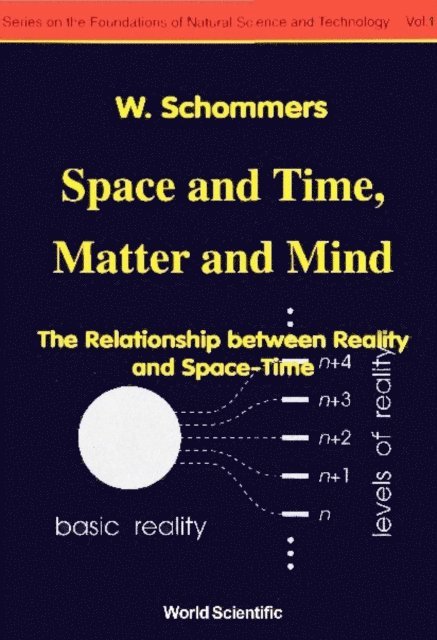
In principle, the elements of space and time cannot be measured. Therefore, the following question arises: How are reality and space-time related to each other? In this book, it is argued on the basis of many facts that reality is not embedded but projected onto space and time. We can never make statements about the actual reality outside (basic reality), but we can “only” form pictures of it. These are pictures of the same reality on different levels. From this point of view, the “hard” objects (matter) and the products of the mind are similar in character.
E-bok
PDF, Engelska, 1995416 kr
Läs direkt efter köp
Information about the reality outside flow via our sense organs into the body, and the brain forms a picture of reality. It is argued that the symbols in the picture have in general no similarity with the objects in the outside world, and many facts support such a view. This conception is discussed in connection with quantum reality. In particular, the role of space and time within quantum theory is also investigated from the historical point of view, highlighting the original ideas. New aspects are covered in connection with the particle concept, particle-wave dualism, locality, the time operator, the superposition principle, and the role of the observer.
E-bok
Engelska, 2013215 kr
Läs direkt efter köp
There is no doubt that nanoscience will be the dominant direction for technology in this century, and that this science will influence our lives to a large extent as well as open completely new perspectives on all scientific and technological disciplines. To be able to produce optimal nanosystems with tailor-made properties, it is necessary to analyze and construct such systems in advance by adequate theoretical and computational methods. Since we work in nanoscience and nanotechnology at the ultimate level, we have to apply the basic laws of physics. What methods and tools are relevant here? The book gives an answer to this question. The background of the theoretical methods and tools is critically discussed, and also the “world view” on which these physical laws are based.Such a debate is not only of academic interest but is of highly general concern, and this is because we constantly move in nanoscience and nanotechnology between two extreme poles, between “infinite life” and “total destruction”. On the one hand, through nanotechnology aging might be soon a fact of the past; on the other hand, in the nano realm uncontrolled processes could lead to a total destruction of the living conditions on the Earth.
E-bok
Engelska, 2014214 kr
Läs direkt efter köp
The relationship between mind and reality is usually perceived as an event that takes place in reality and producing simultaneously an internal image in the mind. So it takes place twice, so to speak, and there is a one-to-one correspondence between the two events. Within this conception, matter is embedded in space and time, and can be designated as “container-principle”. This monograph emphasizes that the well-known philosopher Immanuel Kant denied this principle and he stated that reality is principally not recognizable to a human being, and modern biological evolution seems to lead exactly to Kant''s point of view. Within the theory of evolution, man''s image about reality in mind does not have to be complete and true in the sense of a precise reproduction, and it is relatively easy to recognize that even space and time should not be elements of reality outside. Within this conception, only a certain part of reality, which the human being needs for mastering life, is projected onto space and time, and we come to the so-called “projection principle”. Then, spacetime defines the window to reality, leading to a number of exciting and essential questions, some of which are discussed in this monograph.As is known, current physics is mainly based on the container-principle. But this monograph proposes that the projection principle is obviously more suitable and could help to solve open-ended questions as, for example, in connection with the nature of time, the particle-wave duality, the cosmological constant, etc. Regarding the statistical behavior of matter, Einstein''s statement “God does not play dice” has to be seen in a new light, but also Feynman''s general viewpoint on quantum theory that it cannot be understood by man. However, conventional quantum theory is obviously not a consistent framework as per the projection principle. The term “world equation” is critically probed in this monograph.