Schwarz - Böcker
Visar alla böcker från författaren Schwarz. Handla med fri frakt och snabb leverans.
5 produkter
5 produkter
599 kr
Skickas inom 7-10 vardagar
This volume examines the tumultuous changes that have occurred and are still occurring in the aftermath of European colonization of the globe from 1492 to 1947. Ranges widely over the major themes, regions, theories and practices of postcolonial studyPresents original essays by the leading proponents of postcolonial study in the Americas, Europe, India, Africa, East and West AsiaProvides clear introductions to the major social and political movements underlying colonization and decolonization, accessible histories of the literature and culture, and separate regions affected by European colonizationFeatures introductory essays on the major thinkers and intellectual schools that have informed strategies of national liberation worldwideOffers an incisive summary of the long history and theory of modern European colonization in local detail and global scale
1 286 kr
Skickas inom 3-6 vardagar
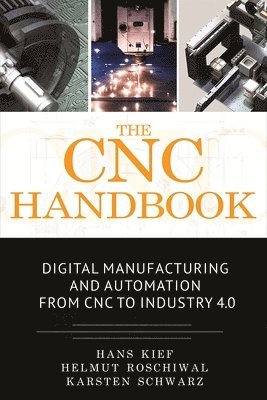
Digital manufacturing is everywhere. Technology advances in production engineering have reduced the “artisan skill” traditionally required in manufacturing processes and replaced it with high-precision, computer-controlled machinery. This reduces human errors and variability in output, but it does not reduce the knowledge required of the professional engineer or shop floor worker. In fact, the reverse is true. They still need to understand the fundamentals, and must acquire other important skills. Anyone who works in machining or additive manufacturing technology must have a solid technical knowledge of CNC technology. It is important to know how the individual components work and how they affect the overall system, the quality of the products produced and the profitability of production. Professionals should be familiar with today's machine tools and the numerous functions of CNC, electrical servo drives, tool systems, NC programming through to digital information processing and automation.The CNC Handbook was a critically acclaimed bestseller in Germany for 30 editions, and is now available in English for the first time. This groundbreaking work introduces readers to the CNC world, and teaches practical details about how different components are applied in practice. Next, the authors explain the functions and connections of all integrated components, and clearly describe CNC and drives, tooling, flexible manufacturing systems (FMS), NC-programming, DNC, digital manufacturing, Industry 4.0 and computer integrated manufacturing (CIM). The book then covers industrial robots, additive manufacturing, energy-efficient manufacturing, simulation systems, and state-of-the-art of machine integrated measuring systems. This authoritative, heavily illustrated book is the perfect resource for the avid CNCer, but also for those who plan and program, set up, operate machinery, or are responsible for operation, maintenance and repair.FeaturesPacked with more than 800 figures, 4-color pictures, and product shots. Authors use their more than 150 combined years of industrial and academic experience to impart CNC knowledge.
853 kr
Skickas inom 10-15 vardagar
1.1 Background The subject of this book is Morse homology as a combination of relative Morse theory and Conley's continuation principle. The latter will be useda s an instrument to express the homology encoded in a Morse complex associated to a fixed Morse function independent of this function. Originally, this type of Morse-theoretical tool was developed by Andreas Floer in order to find a proof of the famous Arnold conjecture, whereas classical Morse theory turned out to fail in the infinite-dimensional setting. In this framework, the homological variant of Morse theory is also known as Floer homology. This kind of homology theory is the central topic of this book. But first, it seems worthwhile to outline the standard Morse theory. 1.1.1 Classical Morse Theory The fact that Morse theory can be formulated in a homological way is by no means a new idea. The reader is referred to the excellent survey paper by Raoul Bott [Bol.
853 kr
Skickas inom 10-15 vardagar
This book presents a link between modem analysis and topology. Based upon classical Morse theory it develops the finite dimensional analogue of Floer homology which, in the recent years, has come to play a significant role in geometry. Morse homology naturally arises from the gradient dynamical system associated with a Morse function. The underlying chain complex, already considered by Thom, Smale, Milnor and Witten, analogously forms the basic ingredient of Floer's homology theory. This concept of relative Morse theory in combination with Conley's continuation principle lends itself to an axiomatic homology functor. The present approach consistenly employs analytic methods in strict analogy with the construction of Floers homology groups. That is a calculus for certain non-linear Fredholm operators on Banach manifolds which here are curve spaces and within which the solution sets form the focal moduli spaces. The book offers a systematic and comprehensive presentation of the analysis of these moduli spaces.All theorems within this analytic schedule comprising Fredholm theory, regularity and compactness results, gluing and orientation analysis, together with their proofs and prerequisite material, are examined here in detail. This exposition thus brings a methodological insight into present-day analysis.
555 kr
Skickas inom 3-6 vardagar