Sebastian Loebner – författare
Visar alla böcker från författaren Sebastian Loebner. Handla med fri frakt och snabb leverans.
10 produkter
10 produkter
Inbunden, Engelska, 2013
2 511 kr
Skickas inom 10-15 vardagar
Understanding Semantics, Second Edition, provides an engaging and accessible introduction to linguistic semantics. The first part takes the reader through a step-by-step guide to the main phenomena and notions of semantics, covering levels and dimensions of meaning, ambiguity, meaning and context, logical relations and meaning relations, the basics of noun semantics, verb semantics and sentence semantics. The second part provides a critical introduction to the basic notions of the three major theoretical approaches to meaning: structuralism, cognitive semantics and formal semantics.Key features include:A consistent mentalist perspective on meaningBroad coverage of lexical and sentence semantics, including three new chapters discussing deixis, NP semantics, presuppositions, verb semantics and framesExamples from a wider range of languages that include German, Japanese, Spanish and Russian.Practical exercises on linguistic dataCompanion website including all figures and tables from the book, an online dictionary, answers to the exercises and useful links at routledge.com/cw/loebner This book is an essential resource for all undergraduate students studying semantics. Sebastian Löbner is a Professor of Linguistics at the Institute for Language and Information at the University of Düsseldorf, Germany
E-bok
PDF, Engelska, 2013866 kr
Läs direkt efter köp
Understanding Semantics, Second Edition, provides an engaging and accessible introduction to linguistic semantics. The first part takes the reader through a step-by-step guide to the main phenomena and notions of semantics, covering levels and dimensions of meaning, ambiguity, meaning and context, logical relations and meaning relations, the basics of noun semantics, verb semantics and sentence semantics. The second part provides a critical introduction to the basic notions of the three major theoretical approaches to meaning: structuralism, cognitive semantics and formal semantics.Key features include:A consistent mentalist perspective on meaningBroad coverage of lexical and sentence semantics, including three new chapters discussing deixis, NP semantics, presuppositions, verb semantics and framesExamples from a wider range of languages that include German, Japanese, Spanish and Russian.Practical exercises on linguistic dataCompanion website including all figures and tables from the book, an online dictionary, answers to the exercises and useful links at routledge.com/cw/loebner This book is an essential resource for all undergraduate students studying semantics. Sebastian Löbner is a Professor of Linguistics at the Institute for Language and Information at the University of Düsseldorf, Germany
E-bok
Engelska, 2013866 kr
Läs direkt efter köp
Understanding Semantics, Second Edition, provides an engaging and accessible introduction to linguistic semantics. The first part takes the reader through a step-by-step guide to the main phenomena and notions of semantics, covering levels and dimensions of meaning, ambiguity, meaning and context, logical relations and meaning relations, the basics of noun semantics, verb semantics and sentence semantics. The second part provides a critical introduction to the basic notions of the three major theoretical approaches to meaning: structuralism, cognitive semantics and formal semantics.Key features include:A consistent mentalist perspective on meaningBroad coverage of lexical and sentence semantics, including three new chapters discussing deixis, NP semantics, presuppositions, verb semantics and framesExamples from a wider range of languages that include German, Japanese, Spanish and Russian.Practical exercises on linguistic dataCompanion website including all figures and tables from the book, an online dictionary, answers to the exercises and useful links at routledge.com/cw/loebner This book is an essential resource for all undergraduate students studying semantics. Sebastian Löbner is a Professor of Linguistics at the Institute for Language and Information at the University of Düsseldorf, Germany
Häftad, Engelska, 2013
764 kr
Skickas inom 10-15 vardagar
Understanding Semantics, Second Edition, provides an engaging and accessible introduction to linguistic semantics. The first part takes the reader through a step-by-step guide to the main phenomena and notions of semantics, covering levels and dimensions of meaning, ambiguity, meaning and context, logical relations and meaning relations, the basics of noun semantics, verb semantics and sentence semantics. The second part provides a critical introduction to the basic notions of the three major theoretical approaches to meaning: structuralism, cognitive semantics and formal semantics.Key features include:A consistent mentalist perspective on meaningBroad coverage of lexical and sentence semantics, including three new chapters discussing deixis, NP semantics, presuppositions, verb semantics and framesExamples from a wider range of languages that include German, Japanese, Spanish and Russian.Practical exercises on linguistic dataCompanion website including all figures and tables from the book, an online dictionary, answers to the exercises and useful links at routledge.com/cw/loebner This book is an essential resource for all undergraduate students studying semantics. Sebastian Löbner is a Professor of Linguistics at the Institute for Language and Information at the University of Düsseldorf, Germany
Del 7 - Language, Cognition, and Mind
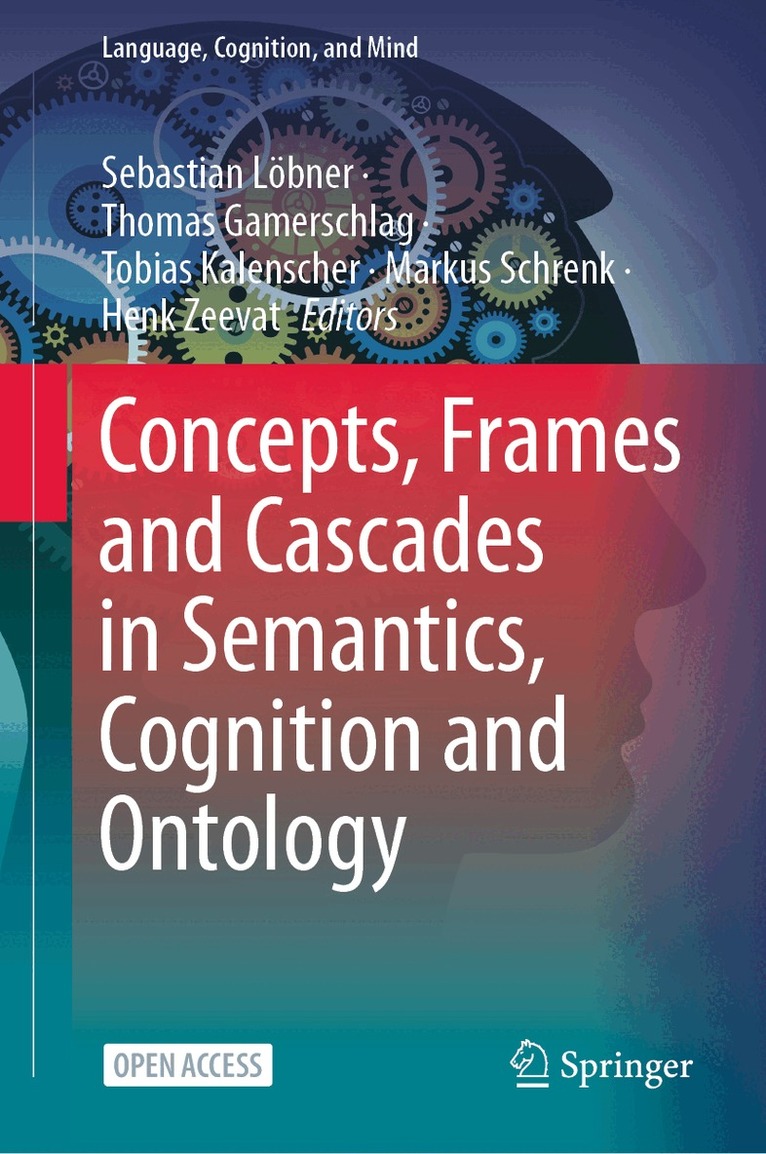
Concepts, Frames and Cascades in Semantics, Cognition and Ontology
Inbunden, Engelska, 2021
546 kr
Skickas inom 10-15 vardagar
This open access book presents novel theoretical, empirical and experimental work exploring the nature of mental representations that support natural language production and understanding, and other manifestations of cognition. One fundamental question raised in the text is whether requisite knowledge structures can be adequately modeled by means of a uniform representational format, and if so, what exactly is its nature.Frames are a key topic covered which have had a strong impact on the exploration of knowledge representations in artificial intelligence, psychology and linguistics; cascades are a novel development in frame theory. Other key subject areas explored are: concepts and categorization, the experimental investigation of mental representation, as well as cognitive analysis in semantics. This book is of interest to students, researchers, and professionals working on cognition in the fields of linguistics, philosophy, and psychology.
Häftad, Engelska, 2022
546 kr
Skickas inom 10-15 vardagar
Häftad, Tyska, 2015
272 kr
Skickas inom 5-8 vardagar
Del 244 - ISSN
Wahr neben Falsch
Inbunden, Tyska, 1990
1 645 kr
Skickas inom 5-8 vardagar
Häftad, Engelska, 2011
562 kr
Skickas inom 10-15 vardagar
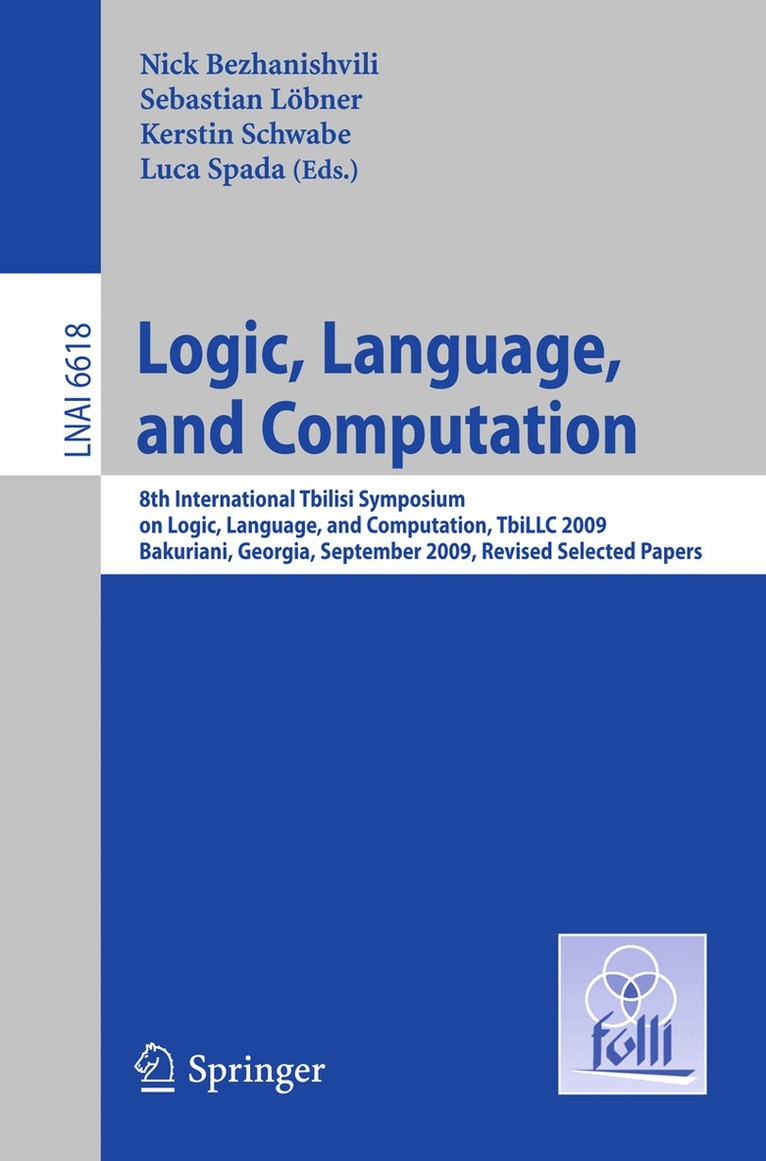
Edited in collaboration with FoLLI, the Association of Logic, Language and Information, this book constitutes the refereed proceedings of the 8th International Tbilisi Symposium on Logic, Language, and Computation, TbiLLC 2009, held in Bakuriani, Georgia, in September 2009. The 20 revised full papers included in the book were carefully reviewed and selected from numerous presentations given at the symposium. The focus of the papers is on the following topics: natural language syntax, semantics, and pragmatics; constructive, modal and algebraic logic; linguistic typology and semantic universals; logics for artificial intelligence; information retrieval, query answer systems; logic, games, and formal pragmatics; language evolution and learnability; computational social choice; historical linguistics, history of logic.
Häftad, Engelska, 2013
518 kr
Skickas inom 10-15 vardagar
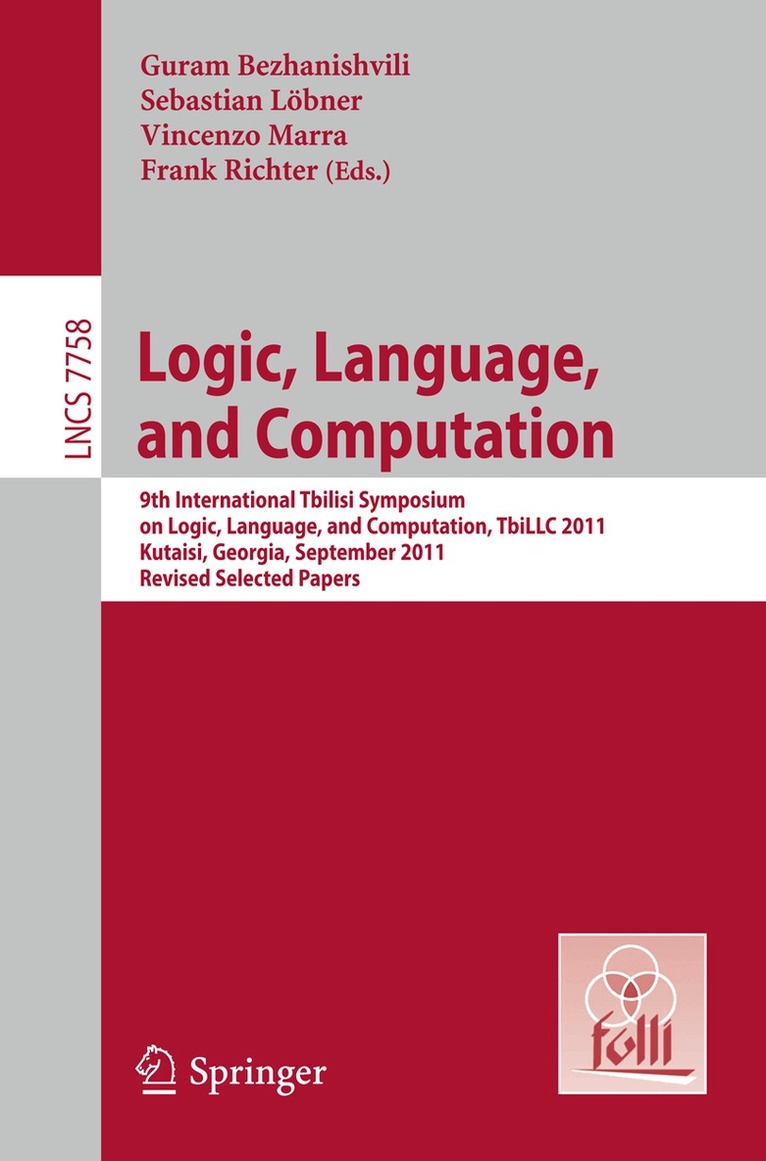
This book constitutes the refereed proceedings of the 9th International Tbilisi Symposium on Logic, Language, and Computation, TbiLLC 2011, held in Kutaisi, Georgia, in September 2011.The book consists of summaries of 3 tutorials presented at the symposium together with 13 full papers that were carefully reviewed and selected from the submissions. The papers are organized in two sections, one on Language and one on Logic and Computation. The range of topics covered in the Language section includes natural language syntax, semantics, and pragmatics, frames in natural language semantics, linguistic typology, and discourse phenomena. The papers in the Logic and Computation section cover such topics as constructive, modal, algebraic, and philosophical logic, as well as logics for computer science applications.