Selma Supek - Böcker
Visar alla böcker från författaren Selma Supek. Handla med fri frakt och snabb leverans.
3 produkter
3 produkter
9 617 kr
Skickas inom 10-15 vardagar
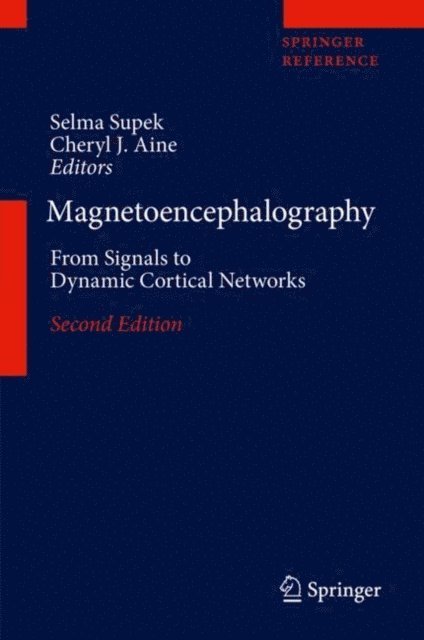
Magnetoencephalography (MEG) is an invaluable functional brain imaging technique that provides direct, real-time monitoring of neuronal activity necessary for gaining insight into dynamic cortical networks. This handbook covers the rich and transdisciplinary nature of the MEG field. The underlying motivation for this book was to make this diverse and extensive collection of chapters available to both newcomers and experienced researchers with the hope of stimulating growth in the MEG area. The book is a comprehensive knowledge base of MEG basics along with the latest developments in methodological, empirical and clinical research, directed toward masters and doctoral students, as well as researchers already in the field. The topics range from neuromagnetic measurements, signal processing and source localization techniques to dynamic functional networks underlying perception and cognition in both health and disease. Topical reviews cover, among others: development on SQUID-based and novel sensors, multi-modal integration (low field MRI and MEG; EEG and fMRI), Bayesian approaches to multi-modal integration, direct neuronal imaging, novel noise reduction methods, source-space functional analysis, decoding of brain states, dynamic brain connectivity, sensory-motor integration, MEG studies on perception and cognition, thalamocortical oscillations, fetal and neonatal MEG, pediatric MEG studies, cognitive development, clinical applications of MEG in epilepsy, pre-surgical mapping, stroke, schizophrenia, stuttering, traumatic brain injury, post-traumatic stress disorder, depression, autism, aging and neurodegeneration, MEG applications in cognitive neuropharmacology, along with an overview of major open-source analysis tools.The 2nd edition, which is now presented as a Springer Reference, has 9 sections compared to 5 in the first edition and includes a total of 61 chapters. It provides more in-depth tutorials on MEG as an enabling tool in neuroscienceand on linear source estimation and spatial filtering approaches. A set of 11 new chapters and 20 updated chapters cover, among others, new topics such as simultaneous MEG and intracerebral EEG recordings, MEG studies on time processing and temporal cognition, open source MNE software, presurgical localization of language, emerging zero helium boil-off MEG technologies and provides updates on novel multi-modal fusion and related modeling approaches, open source analysis packages, neural decoding and MEG Brain Computer Interface, organizational cognitive neuroscience as well as developmental studies and clinical applications. In the last two years significant advances have been made in the field of novel sensor development, particularly for optically pumped magnetometers (OPMs) which are leading the way to a new generation of wearable MEG systems. Included in this new edition is a new chapter covering the topic of “on-scalp” MEG and an updated chapter on OPMs.The book was edited by a board of internationally renowned scientists serving as Section Editors:Part I: MEG Tutorials: Seppo Ahlfors Part II: Source Analysis and Multi-modal Integration: Selma Supek and Cheryl J. AinePart III: Open Source Analysis Packages: Alexandre GramfortPart IV: Functional Connectivity and Oscillatory Activity: Matthew BrooksPart V: Neurodevelopment Across Lifespan: Julia M. StephenPart VI: Sensory and Cognitive Studies: Catherine Tallon-BaudryPart VII: Clinical Application and Translational Studies: Nobukazu NakasatoPart VIII: Novel Brain Research Topics: Lauri Parkkonen Part IX: Emerging Technologies: Risto Ilmoniemi
17th International Conference on Biomagnetism Advances in Biomagnetism - Biomag 2010 - March 28 - April 1, 2010
Biomag March 28 - April 1, 2010
Häftad, Engelska, 2010
2 180 kr
Skickas inom 10-15 vardagar
40th anniversary of "medical uses of SQUID" th It is my great pleasure and honor to invite you to the 17 International Conference on Biomagnetism – Biomag2010 held in Dubrovnik, Croatia from Sunday, March 28 through Thursday, April 1, 2010. The interdisciplinary field of biomagnetism includes dynamic and evolving SQUID-based technologies offering advanced real-time methods for noninvasive assessments of magnetic signals from the brain, heart and other organs as well as a range of modeling, mathematical and computational methods for functional source localization approaches. Excellent spatial resolution and unique, millisecond, temporal resolution of biomagnetic techniques allow insights into cortical neurodynamics and neurobiological basis of the human brain as well as assessment of heart and other organs functions in health and disease. Biomag2010 will be a great opportunity for an exchange of ideas and presentation of the latest developments in instrumentation, modeling approaches, basic and clinical biomedical studies. We are particularly proud to announce the celebration of the 40th anniversary of the first SQUID-based MCG measurements published on April 1, 1970. Since then ''medical uses of SQUID'' were dynamic and growing, including the most recent developments, in combination with a low field MRI, toward a ''direct neuronal imaging''. Dubrovnik, the host city of the Biomag2010, a jewel on the Adriatic, will be a superb and stimulating setting for both scientific and social aspects of this meeting. I am looking forward to hosting you in Dubrovnik, Croatia in spring of 2010.
1 637 kr
Skickas inom 10-15 vardagar
Magnetoencephalography (MEG) is an invaluable functional brain imaging technique that provides direct, real-time monitoring of neuronal activity necessary for gaining insight into dynamic cortical networks. Our intentions with this book are to cover the richness and transdisciplinary nature of the MEG field, make it more accessible to newcomers and experienced researchers and to stimulate growth in the MEG area. The book presents a comprehensive overview of MEG basics and the latest developments in methodological, empirical and clinical research, directed toward master and doctoral students, as well as researchers. There are three levels of contributions: 1) tutorials on instrumentation, measurements, modeling, and experimental design; 2) topical reviews providing extensive coverage of relevant research topics; and 3) short contributions on open, challenging issues, future developments and novel applications. The topics range from neuromagnetic measurements, signal processing and source localization techniques to dynamic functional networks underlying perception and cognition in both health and disease. Topical reviews cover, among others: development on SQUID-based and novel sensors, multi-modal integration (low field MRI and MEG; EEG and fMRI), Bayesian approaches to multi-modal integration, direct neuronal imaging, novel noise reduction methods, source-space functional analysis, decoding of brain states, dynamic brain connectivity, sensory-motor integration, MEG studies on perception and cognition, thalamocortical oscillations, fetal and neonatal MEG, pediatric MEG studies, cognitive development, clinical applications of MEG in epilepsy, pre-surgical mapping, stroke, schizophrenia, stuttering, traumatic brain injury, post-traumatic stress disorder, depression, autism, aging and neurodegeneration, MEG applications in cognitive neuropharmacology and an overview of the major open-source analysis tools.