Senén Barro – författare
Visar alla böcker från författaren . Handla med fri frakt och snabb leverans.
5 produkter
5 produkter
7 668 kr
Skickas
This book presents the proceedings of the 24th European Conference on Artificial Intelligence (ECAI 2020), held in Santiago de Compostela, Spain, from 29 August to 8 September 2020. The conference was postponed from June, and much of it conducted online due to the COVID-19 restrictions. The conference is one of the principal occasions for researchers and practitioners of AI to meet and discuss the latest trends and challenges in all fields of AI and to demonstrate innovative applications and uses of advanced AI technology. The book also includes the proceedings of the 10th Conference on Prestigious Applications of Artificial Intelligence (PAIS 2020) held at the same time. A record number of more than 1,700 submissions was received for ECAI 2020, of which 1,443 were reviewed. Of these, 361 full-papers and 36 highlight papers were accepted (an acceptance rate of 25% for full-papers and 45% for highlight papers). The book is divided into three sections: ECAI full papers; ECAI highlight papers; and PAIS papers. The topics of these papers cover all aspects of AI, including Agent-based and Multi-agent Systems; Computational Intelligence; Constraints and Satisfiability; Games and Virtual Environments; Heuristic Search; Human Aspects in AI; Information Retrieval and Filtering; Knowledge Representation and Reasoning; Machine Learning; Multidisciplinary Topics and Applications; Natural Language Processing; Planning and Scheduling; Robotics; Safe, Explainable, and Trustworthy AI; Semantic Technologies; Uncertainty in AI; and Vision.The book will be of interest to all those whose work involves the use of AI technology.
Engelska, 2012
667 kr
Skickas inom 5-8 vardagar
Del 83 - Studies in Fuzziness and Soft Computing
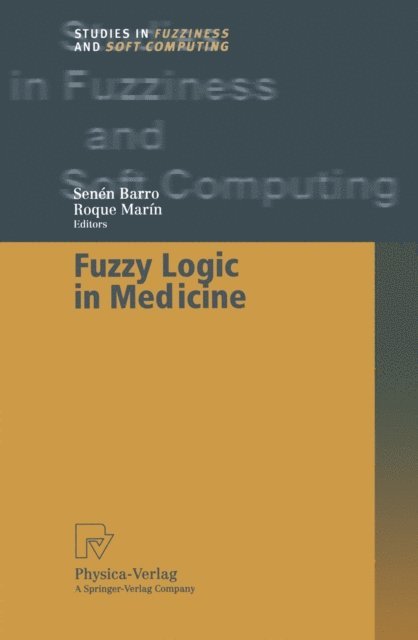
Fuzzy Logic in Medicine
Inbunden, Engelska, 2001
1 116 kr
Skickas inom 10-15 vardagar
To say that Fuzzy Logic in Medicine, or FLM for short, is an important addi tion to the literature of fuzzy logic and its applications, is an understatement. Edited by two prominent informaticians, Professors S. Barro and R. Marin, it is one of the first books in its field. Between its covers, FLM presents authoritative expositions of a wide spectrum of medical and biological ap plications of fuzzy logic, ranging from image classification and diagnostics to anaesthesia control and risk assessment of heart diseases. As the editors note in the preface, recognition of the relevance of fuzzy set theory and fuzzy logic to biological and medical systems has a long history. In this context, particularly worthy of note is the pioneering work of Profes sor Klaus Peter Adlassnig of the University of Vienna School of Medicine. However, it is only within the past decade that we began to see an accelerat ing growth in the visibility and importance of publications falling under the rubric of fuzzy logic in medicine and biology -a leading example of which is the Journal of the Biomedical Fuzzy Systems Association in Japan. Why did it take so long for this to happen? First, a bit of history.
E-bok
PDF, Engelska, 20131 416 kr
Läs direkt efter köp
To say that Fuzzy Logic in Medicine, or FLM for short, is an important addi tion to the literature of fuzzy logic and its applications, is an understatement. Edited by two prominent informaticians, Professors S. Barro and R. Marin, it is one of the first books in its field. Between its covers, FLM presents authoritative expositions of a wide spectrum of medical and biological ap plications of fuzzy logic, ranging from image classification and diagnostics to anaesthesia control and risk assessment of heart diseases. As the editors note in the preface, recognition of the relevance of fuzzy set theory and fuzzy logic to biological and medical systems has a long history. In this context, particularly worthy of note is the pioneering work of Profes sor Klaus Peter Adlassnig of the University of Vienna School of Medicine. However, it is only within the past decade that we began to see an accelerat ing growth in the visibility and importance of publications falling under the rubric of fuzzy logic in medicine and biology -a leading example of which is the Journal of the Biomedical Fuzzy Systems Association in Japan. Why did it take so long for this to happen? First, a bit of history.
Del 83 - Studies in Fuzziness and Soft Computing
Fuzzy Logic in Medicine
Häftad, Engelska, 2010
1 083 kr
Skickas inom 10-15 vardagar
To say that Fuzzy Logic in Medicine, or FLM for short, is an important addi tion to the literature of fuzzy logic and its applications, is an understatement. Edited by two prominent informaticians, Professors S. Barro and R. Marin, it is one of the first books in its field. Between its covers, FLM presents authoritative expositions of a wide spectrum of medical and biological ap plications of fuzzy logic, ranging from image classification and diagnostics to anaesthesia control and risk assessment of heart diseases. As the editors note in the preface, recognition of the relevance of fuzzy set theory and fuzzy logic to biological and medical systems has a long history. In this context, particularly worthy of note is the pioneering work of Profes sor Klaus Peter Adlassnig of the University of Vienna School of Medicine. However, it is only within the past decade that we began to see an accelerat ing growth in the visibility and importance of publications falling under the rubric of fuzzy logic in medicine and biology -a leading example of which is the Journal of the Biomedical Fuzzy Systems Association in Japan. Why did it take so long for this to happen? First, a bit of history.