Seonghui Lee - Böcker
Visar alla böcker från författaren Seonghui Lee. Handla med fri frakt och snabb leverans.
2 produkter
2 produkter
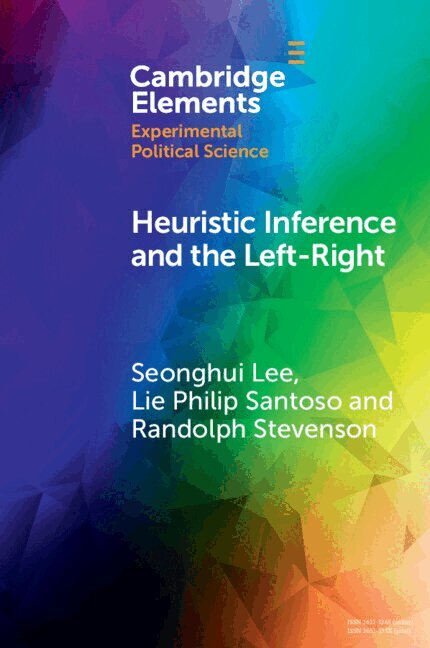
Heuristic Inference and the Left-Right
An Experimental Analysis of How Voters Form Their Left-Right Images of Parties
Häftad, Engelska, 2026
234 kr
Kommande
How do voters form left-right images of political parties? This Element applies the theoretical framework of ecologically rational heuristic inference to synthesize insights from the extensive literature on the meaning of left and right in politics. It proposes several hypotheses about cues that voters with varying levels of political sophistication use to infer parties' left-right positions. These expectations are tested through seven conjoint and factorial survey experiments in Germany, Denmark, Canada, and the UK. Findings show that many voters develop sensible left-right perceptions of parties by relying on small sets of highly predictive cues. However, voters differ in how they interpret these cues. Less politically sophisticated voters tend to infer party positions mainly from partisan signals, whereas more sophisticated voters rely on a broader range of indicators, including party policies, ideological values, and social group support. This title is also available as Open Access on Cambridge Core.
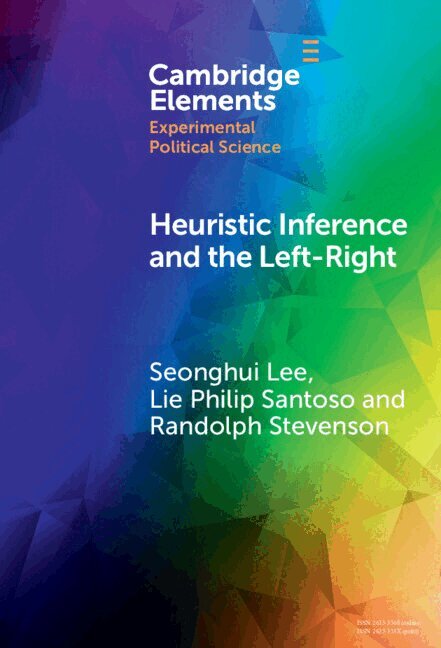
Heuristic Inference and the Left-Right
An Experimental Analysis of How Voters Form Their Left-Right Images of Parties
Inbunden, Engelska, 2026
753 kr
Kommande
How do voters form left-right images of political parties? This Element applies the theoretical framework of ecologically rational heuristic inference to synthesize insights from the extensive literature on the meaning of left and right in politics. It proposes several hypotheses about cues that voters with varying levels of political sophistication use to infer parties' left-right positions. These expectations are tested through seven conjoint and factorial survey experiments in Germany, Denmark, Canada, and the UK. Findings show that many voters develop sensible left-right perceptions of parties by relying on small sets of highly predictive cues. However, voters differ in how they interpret these cues. Less politically sophisticated voters tend to infer party positions mainly from partisan signals, whereas more sophisticated voters rely on a broader range of indicators, including party policies, ideological values, and social group support. This title is also available as Open Access on Cambridge Core.