Serge Morand – författare
1 406 kr
Läs direkt efter köp
701 kr
Läs direkt efter köp
1 906 kr
Skickas inom 7-10 vardagar
995 kr
Skickas inom 5-8 vardagar
700 kr
Skickas inom 10-15 vardagar
1 500 kr
Skickas inom 7-10 vardagar
2 438 kr
Skickas inom 10-15 vardagar
814 kr
Läs direkt efter köp
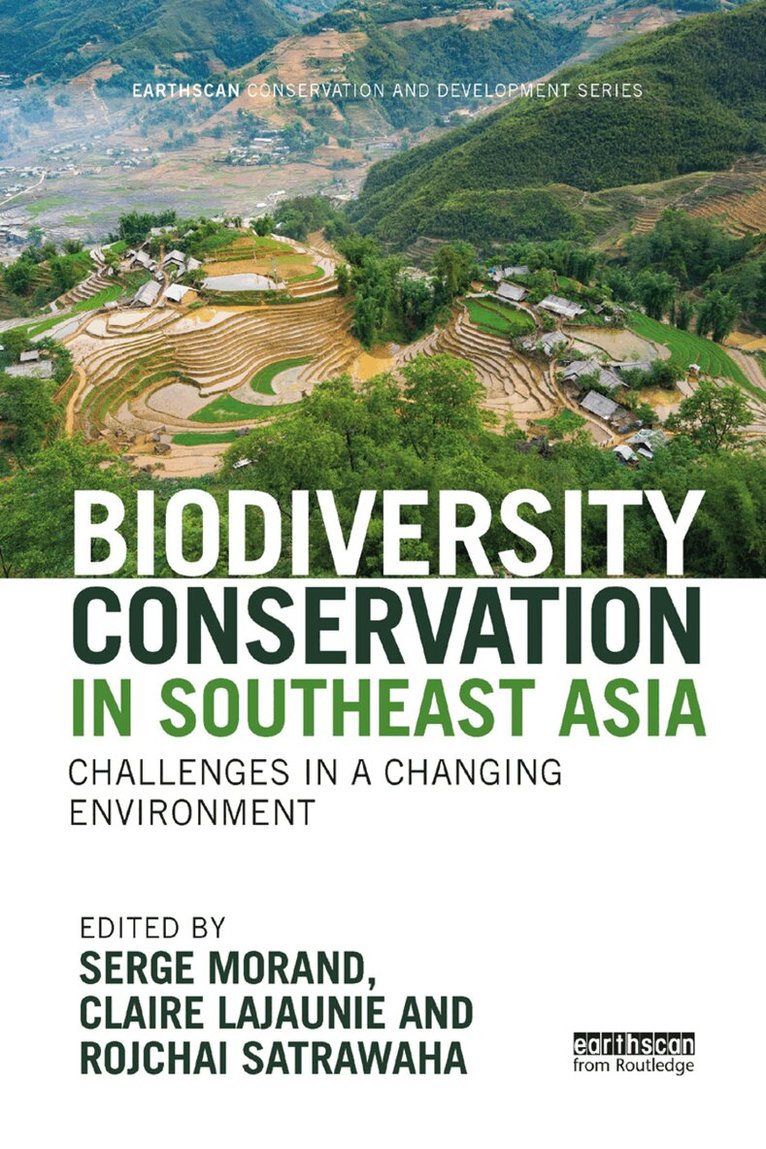
Southeast Asia is highly diversified in terms of socio-ecosystems and biodiversity, but is undergoing dramatic environmental and social changes. These changes characterize the recent period and can be illustrated by the effects of the Green Revolution in the late 1960s and 1970s, to the globalization of trade and increasing agronomic intensification over the past decade.
Biodiversity Conservation in Southeast Asia provides theoretical overviews and challenges for applied research in living resource management, conservation ecology, health ecology and conservation planning in Southeast Asia. Five key themes are addressed: origin and evolution of Southeast Asian biodiversity; challenges in conservation biology; ecosystem services and biodiversity; managing biodiversity and living resources; policy, economics and governance of biodiversity. Detailed case studies are included from Thailand and the Lower Mekong Basin, while other chapters address cross-cutting themes applicable to the whole Southeast Asia region.
This is a valuable resource for academics and students in the areas of ecology, conservation, environmental policy and management, Southeast Asian studies and sustainable development.
814 kr
Läs direkt efter köp
Southeast Asia is highly diversified in terms of socio-ecosystems and biodiversity, but is undergoing dramatic environmental and social changes. These changes characterize the recent period and can be illustrated by the effects of the Green Revolution in the late 1960s and 1970s, to the globalization of trade and increasing agronomic intensification over the past decade.
Biodiversity Conservation in Southeast Asia provides theoretical overviews and challenges for applied research in living resource management, conservation ecology, health ecology and conservation planning in Southeast Asia. Five key themes are addressed: origin and evolution of Southeast Asian biodiversity; challenges in conservation biology; ecosystem services and biodiversity; managing biodiversity and living resources; policy, economics and governance of biodiversity. Detailed case studies are included from Thailand and the Lower Mekong Basin, while other chapters address cross-cutting themes applicable to the whole Southeast Asia region.
This is a valuable resource for academics and students in the areas of ecology, conservation, environmental policy and management, Southeast Asian studies and sustainable development.
1 616 kr
Skickas inom 5-8 vardagar
1 727 kr
Skickas inom 10-15 vardagar
There is a gap between the ecology of health and the concepts supported by international initiatives such as EcoHealth, One Health or Planetary Health; a gap which this book aims to fill.
Global change is accelerated by problems of growing population, industrialization and geopolitics, and the world's biodiversity is suffering as a result, which impacts both humans and animals. However, Biodiversity and Health offers the unique opportunity to demonstrate how ecological, environmental, medical and social sciences can contribute to the improvement of human health and wellbeing through the conservation of biodiversity and the services it brings to societies.
This book gives an expansive and integrated overview of the scientific disciplines that contribute to the connection between health and biodiversity, from the evolutionary ecology of infectious and non-infectious diseases to ethics, law and politics.
Presents the first book to give a broad and integrated overview of the scientific disciplines that contribute to health From evolutionary ecology, to laws and policies, this book explores the links between health and biodiversity Demonstrates how ecological sciences, environmental sciences, medical sciences, and social sciences may contribute to improve human health663 kr
Läs direkt efter köp
354 kr
Skickas inom 5-8 vardagar
342 kr
Skickas inom 5-8 vardagar
1 407 kr
Skickas inom 10-15 vardagar
1 733 kr
Läs direkt efter köp
This second volume is the work of more than 55 authors from 15 different disciplines and includes complex systems science which studies the viability of components, and also the study of empirical situations. As readers will discover, the coviability of social and ecological systems is based on the contradiction between humanity, which adopts finalized objectives, and the biosphere, which refers to a ecological functions. We see how concrete situations shed light on the coviability’s determinants, and in this book the very nature of the coviability, presented as a concept-paradigm, is defined in a transversal and ontological ways.
By adopting a systemic approach, without advocating any economic dogma (such as development) or dichotomizing between humans and nature, while emphasizing what is relevant to humans and what is not, this work neutrally contextualizes man’s place in the biosphere. It offers a new mode of thinking and positioning of the ecological imperative, and will appeal to all those working with social and ecological systems.
1 623 kr
Skickas inom 10-15 vardagar
2 049 kr
Läs direkt efter köp
This book considers the principle of ‘sustainable development’ which is currently facing a growing environmental crisis. A new mode of thinking and positioning the ecological imperative is the major input of this volume. The prism of co-viability is not the economics of political agencies that carry the ideology of the dominant/conventional economic schools, but rather an opening of innovation perspectives through science. This volume, through its four parts, more than 40 chapters and a hundred authors, gives birth to a paradigm which crystallizes within a concept that will support in overcoming the ecological emergency deadlock.
2 004 kr
Skickas inom 10-15 vardagar
1 947 kr
Läs direkt efter köp
1 769 kr
Skickas inom 10-15 vardagar
1 116 kr
Skickas inom 10-15 vardagar
1 116 kr
Skickas inom 10-15 vardagar
1 459 kr
Läs direkt efter köp
This book pursues a multidisciplinary approach in order to evaluate the socio-ecological dimensions of infectious diseases in Southeast Asia. It includes 18 chapters written by respected researchers in the fields of history, sociology, ecology, epidemiology, veterinary sciences, medicine and the environmental sciences on six major topics: (1) Infectious diseases and societies, (2) Health, infectious diseases and socio-ecosystems; (3) Global changes, land use changes and vector-borne diseases; (4) Monitoring and data acquisition; (5) Managing health risks; and (6) Developing strategies. The book offers a valuable guide for students and researchers in the fields of development and environmental studies, animal and human health (veterinarians, physicians), ecology and conservation biology, especially those with a focus on Southeast Asia.