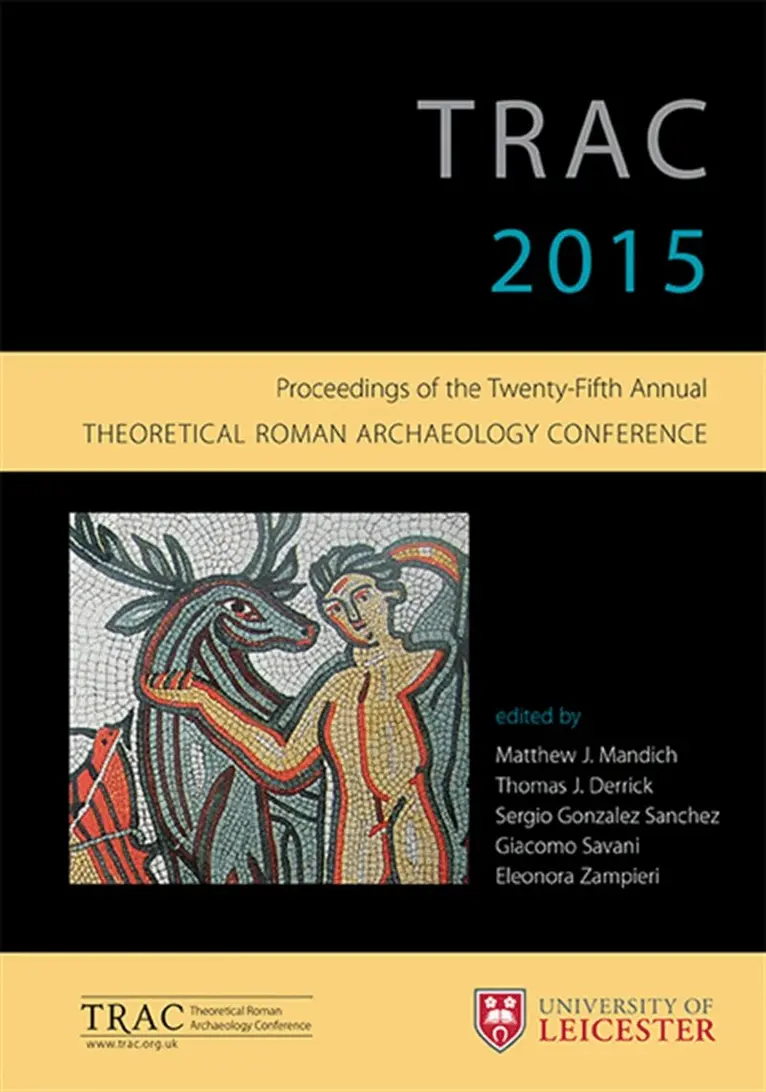
The 2015 TRAC proceedings feature a selection of 14 papers summing up some of the key sessions presented at the conference held at the University of Leicester in March 2015, which drew over 180 delegates of 17 nationalities from a variety of universities, museums, and research institutions in the UK, Europe, and North America. As this conference marked the 25th anniversary of TRAC, the volume opens with a preface commemorating the last 25 years with an eye toward the future direction of both conference and community. The proceedings begin with Dr Andrew Gardner’s keynote paper on the topic of ‘Debating Roman Imperialism: Critique, Construct, Repeat?’. This is followed by an array of papers with topics ranging in geographic scope and period, from small finds in early Roman Britain to bathing practices Late Antique North Africa, and from the investigation of deviant burials to the application of urban scaling theory in Roman contexts. Because of this diversity the volume is not broken into specific sections, however, papers with similar themes are grouped accordingly, allowing the text to flow and be read as a whole. The range of contributing authors is also of note, as papers were submitted by PhD students, post-doctoral researchers, and university faculty, all helping to make the 25th anniversary of this series one that continues to emphasis and reflect the aims of TRAC, both as a conference and as a conduit for exploring more theory-driven approaches to the Roman past.EPUB3: Reflowable
This first thematic volume of the new series TRAC Themes in Roman Archaeology brings renowned international experts to discuss different aspects of interactions between Romans and ‘barbarians’ in the north-western regions of Europe. Northern Europe has become an interesting arena of academic debate around the topics of Roman imperialism and Roman–‘barbarian’ interactions, as these areas comprised Roman provincial territories, the northern frontier system of the Roman Empire (limes), the vorlimes (or buffer zone), and the distant barbaricum. This area is, today, host to several modern European nations with very different historical and academic discourses on their Roman past, a factor in the recent tendency towards the fragmentation of approaches and the application of post-colonial theories that have favoured the advent of a varied range of theoretical alternatives. Case studies presented here span across disciplines and territories, from American anthropological studies on transcultural discourse and provincial organization in Gaul, to historical approaches to the propagandistic use of the limes in the early 20th century German empire; from Danish research on warrior identities and Roman–Scandinavian relations, to innovative ideas on culture contact in Roman Ireland; and from new views on Romano-Germanic relations in Central European Barbaricum, to a British comparative exercise on frontier cultures. The volume is framed by a brilliant theoretical introduction by Prof. Richard Hingley and a comprehensive concluding discussion by Prof. David Mattingly.
The 2015 TRAC proceedings feature a selection of 14 papers summing up some of the key sessions presented at the conference held at the University of Leicester in March 2015, which drew over 180 delegates of 17 nationalities from a variety of universities, museums, and research institutions in the UK, Europe, and North America. As this conference marked the 25th anniversary of TRAC, the volume opens with a preface commemorating the last 25 years with an eye toward the future direction of both conference and community. The proceedings begin with Dr Andrew Gardner’s keynote paper on the topic of ‘Debating Roman Imperialism: Critique, Construct, Repeat?’. This is followed by an array of papers with topics ranging in geographic scope and period, from small finds in early Roman Britain to bathing practices Late Antique North Africa, and from the investigation of deviant burials to the application of urban scaling theory in Roman contexts. Because of this diversity the volume is not broken into specific sections, however, papers with similar themes are grouped accordingly, allowing the text to flow and be read as a whole. The range of contributing authors is also of note, as papers were submitted by PhD students, post-doctoral researchers, and university faculty, all helping to make the 25th anniversary of this series one that continues to emphasis and reflect the aims of TRAC, both as a conference and as a conduit for exploring more theory-driven approaches to the Roman past.EPUB3: Reflowable
This first thematic volume of the new series TRAC Themes in Roman Archaeology brings renowned international experts to discuss different aspects of interactions between Romans and ‘barbarians’ in the north-western regions of Europe. Northern Europe has become an interesting arena of academic debate around the topics of Roman imperialism and Roman–‘barbarian’ interactions, as these areas comprised Roman provincial territories, the northern frontier system of the Roman Empire (limes), the vorlimes (or buffer zone), and the distant barbaricum. This area is, today, host to several modern European nations with very different historical and academic discourses on their Roman past, a factor in the recent tendency towards the fragmentation of approaches and the application of post-colonial theories that have favoured the advent of a varied range of theoretical alternatives. Case studies presented here span across disciplines and territories, from American anthropological studies on transcultural discourse and provincial organization in Gaul, to historical approaches to the propagandistic use of the limes in the early 20th century German empire; from Danish research on warrior identities and Roman–Scandinavian relations, to innovative ideas on culture contact in Roman Ireland; and from new views on Romano-Germanic relations in Central European Barbaricum, to a British comparative exercise on frontier cultures. The volume is framed by a brilliant theoretical introduction by Prof. Richard Hingley and a comprehensive concluding discussion by Prof. David Mattingly.