Shad Roundy – författare
Visar alla böcker från författaren Shad Roundy. Handla med fri frakt och snabb leverans.
6 produkter
6 produkter
Inbunden, Engelska, 2003
2 152 kr
Skickas inom 10-15 vardagar
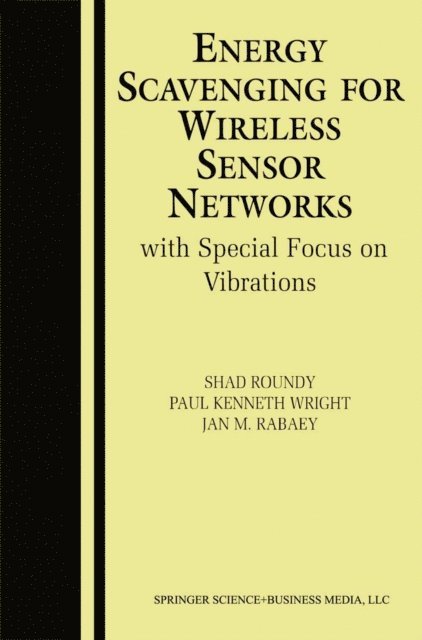
The vast reduction in size and power consumption of CMOS circuitry has led to a large research effort based around the vision of wireless sensor networks. The proposed networks will be comprised of thousands of small wireless nodes that operate in a multi-hop fashion, replacing long transmission distances with many low power, low cost wireless devices. The result will be the creation of an intelligent environment responding to its inhabitants and ambient conditions. Wireless devices currently being designed and built for use in such environments typically run on batteries. However, as the networks increase in number and the devices decrease in size, the replacement of depleted batteries will not be practical. The cost of replacing batteries in a few devices that make up a small network about once per year is modest. However, the cost of replacing thousands of devices in a single building annually, some of which are in areas difficult to access, is simply not practical. Another approach would be to use a battery that is large enough to last the entire lifetime of the wireless sensor device. However, a battery large enough to last the lifetime of the device would dominate the overall system size and cost, and thus is not very attractive. Alternative methods of powering the devices that will make up the wireless networks are desperately needed.
Häftad, Engelska, 2012
2 152 kr
Skickas inom 10-15 vardagar
The vast reduction in size and power consumption of CMOS circuitry has led to a large research effort based around the vision of wireless sensor networks. The proposed networks will be comprised of thousands of small wireless nodes that operate in a multi-hop fashion, replacing long transmission distances with many low power, low cost wireless devices. The result will be the creation of an intelligent environment responding to its inhabitants and ambient conditions. Wireless devices currently being designed and built for use in such environments typically run on batteries. However, as the networks increase in number and the devices decrease in size, the replacement of depleted batteries will not be practical. The cost of replacing batteries in a few devices that make up a small network about once per year is modest. However, the cost of replacing thousands of devices in a single building annually, some of which are in areas difficult to access, is simply not practical. Another approach would be to use a battery that is large enough to last the entire lifetime of the wireless sensor device. However, a battery large enough to last the lifetime of the device would dominate the overall system size and cost, and thus is not very attractive. Alternative methods of powering the devices that will make up the wireless networks are desperately needed.
E-bok
PDF, Engelska, 20122 840 kr
Läs direkt efter köp
The vast reduction in size and power consumption of CMOS circuitry has led to a large research effort based around the vision of wireless sensor networks. The proposed networks will be comprised of thousands of small wireless nodes that operate in a multi-hop fashion, replacing long transmission distances with many low power, low cost wireless devices. The result will be the creation of an intelligent environment responding to its inhabitants and ambient conditions. Wireless devices currently being designed and built for use in such environments typically run on batteries. However, as the networks increase in number and the devices decrease in size, the replacement of depleted batteries will not be practical. The cost of replacing batteries in a few devices that make up a small network about once per year is modest. However, the cost of replacing thousands of devices in a single building annually, some of which are in areas difficult to access, is simply not practical. Another approach would be to use a battery that is large enough to last the entire lifetime of the wireless sensor device. However, a battery large enough to last the lifetime of the device would dominate the overall system size and cost, and thus is not very attractive. Alternative methods of powering the devices that will make up the wireless networks are desperately needed.
Del 12 - Advanced Micro and Nanosystems
Micro Energy Harvesting
Inbunden, Engelska, 2015
1 770 kr
Skickas inom 11-20 vardagar
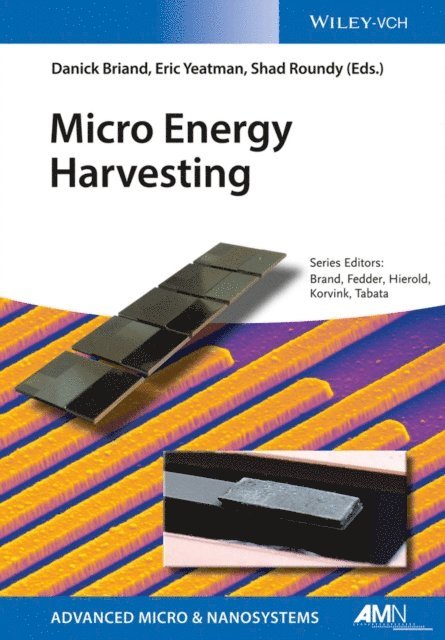
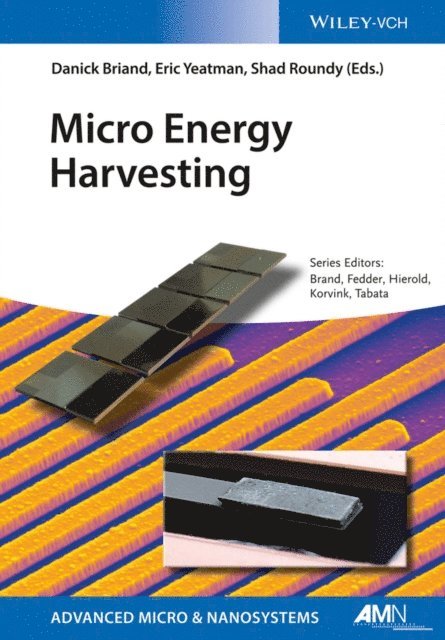
With its inclusion of the fundamentals, systems and applications, this reference provides readers with the basics of micro energy conversion along with expert knowledge on system electronics and real-life microdevices.The authors address different aspects of energy harvesting at the micro scale with a focus on miniaturized and microfabricated devices. Along the way they provide an overview of the field by compiling knowledge on the design, materials development, device realization and aspects of system integration, covering emerging technologies, as well as applications in power management, energy storage, medicine and low-power system electronics. In addition, they survey the energy harvesting principles based on chemical, thermal, mechanical, as well as hybrid and nanotechnology approaches.In unparalleled detail this volume presents the complete picture -- and a peek into the future -- of micro-powered microsystems.
E-bok
Engelska, 20152 374 kr
Läs direkt efter köp
With its inclusion of the fundamentals, systems and applications, this reference provides readers with the basics of micro energy conversion along with expert knowledge on system electronics and real-life microdevices. The authors address different aspects of energy harvesting at the micro scale with a focus on miniaturized and microfabricated devices. Along the way they provide an overview of the field by compiling knowledge on the design, materials development, device realization and aspects of system integration, covering emerging technologies, as well as applications in power management, energy storage, medicine and low-power system electronics. In addition, they survey the energy harvesting principles based on chemical, thermal, mechanical, as well as hybrid and nanotechnology approaches. In unparalleled detail this volume presents the complete picture -- and a peek into the future -- of micro-powered microsystems.
E-bok
PDF, Engelska, 20152 374 kr
Läs direkt efter köp
With its inclusion of the fundamentals, systems and applications, this reference provides readers with the basics of micro energy conversion along with expert knowledge on system electronics and real-life microdevices. The authors address different aspects of energy harvesting at the micro scale with a focus on miniaturized and microfabricated devices. Along the way they provide an overview of the field by compiling knowledge on the design, materials development, device realization and aspects of system integration, covering emerging technologies, as well as applications in power management, energy storage, medicine and low-power system electronics. In addition, they survey the energy harvesting principles based on chemical, thermal, mechanical, as well as hybrid and nanotechnology approaches. In unparalleled detail this volume presents the complete picture -- and a peek into the future -- of micro-powered microsystems.