
Shah Alam – författare
Visar alla böcker från författaren Shah Alam. Handla med fri frakt och snabb leverans.
4 produkter
4 produkter
688 kr
Skickas inom 5-8 vardagar
651 kr
Skickas inom 3-6 vardagar
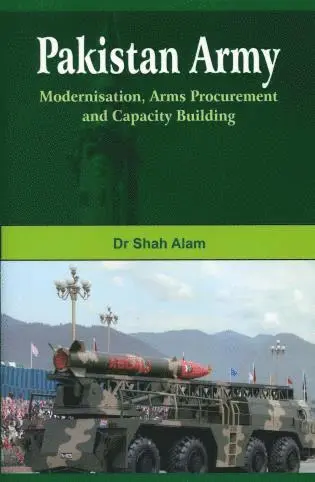
The book explains genesis, expansion, development, and modernisation of the Pakistan Army. It undertakes only the Pakistan Army and does not include the Pakistan Nay and the Pakistan Air Force. The book comprehensively explains and analyses the Pakistan Army. Initially, Pakistan had faced several challenges to meet its defence needs. Pakistan pursued strategy of external alignment to get arms and financial assistance. Pakistan obtained arms from various sources such as the US, Britain, China, Russia (former USSR), France, and others. It explains Pakistan's tie with arms suppliers and dynamics in their relationships. China transferred not only arms to Pakistan but also assisted in establishing defence industries. Pakistan-China complex relationship and Beijing's arms transfer policy towards Islamabad added intricacies in the regional security. Pakistan's arms acquisitions policy helped not only in expanding and modernising the Pakistan Army but also contributed in expanding and strengthening the defence industrial base. With the 550000 strength, modern and sophisticated arms, missiles and nuclear capable delivery missiles, the Pakistan Army has emerged a force in the region.
739 kr
Skickas inom 3-6 vardagar
The Revolution 1979 was a long process of political socialization that completely transformed Iran's outlook. Iran's social, political, and economic spheres abruptly changed due to the revolution. It traces genesis of the revolution and how Islam an ideology played dominant role in bringing revolution and shaping the post-revolution Iran. The Revolution 1979 replaced monarchy with clerics-rule and religion coalesced with politics. A new political culture emerged under influence of religion that swayed political process. The emergence of a new political culture in the post-Shah period influenced political process which gave birth to a new political system. Ayatollah Khomeini became the Velayat-e Faqih (Supreme Leader) in the post-Shah period since he led the revolution. The concept of Velayat-e Faqih is derived from the Imamate system. The Velayat-e Faqih is the most powerful and dominant institution in Iran and whole Iranian system revolve around it, and all institutions derive their legitimacy from it. Iran's society is transformed along Islamic line and major changes are introduced in social aspects.Educational system and women affairs have received major changes, and restrictions are enhanced over mass-media and social activities. Iran's economy has also come under religious influence and witnessed creation of the Islamic banks and other institutions to manage Iranian economy. It is noteworthy that leaders and political forces were divided over policy issues in the post-Revolution Iran which still continue. The Revolution 1979 has left indelible impression on Iran's society, polity, and economy and Islam will remain as an ideology in determining the country's behavior despite divisions within political forces.
458 kr
Skickas inom 3-6 vardagar
The Islamic Revolution of 1979 in Iran is a watershed in the history of Iran where Islam had played a dominant role in restructuring and reshaping society as a whole. The fusion of religion with politics and working as ideology is unique in the history of Islam. The structural nature and functional scope of the three branches of the government has been changed along Islamic lines since the establishment of the Islamic Republic. Islam's penetration is so extensive that its manifestation has come up in the form of the institutionalized role of Islam. In the aftermath of the revolution, a new constitution was enacted which declared Twelver Shiism as state religion. Islam has profound impact on social, political and economic system of Iran. Iranian economy has also been restructured along Islamic line. Its influence is deep and far-reaching in the economic system of Iran. The author, in this book has analysed the role of Islam in the Transformation of Social, Political and Economic structure of Iran post Islamic Revolution of 1979.