
Shaun May – författare
Visar alla böcker från författaren . Handla med fri frakt och snabb leverans.
5 produkter
5 produkter

Häftad, Engelska, 2016
508 kr
Skickas inom 10-15 vardagar
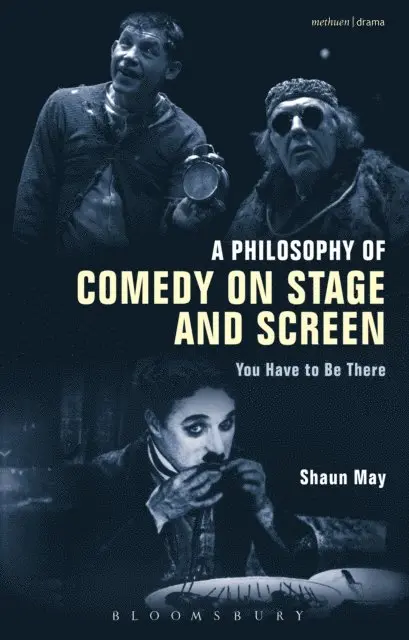
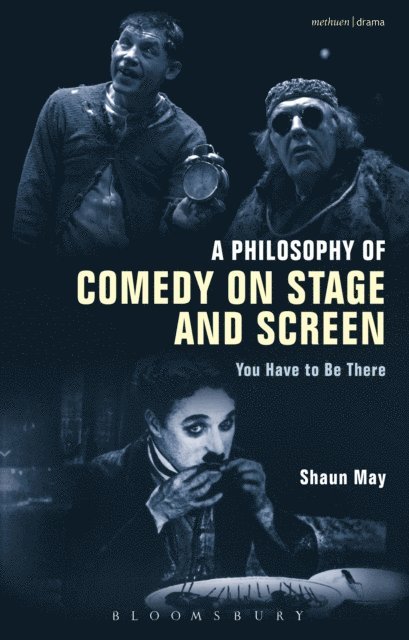
As far as we know, only human beings have a sense of humour – although chimps might laugh when tickled, and dogs respond similarly in play, Seth McFarlane’s fan-base is comprised exclusively of humans. Whilst animals and robots might feature as prominent characters in our favourite comic movies, shows and stand-up routines, we have no reason to suspect that their real-life brethren get the joke. Drawing on the philosophy of Martin Heidegger, Shaun May attempts to address this issue – suggesting that there is something distinctive about human beings which grounds our ability to make and comprehend jokes. Guiding the reader through a range of examples, including the films of Charlie Chaplin, the stand-up of Francesca Martinez, the TV show Family Guy and Samuel Beckett’s Endgame, he demonstrates that in order to get the joke you have to ‘be there’.

Inbunden, Engelska, 2015
1 679 kr
Skickas inom 10-15 vardagar
As far as we know, only human beings have a sense of humour – although chimps might laugh when tickled, and dogs respond similarly in play, Seth McFarlane’s fan-base is comprised exclusively of humans. Whilst animals and robots might feature as prominent characters in our favourite comic movies, shows and stand-up routines, we have no reason to suspect that their real-life brethren get the joke. Drawing on the philosophy of Martin Heidegger, Shaun May attempts to address this issue – suggesting that there is something distinctive about human beings which grounds our ability to make and comprehend jokes. Guiding the reader through a range of examples, including the films of Charlie Chaplin, the stand-up of Francesca Martinez, the TV show Family Guy and Samuel Beckett’s Endgame, he demonstrates that in order to get the joke you have to ‘be there’.
E-bok
Engelska, 2015545 kr
Läs direkt efter köp
As far as we know, only human beings have a sense of humour – although chimps might laugh when tickled, and dogs respond similarly in play, Seth McFarlane''s fan-base is comprised exclusively of humans. Whilst animals and robots might feature as prominent characters in our favourite comic movies, shows and stand-up routines, we have no reason to suspect that their real-life brethren get the joke. Drawing on the philosophy of Martin Heidegger, Shaun May attempts to address this issue – suggesting that there is something distinctive about human beings which grounds our ability to make and comprehend jokes. Guiding the reader through a range of examples, including the films of Charlie Chaplin, the stand-up of Francesca Martinez, the TV show Family Guy and Samuel Beckett''s Endgame, he demonstrates that in order to get the joke you have to ''be there''.
E-bok
PDF, Engelska, 2015545 kr
Läs direkt efter köp
As far as we know, only human beings have a sense of humour – although chimps might laugh when tickled, and dogs respond similarly in play, Seth McFarlane''s fan-base is comprised exclusively of humans. Whilst animals and robots might feature as prominent characters in our favourite comic movies, shows and stand-up routines, we have no reason to suspect that their real-life brethren get the joke. Drawing on the philosophy of Martin Heidegger, Shaun May attempts to address this issue – suggesting that there is something distinctive about human beings which grounds our ability to make and comprehend jokes. Guiding the reader through a range of examples, including the films of Charlie Chaplin, the stand-up of Francesca Martinez, the TV show Family Guy and Samuel Beckett''s Endgame, he demonstrates that in order to get the joke you have to ''be there''.
Häftad, Engelska, 2018
447 kr
Skickas inom 5-8 vardagar
The entry of the capital relation into its epoch of structural crisis forms the basis for the development of the author’s conception of revolutionary agency. Drawing on the work and achievements of both Marx and Hungarian socialist thinker István Mészáros, May relates the emergence and deepening of the structural crisis to the decline of trade unionism as the traditional and universal form of organization deployed economistically by workers against capital. In the relationship between the «defensively-structured», universal, trade union form and the growing contradictions of the global capitalist system, May seeks to unearth the possibility of a higher form of agency which is more adequately adapted to address the immediate and long-term objectives facing millions of people today worldwide in the age of capital’s «destructive self-reproduction». Looking back in order to look forward, he also subjects the form of agency within the Russian Revolution to a critique which relates it directly to the conditions prevailing in Russia at the time. In so doing, he questions its supposed validity as a form of revolutionary agency for the struggle to put an end to the global capitalist system today.