Sheila Suess Kennedy - Böcker
Visar alla böcker från författaren Sheila Suess Kennedy. Handla med fri frakt och snabb leverans.
6 produkter
6 produkter
833 kr
Skickas inom 10-15 vardagar
Freedom of speech is a foundational principle of the American Constitutional system. This collection of over 100 primary documents from a variety of sources will help students understand exactly what is meant by free speech, and how it has evolved since the founding of our country. Court cases, opinion pieces, and many other documents bring to life the tension between America's constitutional commitment to robust and unrestrained discourse and recurring efforts to suppress expression deemed dangerous, degrading or obscene. Explanatory introductions to each document aid users in understanding the various arguments put forth in debates over exactly how to define the Constitution to encourage readers to consider all sides when drawing their own conclusions.Relying heavily on Supreme Court precedents that have shaped First Amendment law, the volume also provides plenty of carefully selected source materials chosen to reflect the culture of the times, allowing the reader to better understand the climate giving rise to each controversy. The introductory and explanatory text help readers understand the nature of the conflicts, the issues being litigated, the social and cultural pressures that shaped each debate, and the manner in which the composition of the Supreme Court and the passions of the individual Justices affected the development of the law. This welcome resource will provide students with the opportunity to explore the philosophy of the First Amendment's Free Speech provisions and to understand how our historic commitment to freedom of expression has fared at various times in our history.
294 kr
Skickas inom 5-8 vardagar
Republicans have a lot more in common with the ACLU than they think! For decades conservative Republicans have railed against the 'liberal' American Civil Liberties Union and its state affiliates for defending unpopular causes from the rights of 'criminals' to flag burning, pornography, and Nazi marches down Main Street. So what possessed the Indiana CLU to put a card-carrying Republican at its helm? How could anyone who supported George Bush be a civil libertarian? In this fascinating first-hand account, Sheila S. Kennedy explains her amazement at stalwart conservatives who seem to think that being a Republican is utterly incompatible with a firm devotion to civil liberties. In perceptive, humorous, and easy-to-understand anecdotes, Kennedy, a self-described Goldwater Republican, skewers the rampant misrepresentations about civil libertarians, the ACLU, and those who have abandoned the libertarian heart of the GOP.With robust enthusiasm and a fervent conviction that the nation needs a 'Liberty's Lawyer', Kennedy offers her thoughts on: The Great Prayer Wars; The Criminal's Lobby versus Tax and Spend Conservatives; The Gay Nineties and Family Values; Purveyors of Filth at the Local Library; A Day at the Legislature, or Can These People Really Be Representative?; and more.
1 939 kr
Tillfälligt slut
Too often, say its critics, U.S. domestic policy is founded on ideology rather than evidence. Take "Charitable Choice": legislation enacted with the assumption that faith-based organizations can offer the best assistance to the needy at the lowest cost. The Charitable Choice provision of the 1996 Welfare Reform Act—buttressed by President Bush's Faith-Based Initiative of 2000—encouraged religious organizations, including congregations, to bid on government contracts to provide social services. But in neither year was data available to prove or disprove the effectiveness of such an approach.Charitable Choice at Work fills this gap with a comprehensive look at the evidence for and against faith-based initiatives. Sheila Suess Kennedy and Wolfgang Bielefeld review the movement's historical context along with legal analysis of constitutional concerns including privatization, federalism, and separation of church and state. Using both qualitative and, where possible, statistical data, the authors analyze the performance of job placement programs in three states with a representative range of religious, political, and demographic traits—Massachusetts, Indiana, and North Carolina. Throughout, they focus on measurable outcomes as they compare non-faith-based with faith-based organizations, nonprofits with for-profits, and the logistics of contracting before and after Charitable Choice.Among their findings: in states where such information is available, the composition of social service contractor pools has changed very little. Reflecting their varied political cultures, states have funded programs differently. Faith-based organizations have not been eager to seek government contracts, perhaps wary of additional legal restraints and reporting burdens.The authors conclude that faith-based organizations appear no more effective than secular organizations at government-funded social service provision, that there has been no dramatic change in the social welfare landscape since Charitable Choice, and that the constitutional concerns of its detractors may be valid. This empirical study penetrates the fog of the culture wars, moving past controversy over the role of religion in public life to offer pragmatic suggestions for policymakers and organizations who must decide how best to assist the needy.
656 kr
Tillfälligt slut
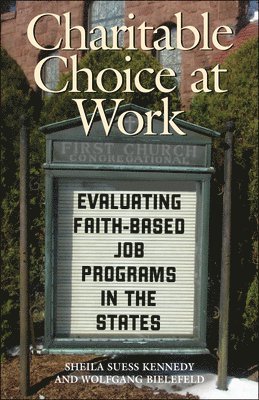
Too often, say its critics, U.S. domestic policy is founded on ideology rather than evidence. Take "Charitable Choice": legislation enacted with the assumption that faith-based organizations can offer the best assistance to the needy at the lowest cost. The Charitable Choice provision of the 1996 Welfare Reform Act - buttressed by President Bush's Faith-Based Initiative of 2000 - encouraged religious organizations, including congregations, to bid on government contracts to provide social services. But in neither year was data available to prove or disprove the effectiveness of such an approach. "Charitable Choice at Work" fills this gap with a comprehensive look at the evidence for and against faith-based initiatives. Sheila Suess Kennedy and Wolfgang Bielefeld review the movement's historical context along with legal analysis of constitutional concerns including privatization, federalism, and separation of church and state. Using both qualitative and, where possible, statistical data, the authors analyze the performance of job placement programs in three states with a representative range of religious, political, and demographic traits - Massachusetts, Indiana, and North Carolina.Throughout, they focus on measurable outcomes as they compare non-faith-based with faith-based organizations, nonprofits with for-profits, and the logistics of contracting before and after Charitable Choice. Among their findings: in states where such information is available, the composition of social service contractor pools has changed very little. Reflecting their varied political cultures, states have funded programs differently. Faith-based organizations have not been eager to seek government contracts, perhaps wary of additional legal restraints and reporting burdens. The authors conclude that faith-based organizations appear no more effective than secular organizations at government-funded social service provision, that there has been no dramatic change in the social welfare landscape since Charitable Choice, and that the constitutional concerns of its detractors may be valid. This empirical study penetrates the fog of the culture wars, moving past controversy over the role of religion in public life to offer pragmatic suggestions for policymakers and organizations who must decide how best to assist the needy.
247 kr
Skickas inom 5-8 vardagar
Political scientists have accumulated a significant amount of data suggesting that over the past decades, Americans have become less trusting of each other, and that as our population's diversity increases, our trust in our neighbors declines. Social scientists warn us that this erosion of interpersonal social trust has very negative implications for our ability to govern ourselves effectively. In this informative discussion of Americans growing distrust, political scientist Sheila Suess Kennedy argues that diversity is not the reason we trust less. The culprit is a loss of faith in our social and governing institutions, and the remedy is to make them trustworthy once more.Rather than attempting to limit diversity through divisive measures such as building a wall between the United States and Mexico or imposing stricter immigration quotas, Kennedy emphasizes the need for the following confidence-building government reforms: electoral reforms designed to eliminate gerrymandering, to ensure that electoral-college votes reflect the popular vote, and to increase voter participation through a nation-wide vote-by-mail system; improved government accountability so that the people are confident that constitutional checks and balances are honored and that government agencies are run by true experts, not political appointees; creation of an affordable nation-wide health care system that removes the current health care anxieties experienced by so many Americans; and, Kennedy's cogent arguments, thorough research, and clear presentation make for a compelling book that will be of interest to politicians and health care alike.
108 kr
Skickas inom 7-10 vardagar
Honest, objective, and informed political debates are all too rare in today's polarized and partisan climate. Public policy is increasingly driven by ideology while political spin, distortions, and even demonizing opponents by disseminating outright lies are routine practice from Washington to the local city council. Super-heated and hyper-partisan rhetoric, increasingly homogeneous political and ideological communities, and the public's spotty knowledge about our political system all undermine informed and considered responses to policy debates. This book identifies common areas of confusion or misunderstanding about our political system-clarifying many distortions of accepted history, constitutional law, economics, and science-to help readers distinguish documented facts from the different conclusions and interpretations that may be drawn from those facts. Sheila Suess Kennedy aims to create a more informed electorate and to better ground debates in fact, from Capitol Hill to the family dinner table. Talking Politics?What You Need to Know before Opening Your Mouth provides a solid starting point from which Americans can build more persuasive arguments for their preferred policies, whatever they may be, and will interest students of political science, civics, and history, from high school to undergraduates, and the general public interested in politics and informed discussion.