Sheng Gao – författare
Visar alla böcker från författaren Sheng Gao. Handla med fri frakt och snabb leverans.
4 produkter
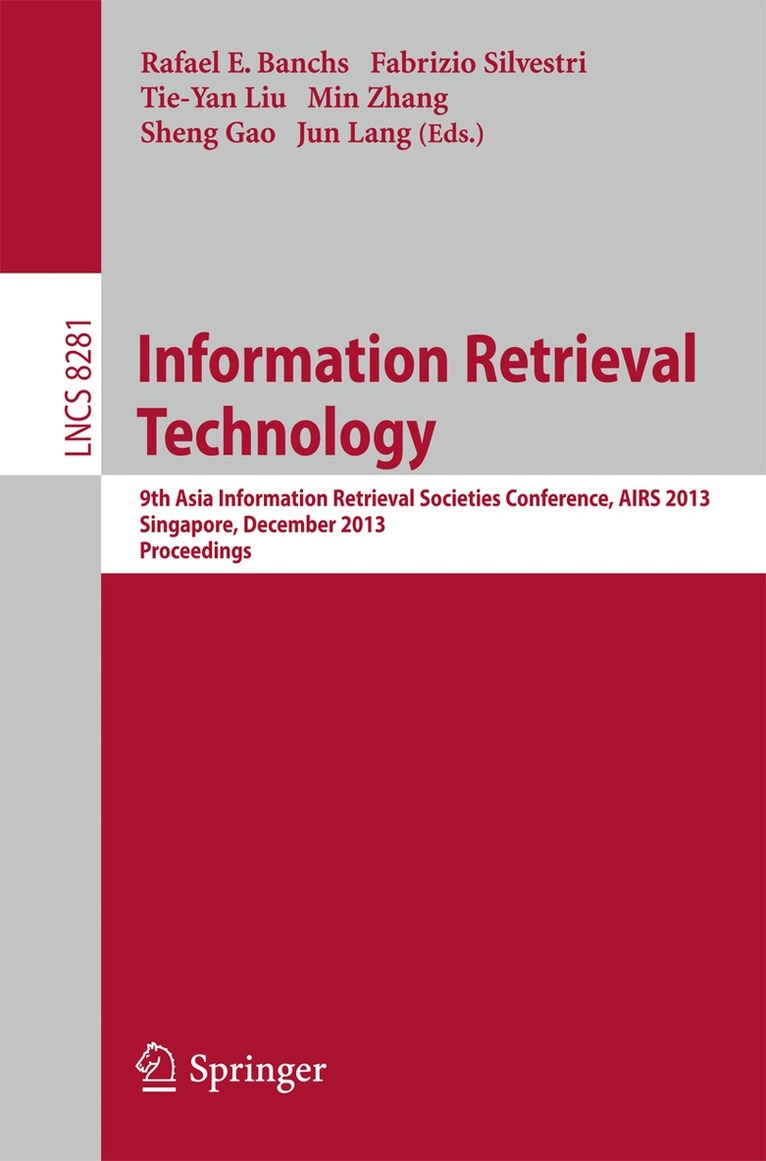
Information Retrieval Technology
9th Asia Information Retrieval Societies Conference, AIRS 2013, Singapore, December 9-11, 2013, Proceedings
Av Rafael Banchs, Fabrizio Silvestri m. fl.
Häftad, 2013
568 kr
Lägg i varukorg
This book constitutes the refereed proceedings of the 9th Information Retrieval Societies Conference, AIRS 2013, held in Singapore, in December 2013. The 27 full papers and 18 poster presentations included in this volume were carefully reviewed and selected from 109 submissions. They are organized …
Information Retrieval Technology
9th Asia Information Retrieval Societies Conference, AIRS 2013, Singapore, December 9-11, 2013, Proceedings
E-bok, 2013
734 kr
Lägg i varukorg
This book constitutes the refereed proceedings of the 9th Information Retrieval Societies Conference, AIRS 2013, held in Singapore, in December 2013. The 27 full papers and 18 poster presentations included in this volume were carefully reviewed and selected from 109 submissions. They are organized …
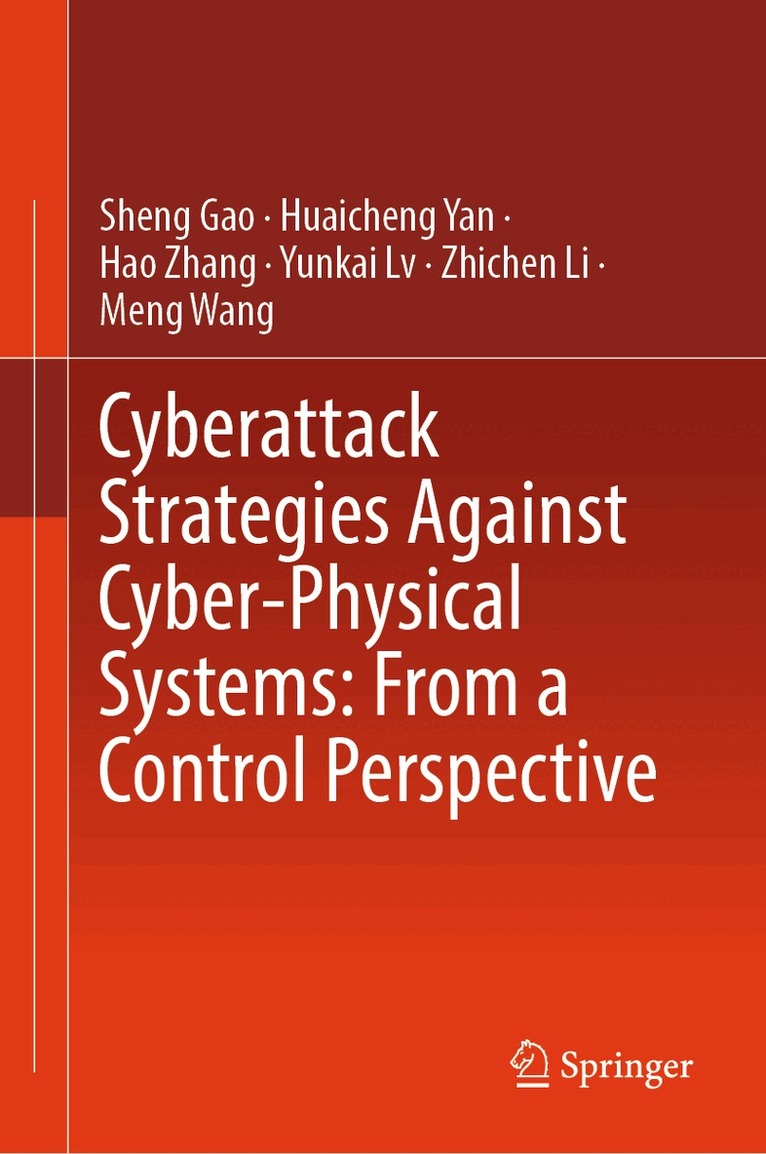
Cyberattack Strategies Against Cyber-Physical Systems: From a Control Perspective
Av Sheng Gao, Huaicheng Yan m. fl.
Inbunden, 2026
1633 kr
Lägg i varukorg
This book mainly focuses on the key technologies and important issues related to cyberattack strategy design against cyber-physical systems from the perspective of the attacker. Chapter 1 introduces the concept of cyber-physical systems, the significance of their cybersecurity, and research …
Cyberattack Strategies Against Cyber-Physical Systems: From a Control Perspective
Av Meng Wang, Zhichen Li m. fl.
E-bok, 2026
2111 kr
Lägg i varukorg
This book mainly focuses on the key technologies and important issues related to cyberattack strategy design against cyber-physical systems from the perspective of the attacker. Chapter 1 introduces the concept of cyber-physical systems, the significance of their cybersecurity, and research …