Sherman Karp - Böcker
Visar alla böcker från författaren Sherman Karp. Handla med fri frakt och snabb leverans.
5 produkter
5 produkter
2 101 kr
Skickas inom 10-15 vardagar
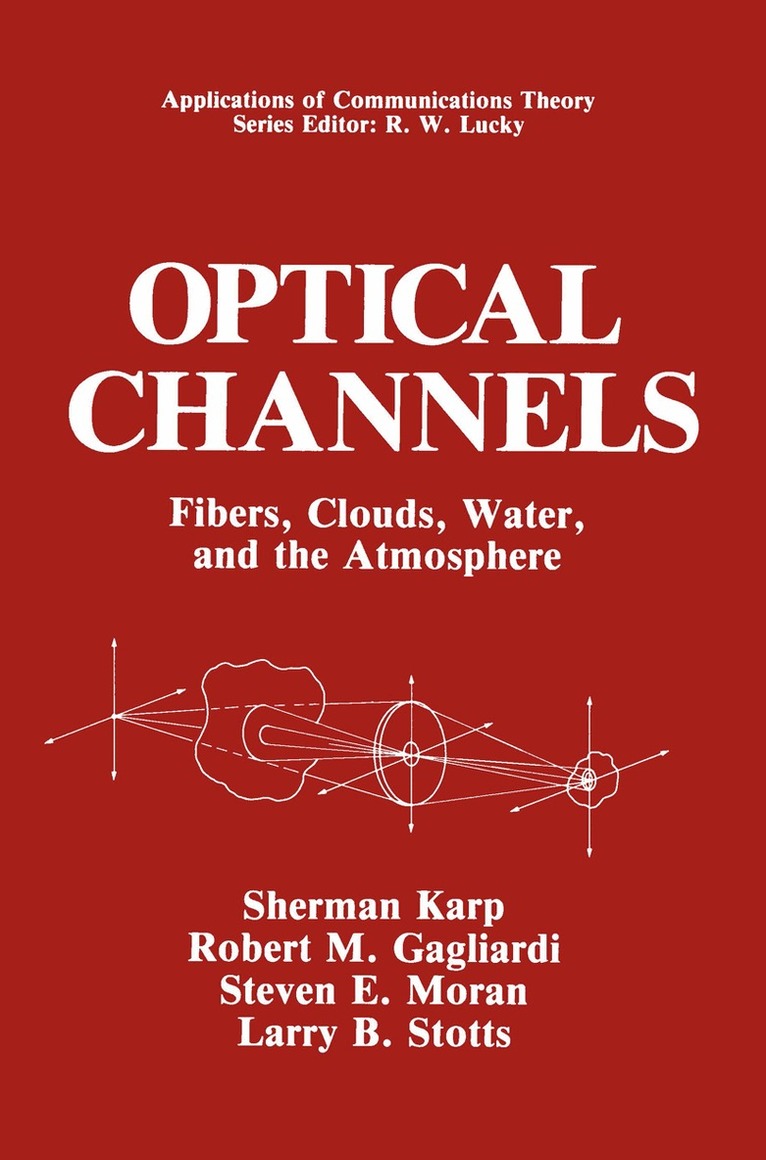
When we were first approached by Dr. Lucky to write this book we were very enthusiastic about the prospect, since we had contemplated a similar project for quite some time. The difficulty lay in how best to digest the vast amount of data on optical propagation, reduce it to a book of manageable size, and simultaneously form the transition from the physics of propagation to the engineering of optical channels. This is the intent of Optical Channels. In accomplishing our goal it was necessary to condense the material on optical propagation and, in so doing, we have left a large amount to be handled via references. We have tried to make these decisions in a consistent manner so that the book will be uniform in its treatment of this topic. We identify four channels for consideration: the free-space channel, which: is characteristic of a tranquil atmosphere or a space-to-space link; the turbulent channel, which is characteristic of the atmospheric channel; the scatter channel in two forms, clouds and water; and the fiber optic channel. For each of these channels we have tried to reduce the applicable propagation theory to a level that can be used for engineering design. This has been done by example, but here again decisions had to be made on which examples to present. We have not tried to present any material on optical components and consequently other references on engineering would be necessary to supplement this book.
Del 21 - Wiley Series in Telecommunications and Signal Processing
Optical Communications
Inbunden, Engelska, 1995
2 197 kr
Skickas inom 7-10 vardagar
This updated edition concentrates on modern analysis and design. Includes new material in the key areas of digital communications, fiber optics, lightwave networks, atmospheric channels and space links--all of which are now critical topics in optical applications. Contains brief sections on optical hardware and device descriptions. Features new homework problems and references.
Fundamentals of Electro-Optic Systems Design
Communications, Lidar, and Imaging
Inbunden, Engelska, 2012
1 416 kr
Skickas inom 7-10 vardagar
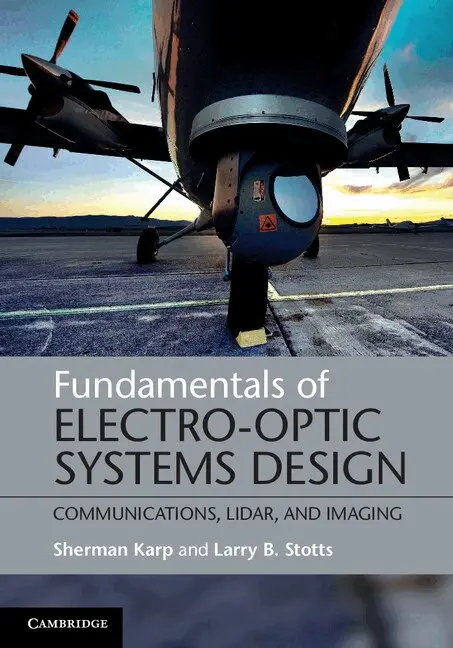
Using fundamentals of communication theory, thermodynamics, information theory and propagation theory, this book explains the universal principles underlying a diverse range of electro-optical systems. From fiber optics and infra-red imaging to free space communications and laser remote sensing, the authors relate key concepts in science and device engineering to practical systems issues. A broad spectrum of coherent and incoherent imaging and communications systems is considered, accompanied by many real-world examples. The authors also present new insights into LIDAR and free space communications and imaging, providing practical guidance on identifying the fundamental limitations of transmission and imaging through deleterious channels. Accompanied by online examples of processed images and videos, this uniquely tailored guide to the fundamental principles underlying modern electro-optical systems is an essential reference for all practising engineers and academic researchers in optical engineering.
634 kr
Skickas inom 5-8 vardagar
2 101 kr
Skickas inom 10-15 vardagar
When we were first approached by Dr. Lucky to write this book we were very enthusiastic about the prospect, since we had contemplated a similar project for quite some time. The difficulty lay in how best to digest the vast amount of data on optical propagation, reduce it to a book of manageable size, and simultaneously form the transition from the physics of propagation to the engineering of optical channels. This is the intent of Optical Channels. In accomplishing our goal it was necessary to condense the material on optical propagation and, in so doing, we have left a large amount to be handled via references. We have tried to make these decisions in a consistent manner so that the book will be uniform in its treatment of this topic. We identify four channels for consideration: the free-space channel, which: is characteristic of a tranquil atmosphere or a space-to-space link; the turbulent channel, which is characteristic of the atmospheric channel; the scatter channel in two forms, clouds and water; and the fiber optic channel. For each of these channels we have tried to reduce the applicable propagation theory to a level that can be used for engineering design. This has been done by example, but here again decisions had to be made on which examples to present. We have not tried to present any material on optical components and consequently other references on engineering would be necessary to supplement this book.