215 kr
Sherry Turkle – författare
- Häftad, Engelska, 2016
- Inbunden, Svenska, 2017
264 kr
Skickas
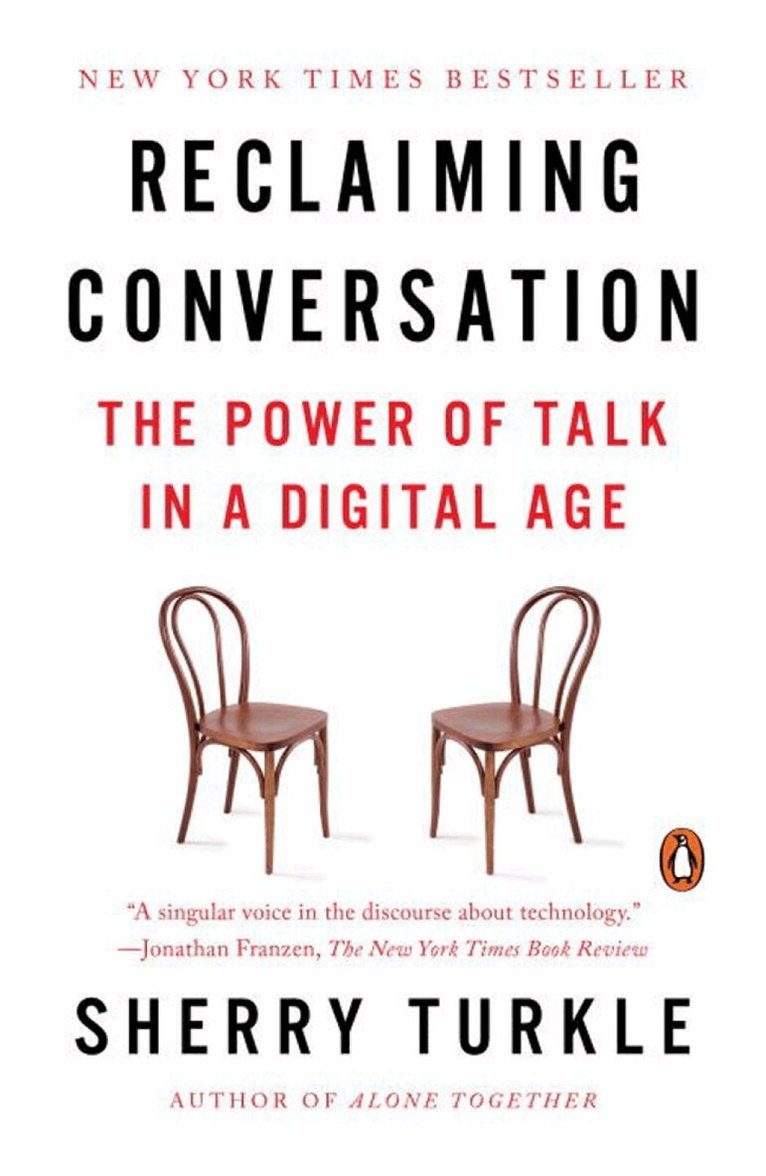
Att föra ett samtal mellan fyra ögon är det mest mänskliga – och mest förmänskligande – av allt vi gör. Genom att skänka varandra vår fulla uppmärksamhet lär vi oss att lyssna. Det är då vi utvecklar vår förmåga till empati. Det är då vi upplever glädjen över att bli hörda, att bli förstådda. Och att samtala utvecklar vår förmåga till självreflektion, alltså det där samtalet vi för med oss själva, som är hörnstenen i vår tidiga utveckling och följer oss genom hela livet. Sherry Turkle, psykolog och sociolog, har under trettio år studerat vår relation till digital teknik. Hon var länge entusiastisk för de möjligheter den skapade men har under senare år undersökt dess baksidor. I "Tillbaka till samtalet" driver Turkle tesen att vi på grund av vårt förhållande till våra smarta telefoner och de möjligheter till kommunikation de medför har blivit allt sämre på att föra meningsfulla samtal ansikte mot ansikte – den sortens samtal som är förutsättningslöst och spontant, där vi leker med idéer och tillåter oss själva att vara fullständigt närvarande och sårbara. Det är just sådana samtal som främjar empati och intimitet och stärker vårt sociala beteende. I dessa samtal blomstrar det kreativa samarbete som är så nödvändigt inom både utbildning och affärer. Turkle lutar sig år fem år av forskning och intervjuer i familjer, skolor och på arbetsplatser när hon hävdar att vi måste skaffa oss en bättre förståelse för vad mobiltekniken kan, och inte kan, göra för oss. Den för underverk med sig, men det har blivit dags att fundera över om den inte ibland hamnar i vägen för andra saker som är viktiga för oss – och när vi väl har insett att det är så kan vi göra något åt saken: Vi kan både omforma tekniken och förändra vilken roll den spelar i våra liv. This is a persuasive and intimate book, one that explores the minutiae of human relationships. Turkle uses our experiences to shame us, showing how, phones in hand, we turn away from our children, friends and co-workers, even from ourselves. / Washington Post Reclaiming Conversation is best appreciated as a sophisticated self-help book. It makes a compelling case that children develop better, students learn better, and employees perform better when their monitors set good examples and carve our spaces for face-to-face interactions. /Jonathan Franzen, The New York Times Book Review - Häftad, Engelska, 2017
247 kr
Skickas inom 5-8 vardagar
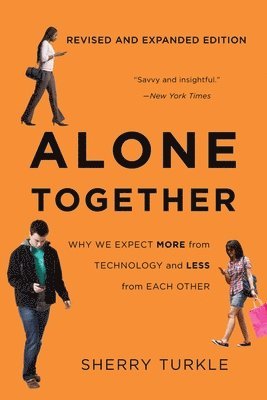
Technology has become the architect of our intimacies. Online, we fall prey to the illusion of companionship, gathering thousands of Twitter and Facebook friends, and confusing tweets and wall posts with authentic communication. But this relentless connection leads to a new solitude. We turn to new technology to fill the void, but as MIT technology and society specialist Sherry Turkle argues, as technology ramps up, our emotional lives ramp down. Even the presence of sociable robots in our lives that pretend to demonstrate empathy makes us feel more isolated, as Turkle explains in a new introduction updating the book to the present day. Alone Together is the result of Turkle's nearly fifteen-year exploration of our lives on the digital terrain. Based on interviews with hundreds of children and adults, it describes new, unsettling relationships between friends, lovers, parents, and children, and new instabilities in how we understand privacy and community, intimacy and solitude. - E-bokEngelska, 2005
424 kr
Läs direkt efter köp
A new edition of the classic primer in the psychology of computation, with a new introduction, a new epilogue, and extensive notes added to the original text.
In The Second Self, Sherry Turkle looks at the computer not as a "tool," but as part of our social and psychological lives; she looks beyond how we use computer games and spreadsheets to explore how the computer affects our awareness of ourselves, of one another, and of our relationship with the world. "Technology," she writes, "catalyzes changes not only in what we do but in how we think." First published in 1984, The Second Self is still essential reading as a primer in the psychology of computation. This twentieth anniversary edition allows us to reconsider two decades of computer culture—to (re)experience what was and is most novel in our new media culture and to view our own contemporary relationship with technology with fresh eyes. Turkle frames this classic work with a new introduction, a new epilogue, and extensive notes added to the original text.
Turkle talks to children, college students, engineers, AI scientists, hackers, and personal computer owners—people confronting machines that seem to think and at the same time suggest a new way for us to think—about human thought, emotion, memory, and understanding. Her interviews reveal that we experience computers as being on the border between inanimate and animate, as both an extension of the self and part of the external world. Their special place betwixt and between traditional categories is part of what makes them compelling and evocative. (In the introduction to this edition, Turkle quotes a PDA user as saying, "When my Palm crashed, it was like a death. I thought I had lost my mind.") Why we think of the workings of a machine in psychological terms—how this happens, and what it means for all of us—is the ever more timely subject of The Second Self.
- E-bokEngelska, 2009
496 kr
Läs direkt efter köp
How the simulation and visualization technologies so pervasive in science, engineering, and design have changed our way of seeing the world.
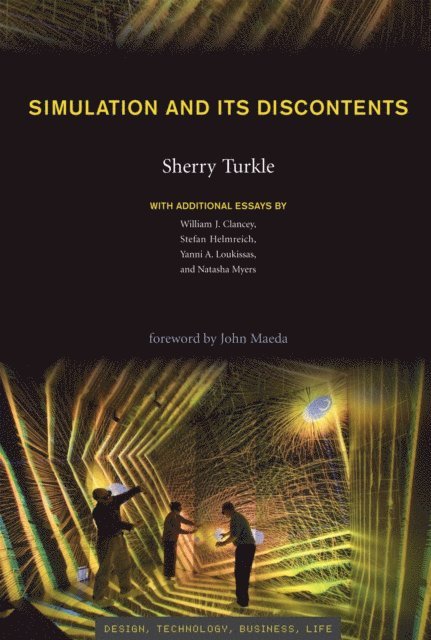
Over the past twenty years, the technologies of simulation and visualization have changed our ways of looking at the world. In Simulation and Its Discontents, Sherry Turkle examines the now dominant medium of our working lives and finds that simulation has become its own sensibility. We hear it in Turkle''s description of architecture students who no longer design with a pencil, of science and engineering students who admit that computer models seem more “real” than experiments in physical laboratories.
Echoing architect Louis Kahn''s famous question, “What does a brick want?”, Turkle asks, “What does simulation want?” Simulations want, even demand, immersion, and the benefits are clear. Architects create buildings unimaginable before virtual design; scientists determine the structure of molecules by manipulating them in virtual space; physicians practice anatomy on digitized humans. But immersed in simulation, we are vulnerable. There are losses as well as gains. Older scientists describe a younger generation as “drunk with code.” Young scientists, engineers, and designers, full citizens of the virtual, scramble to capture their mentors'' tacit knowledge of buildings and bodies. From both sides of a generational divide, there is anxiety that in simulation, something important is slipping away. Turkle''s examination of simulation over the past twenty years is followed by four in-depth investigations of contemporary simulation culture: space exploration, oceanography, architecture, and biology.
- E-bokEngelska, 2011
476 kr
Läs direkt efter köp
Memoir, clinical writings, and ethnography inform new perspectives on the experience of technology; personal stories illuminate how technology enters the inner life.
For more than two decades, in such landmark studies as The Second Self and Life on the Screen, Sherry Turkle has challenged our collective imagination with her insights about how technology enters our private worlds. In The Inner History of Devices, she describes her process, an approach that reveals how what we make is woven into our ways of seeing ourselves. She brings together three traditions of listening—that of the memoirist, the clinician, and the ethnographer. Each informs the others to compose an inner history of devices. We read about objects ranging from cell phones and video poker to prosthetic eyes, from Web sites and television to dialysis machines.
In an introductory essay, Turkle makes the case for an “intimate ethnography” that challenges conventional wisdom. One personal computer owner tells Turkle: “This computer means everything to me. It''s where I put my hope.” Turkle explains that she began that conversation thinking she would learn how people put computers to work. By its end, her question has changed: “What was there about personal computers that offered such deep connection? What did a computer have that offered hope?” The Inner History of Devices teaches us to listen for the answer.
In the memoirs, ethnographies, and clinical cases collected in this volume, we read about an American student who comes to terms with her conflicting identities as she contemplates a cell phone she used in Japan (“Tokyo sat trapped inside it”); a troubled patient who uses email both to criticize her therapist and to be reassured by her; a compulsive gambler who does not want to win steadily at video poker because a pattern of losing and winning keeps her more connected to the body of the machine. In these writings, we hear untold stories. We learn that received wisdom never goes far enough.
- E-bokEngelska, 2011
357 kr
Läs direkt efter köp
Autobiographical essays, framed by two interpretive essays by the editor, describe the power of an object to evoke emotion and provoke thought: reflections on a cello, a laptop computer, a 1964 Ford Falcon, an apple, a mummy in a museum, and other "things-to-think-with."
For Sherry Turkle, "We think with the objects we love; we love the objects we think with." In Evocative Objects, Turkle collects writings by scientists, humanists, artists, and designers that trace the power of everyday things. These essays reveal objects as emotional and intellectual companions that anchor memory, sustain relationships, and provoke new ideas.These days, scholars show new interest in the importance of the concrete. This volume''s special contribution is its focus on everyday riches: the simplest of objects—an apple, a datebook, a laptop computer—are shown to bring philosophy down to earth. The poet contends, "No ideas but in things." The notion of evocative objects goes further: objects carry both ideas and passions. In our relations to things, thought and feeling are inseparable.
Whether it''s a student''s beloved 1964 Ford Falcon (left behind for a station wagon and motherhood), or a cello that inspires a meditation on fatherhood, the intimate objects in this collection are used to reflect on larger themes—the role of objects in design and play, discipline and desire, history and exchange, mourning and memory, transition and passage, meditation and new vision.In the interest of enriching these connections, Turkle pairs each autobiographical essay with a text from philosophy, history, literature, or theory, creating juxtapositions at once playful and profound. So we have Howard Gardner''s keyboards and Lev Vygotsky''s hobbyhorses; William Mitchell''s Melbourne train and Roland Barthes'' pleasures of text; Joseph Cevetello''s glucometer and Donna Haraway''s cyborgs. Each essay is framed by images that are themselves evocative. Essays by Turkle begin and end the collection, inviting us to look more closely at the everyday objects of our lives, the familiar objects that drive our routines, hold our affections, and open out our world in unexpected ways.
- E-bokEngelska, 2011
350 kr
Läs direkt efter köp
Passion for objects and love for science: scientists and students reflect on how objects fired their scientific imaginations.
"This is a book about science, technology, and love,” writes Sherry Turkle. In it, we learn how a love for science can start with a love for an object—a microscope, a modem, a mud pie, a pair of dice, a fishing rod. Objects fire imagination and set young people on a path to a career in science. In this collection, distinguished scientists, engineers, and designers as well as twenty-five years of MIT students describe how objects encountered in childhood became part of the fabric of their scientific selves. In two major essays that frame the collection, Turkle tells a story of inspiration and connection through objects that is often neglected in standard science education and in our preoccupation with the virtual. The senior scientists'' essays trace the arc of a life: the gears of a toy car introduce the chain of cause and effect to artificial intelligence pioneer Seymour Papert; microscopes disclose the mystery of how things work to MIT President and neuroanatomist Susan Hockfield; architect Moshe Safdie describes how his boyhood fascination with steps, terraces, and the wax hexagons of beehives lead him to a life immersed in the complexities of design. The student essays tell stories that echo these narratives: plastic eggs in an Easter basket reveal the power of centripetal force; experiments with baking illuminate the geology of planets; LEGO bricks model worlds, carefully engineered and colonized. All of these voices—students and mentors—testify to the power of objects to awaken and inform young scientific minds. This is a truth that is simple, intuitive, and easily overlooked.
- E-bokEngelska, 2024
308 kr
Läs direkt efter köp
- Häftad, Engelska, 2011
574 kr
Skickas inom 5-8 vardagar
- Häftad, Engelska, 2011
434 kr
Skickas inom 5-8 vardagar
- Häftad, Engelska, 2022
597 kr
Skickas inom 5-8 vardagar
- Häftad, Engelska, 2005
541 kr
Skickas inom 5-8 vardagar
- Inbunden, Engelska, 2026
353 kr
Kommande
- Häftad, Engelska, 2026
400 kr
Kommande
- Inbunden, Engelska, 2021
276 kr
Skickas inom 5-8 vardagar
- E-bokEngelska, 2021
90 kr
Läs direkt efter köp
- Häftad, Engelska, 2022
190 kr
Skickas inom 5-8 vardagar
- Häftad, Engelska, 1997
279 kr
Skickas inom 3-6 vardagar
- E-bokEngelska, 2015
134 kr
Läs direkt efter köp
Renowned media scholar Sherry Turkle investigates how a flight from conversation undermines our relationships, creativity, and productivity—and why reclaiming face-to-face conversation can help us regain lost ground.
We live in a technological universe in which we are always communicating. And yet we have sacrificed conversation for mere connection. Preeminent author and researcher Sherry Turkle has been studying digital culture for over thirty years. Long an enthusiast for its possibilities, here she investigates a troubling consequence: at work, at home, in politics, and in love, we find ways around conversation, tempted by the possibilities of a text or an email in which we don’t have to look, listen, or reveal ourselves. We develop a taste for what mere connection offers. The dinner table falls silent as children compete with phones for their parents’ attention. Friends learn strategies to keep conversations going when only a few people are looking up from their phones. At work, we retreat to our screens although it is conversation at the water cooler that increases not only productivity but commitment to work. Online, we only want to share opinions that our followers will agree with – a politics that shies away from the real conflicts and solutions of the public square. The case for conversation begins with the necessary conversations of solitude and self-reflection. They are endangered: these days, always connected, we see loneliness as a problem that technology should solve. Afraid of being alone, we rely on other people to give us a sense of ourselves, and our capacity for empathy and relationship suffers. We see the costs of the flight from conversation everywhere: conversation is the cornerstone for democracy and in business it is good for the bottom line. In the private sphere, it builds empathy, friendship, love, learning, and productivity. But there is good news: we are resilient. Conversation cures. Based on five years of research and interviews in homes, schools, and the workplace, Turkle argues that we have come to a better understanding of where our technology can and cannot take us and that the time is right to reclaim conversation. The most human—and humanizing—thing that we do. The virtues of person-to-person conversation are timeless, and our most basic technology, talk, responds to our modern challenges. We have everything we need to start, we have each other.
- E-bokEngelska, 2011
209 kr
Läs direkt efter köp
Life on the Screen is a book not about computers, but about people and how computers are causing us to reevaluate our identities in the age of the Internet. We are using life on the screen to engage in new ways of thinking about evolution, relationships, politics, sex, and the self. Life on the Screen traces a set of boundary negotiations, telling the story of the changing impact of the computer on our psychological lives and our evolving ideas about minds, bodies, and machines. What is emerging, Turkle says, is a new sense of identity—as decentered and multiple. She describes trends in computer design, in artificial intelligence, and in people’s experiences of virtual environments that confirm a dramatic shift in our notions of self, other, machine, and world. The computer emerges as an object that brings postmodernism down to earth. - Häftad, Franska, 2019
565 kr
Skickas inom 3-6 vardagar
102 kr
Läs direkt efter köp
¿Hemos sacrificado la conversación por la conexión? Estamos sumidos en la cultura digital y en un estado de constante conexión. Hemos desarrollado afición por las interacciones sociales virtuales dentro de los ámbitos del trabajo, la familia, la amistad, la educación y las relaciones sentimentales, sin advertir el peligro que ello comporta. Casi sin darnos cuenta, hemos abandonado la conversación cara a cara.Sherry Turkle, la principal especialista en la interacción entre las nuevas tecnologías y el ser humano, analiza en este libro las desastrosas consecuencias de la pérdida de la conversación que hemos experimentado en los últimos años, que hace peligrar lo que nos define como seres humanos.En defensa de la conversación es una cautivadora apología del valor fundamental de las conversaciones cara a cara en todos los ámbitos de nuestra vida y una llamada a recuperar el terreno perdido. "Turkle no está en contra de la tecnología, sino a favor de la conversación. Su antídoto es muy simple: hay que hablar más los unos con los otros."The Guardian"Son los inquietantes aspectos sobre la sociedad y la tecnología móvil a los que Sherry Turkle atiende en un libro inteligente y observador."The New York Book Review"El argumento de Turkle proviene de su extensa investigación y de la agudeza de su conocimiento psicológico."Jonathan Frazen, The New York Times"Un libro incisivo y brillante que explica el poder de la conversación."Howard Gardner"Un libro persuasivo e íntimo que explora las sutilezas de las relaciones humanas."The Washington Post"El libro de Turkle es ingenioso, está bien escrito y da mucho que pensar Hablar no cuesta nada, pero la conversación no tiene precio."Boston Globe"Recuerda qué está en juego cuando la máquina se impone a las conversaciones cara a cara, pero defiende que no es demasiado tarde para recuperarlas."Seattle Times- Häftad, Engelska, 1992
481 kr
Tillfälligt slut
'Dynasty 1991', provides a portrayal of the last years of Lacan's life and the events that unfolded in the years following his death in 1981. - Häftad, Spanska, 2021
222 kr
Tillfälligt slut