Shi-Ju Ran – författare
Visar alla böcker från författaren . Handla med fri frakt och snabb leverans.
2 produkter
2 produkter
Inbunden, Engelska, 2027
935 kr
Kommande
Tensor network methods are powerful theoretical tools with applications across a range of fields, including quantum physics and artificial intelligence. This accessible text provides a logical, self-contained route into the mathematical framework of tensor networks, presented with unified notation. The inclusion of the necessary prerequisites in linear algebra and quantum mechanics make it accessible for learners from a range of fields. Beginning with matrices, tensors, contractions, and tensor decompositions, it builds the quantum and lattice-model foundations needed to understand modern tensor network methods. Readers are then guided through concepts such as matrix product states, canonical forms, entanglement, time-evolution algorithms, density matrix renormalization group methods and renormalization techniques. The final chapters connect these ideas to machine learning, including probabilistic modelling, generative learning, and quantum artificial intelligence. Designed for graduate-level study, the book's confident explanation, supported by extensive diagrams and exercises, will equip students and researchers with the practical skills for research.
Häftad, Engelska, 2020
543 kr
Skickas inom 10-15 vardagar
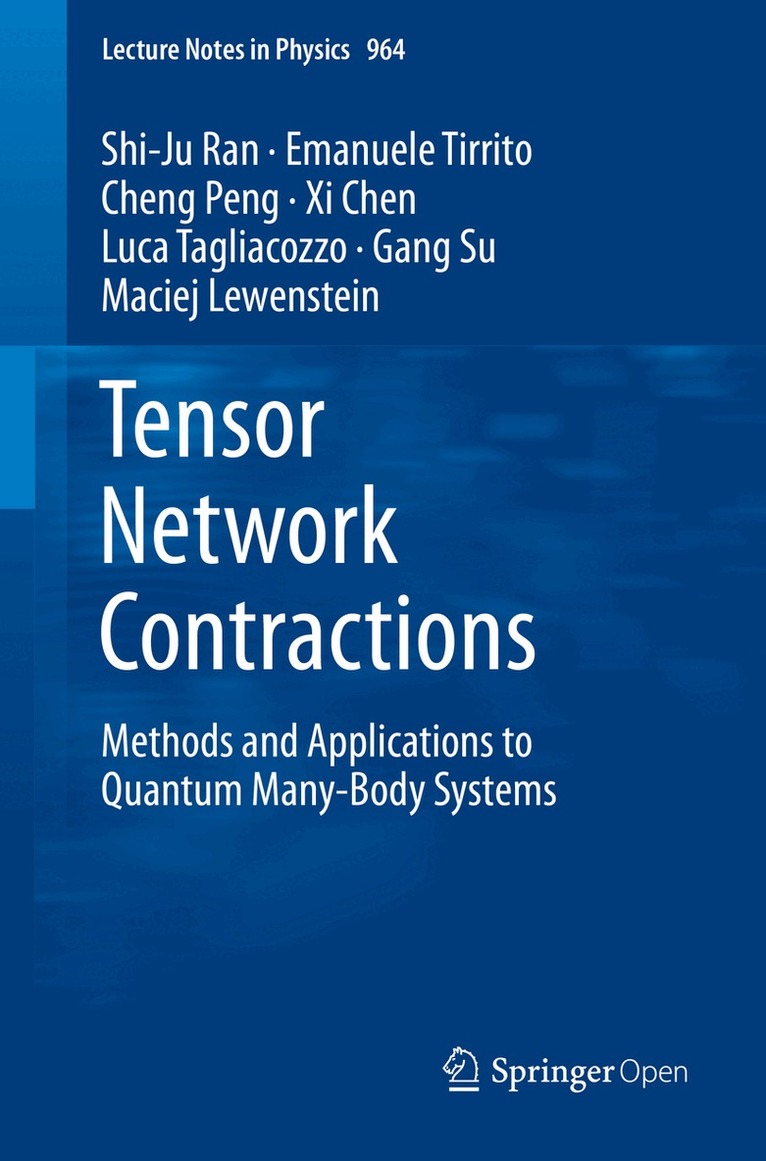
Tensor network is a fundamental mathematical tool with a huge range of applications in physics, such as condensed matter physics, statistic physics, high energy physics, and quantum information sciences. This open access book aims to explain the tensor network contraction approaches in a systematic way, from the basic definitions to the important applications. This book is also useful to those who apply tensor networks in areas beyond physics, such as machine learning and the big-data analysis. Tensor network originates from the numerical renormalization group approach proposed by K. G. Wilson in 1975. Through a rapid development in the last two decades, tensor network has become a powerful numerical tool that can efficiently simulate a wide range of scientific problems, with particular success in quantum many-body physics. Varieties of tensor network algorithms have been proposed for different problems. However, the connections among different algorithms are notwell discussed or reviewed. To fill this gap, this book explains the fundamental concepts and basic ideas that connect and/or unify different strategies of the tensor network contraction algorithms. In addition, some of the recent progresses in dealing with tensor decomposition techniques and quantum simulations are also represented in this book to help the readers to better understand tensor network. This open access book is intended for graduated students, but can also be used as a professional book for researchers in the related fields. To understand most of the contents in the book, only basic knowledge of quantum mechanics and linear algebra is required. In order to fully understand some advanced parts, the reader will need to be familiar with notion of condensed matter physics and quantum information, that however are not necessary to understand the main parts of the book. This book is a good source for non-specialists on quantum physics to understand tensor network algorithms and the related mathematics.