Shinji Teraji – författare
Visar alla böcker från författaren Shinji Teraji. Handla med fri frakt och snabb leverans.
8 produkter
The Cognitive Basis of Institutions
A Synthesis of Behavioral and Institutional Economics
Häftad, 2018
1355 kr
Lägg i varukorg
The Cognitive Basis of Institutions: A Synthesis of Behavioral and Institutional Economics synthesizes modern research in behavioral economics with traditional institutional economics. This work emphasizes that institution and agent are inextricably linked, and that both cognitive and institutional …
Cognitive Basis of Institutions
A Synthesis of Behavioral and Institutional Economics
E-bok, 2018
1945 kr
Lägg i varukorg
The Cognitive Basis of Institutions: A Synthesis of Behavioral and Institutional Economics synthesizes modern research in behavioral economics with traditional institutional economics. This work emphasizes that institution and agent are inextricably linked, and that both cognitive and institutional …
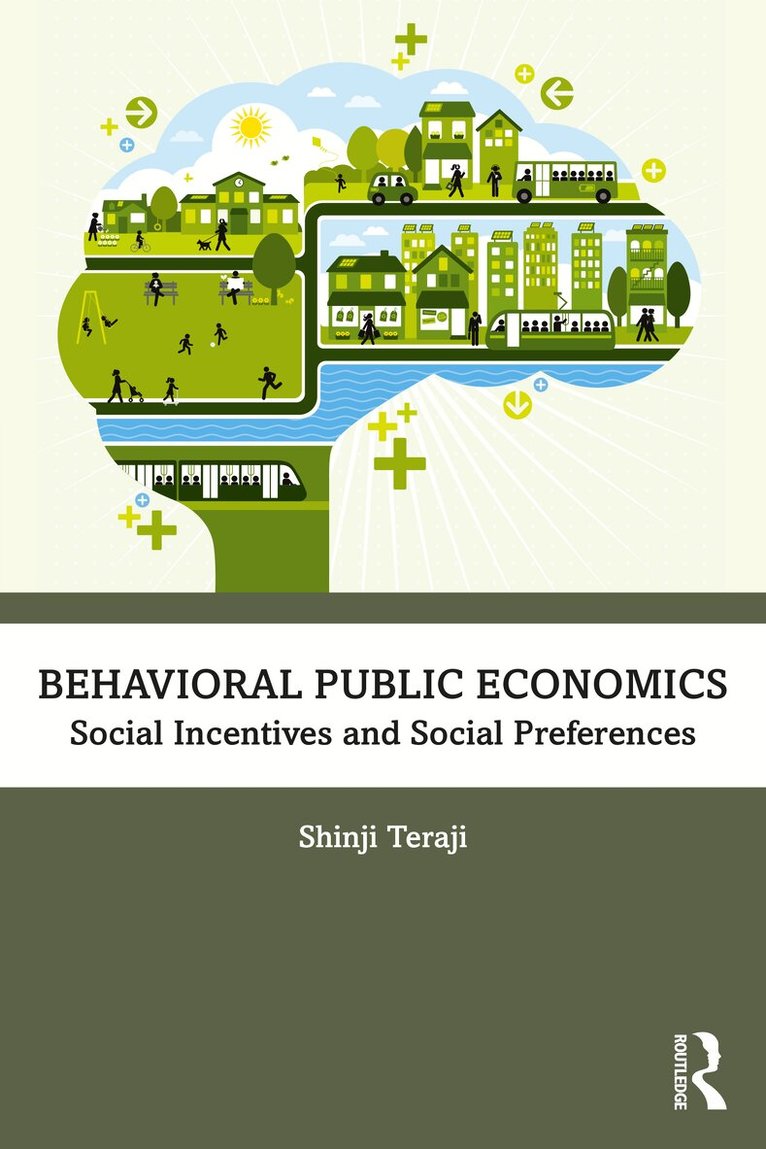
Behavioral Public Economics
Social Incentives and Social Preferences
Inbunden, 2021
2439 kr
Lägg i varukorg
Behavioral Public Economics shows how standard public economics can be improved using insights from behavioral economics. Public economics typically lists four market failures that may justify government intervention in markets—imperfect competition (or natural monopoly), externalities, public …
Behavioral Public Economics
Social Incentives and Social Preferences
Häftad, 2021
615 kr
Lägg i varukorg
Behavioral Public Economics shows how standard public economics can be improved using insights from behavioral economics. Public economics typically lists four market failures that may justify government intervention in markets—imperfect competition (or natural monopoly), externalities, public …
Behavioral Public Economics
Social Incentives and Social Preferences
E-bok, 2021
745 kr
Lägg i varukorg
Behavioral Public Economics shows how standard public economics can be improved using insights from behavioral economics. Public economics typically lists four market failures that may justify government intervention in markets—imperfect competition (or natural monopoly), externalities, public …
Behavioral Public Economics
Social Incentives and Social Preferences
E-bok, 2021
745 kr
Lägg i varukorg
Behavioral Public Economics shows how standard public economics can be improved using insights from behavioral economics. Public economics typically lists four market failures that may justify government intervention in markets—imperfect competition (or natural monopoly), externalities, public …
Evolving Norms
Cognitive Perspectives in Economics
Inbunden, 2016
1126 kr
Lägg i varukorg
This book presents institutional evolution and individual choice as codependent results of behavioral patterns. Drawing on F.A. Hayek's concepts of cognition and cultural evolution, Teraji demonstrates how the relationship between the sensory and social orders can allow economists to track social …
Evolving Norms
Cognitive Perspectives in Economics
E-bok, 2016
1562 kr
Lägg i varukorg
This book presents institutional evolution and individual choice as codependent results of behavioral patterns. Drawing on F.A. Hayek''s concepts of cognition and cultural evolution, Teraji demonstrates how the relationship between the sensory and social orders can allow economists to track social …