Shmuel Bolozky – författare
Visar alla böcker från författaren Shmuel Bolozky. Handla med fri frakt och snabb leverans.
4 produkter
4 produkter
Häftad, Engelska, 2005
758 kr
Skickas inom 7-10 vardagar
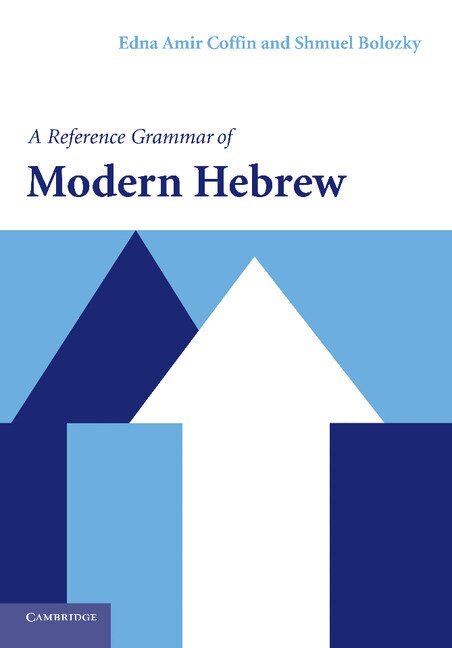
A Reference Grammar of Modern Hebrew provides a clearly-structured and accessible guide to all aspects of contemporary Hebrew grammar. Systematically organised, it presents the basic structures of the language, looking at grammatical categories, phrases, expressions, and the construction of clauses and sentences. Drawing on their extensive experience of teaching Hebrew to English-speaking students, the authors also provide a wide range of examples to illustrate each point, and introduce in a clear and accessible way the writing and pronunciation of the language, its punctuation rules, and its use in context. Wherever possible, equivalent Hebrew terminology is given to facilitate students' use of Hebrew language textbooks. Specialised linguistic terminology is kept to a minimum, and verb and noun tables are provided as well as a comprehensive index of terms, making this both a useful teaching resource and an easy-to-use reference tool for those wishing to look up specific details of the language.
Inbunden, Engelska, 2005
1 311 kr
Skickas inom 7-10 vardagar
A Reference Grammar of Modern Hebrew provides a clearly-structured and accessible guide to all aspects of contemporary Hebrew grammar. Systematically organised, it presents the basic structures of the language, looking at grammatical categories, phrases, expressions, and the construction of clauses and sentences. Drawing on their extensive experience of teaching Hebrew to English-speaking students, the authors also provide a wide range of examples to illustrate each point, and introduce in a clear and accessible way the writing and pronunciation of the language, its punctuation rules, and its use in context. Wherever possible, equivalent Hebrew terminology is given to facilitate students' use of Hebrew language textbooks. Specialised linguistic terminology is kept to a minimum, and verb and noun tables are provided as well as a comprehensive index of terms, making this both a useful teaching resource and an easy-to-use reference tool for those wishing to look up specific details of the language.
E-bok
PDF, Engelska, 2005897 kr
Läs direkt efter köp
A Reference Grammar of Modern Hebrew provides a clearly-structured and accessible guide to all aspects of contemporary Hebrew grammar. Systematically organised, it presents the basic structures of the language, looking at grammatical categories, phrases, expressions, and the construction of clauses and sentences. Drawing on their extensive experience of teaching Hebrew to English-speaking students, the authors also provide a wide range of examples to illustrate each point, and introduce in a clear and accessible way the writing and pronunciation of the language, its punctuation rules, and its use in context. Wherever possible, equivalent Hebrew terminology is given to facilitate students'' use of Hebrew language textbooks. Specialised linguistic terminology is kept to a minimum, and verb and noun tables are provided as well as a comprehensive index of terms, making this both a useful teaching resource and an easy-to-use reference tool for those wishing to look up specific details of the language.
E-bok
PDF, Engelska, 20172 573 kr
Läs direkt efter köp
Morphological productivity is the likelihood of a morphological pattern being used or comprehended in new word formation. Three methods of measuring productivity of word formation are proposed productivity tests (open-ended and judgment tasks), dictionary comparison (newer with older dictionaries, supplements with earlier versions), and the ratio of hapax legomena to tokens in corpora. Processes which score highly by all three criteria can safely be regarded as productive. The model is examined in light of data from Israeli Hebrew, which as a Semitic language offers a rich array of discontinuous and linear derivation patterns. The Hebrew data also support the claims that in essence, lexical formation is semantically based; that it is constrained by a requirement for distinctiveness; and that it may vary significantly with the type of derivation base.