
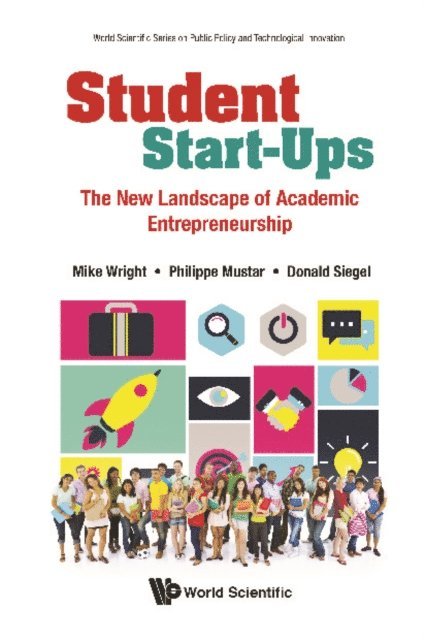
There has been a substantial rise in the number of entrepreneurship courses and programs at colleges and universities. Despite the rapid rise of undergraduate entrepreneurship, there have been few academic studies of this phenomenon. Little is known about the antecedents and consequences of these activities. Student Start-Ups: The New Landscape of Academic Entrepreneurship is the first book of its kind on student entrepreneurship. It sets out to provide a structured approach to understanding the development of the phenomenon by synthesizing and offering the best available quantitative data and new case studies from a range of countries and universities. In doing so, they present the evolution of different models of student entrepreneurship with insights and implications for practice, policy and research.

This multi-volume set covers a wide range of topics on innovation, which are all of great interest to academics, policymakers, university administrators, state and regional economic development officials, and students. Two unique features of the volume are the large body of global evidence on innovation presented and its consideration of the following timely and important topics in innovation: cybersecurity, open innovation, the globalization of R&D, and university technology transfer. Innovation is a topic of great importance in many fields in business administration, such as management, strategy, operations management, finance, marketing, and accounting, as well as in numerous social science disciplines, including economics, sociology, political science, and psychology. This volume fully reflects such interdisciplinary approaches.Volume 1 provides extensive global evidence on university technology transfer and innovation partnerships. Volume 2 is focused on the managerial and public policy implications of the globalization of R&D. Volume 3 presents state-of-the-art theoretical and empirical evidence on open innovation. Volume 4 is a comprehensive analysis of cybersecurity. This set is essential reading for those who wish to have a comprehensive understanding of the antecedents and consequences of innovation.
There has been a substantial rise in the number of entrepreneurship courses and programs at colleges and universities. Despite the rapid rise of undergraduate entrepreneurship, there have been few academic studies of this phenomenon. Little is known about the antecedents and consequences of these activities. Student Start-Ups: The New Landscape of Academic Entrepreneurship is the first book of its kind on student entrepreneurship. It sets out to provide a structured approach to understanding the development of the phenomenon by synthesizing and offering the best available quantitative data and new case studies from a range of countries and universities. In doing so, they present the evolution of different models of student entrepreneurship with insights and implications for practice, policy and research.
This multi-volume set covers a wide range of topics on innovation, which are all of great interest to academics, policymakers, university administrators, state and regional economic development officials, and students. Two unique features of the volume are the large body of global evidence on innovation presented and its consideration of the following timely and important topics in innovation: cybersecurity, open innovation, the globalization of R&D, and university technology transfer. Innovation is a topic of great importance in many fields in business administration, such as management, strategy, operations management, finance, marketing, and accounting, as well as in numerous social science disciplines, including economics, sociology, political science, and psychology. This volume fully reflects such interdisciplinary approaches.Volume 1 provides extensive global evidence on university technology transfer and innovation partnerships. Volume 2 is focused on the managerial and public policy implications of the globalization of R&D. Volume 3 presents state-of-the-art theoretical and empirical evidence on open innovation. Volume 4 is a comprehensive analysis of cybersecurity. This set is essential reading for those who wish to have a comprehensive understanding of the antecedents and consequences of innovation.