Silvio Ghilardi – författare
Visar alla böcker från författaren Silvio Ghilardi. Handla med fri frakt och snabb leverans.
6 produkter
6 produkter
Inbunden, Engelska, 2002
1 084 kr
Skickas inom 10-15 vardagar
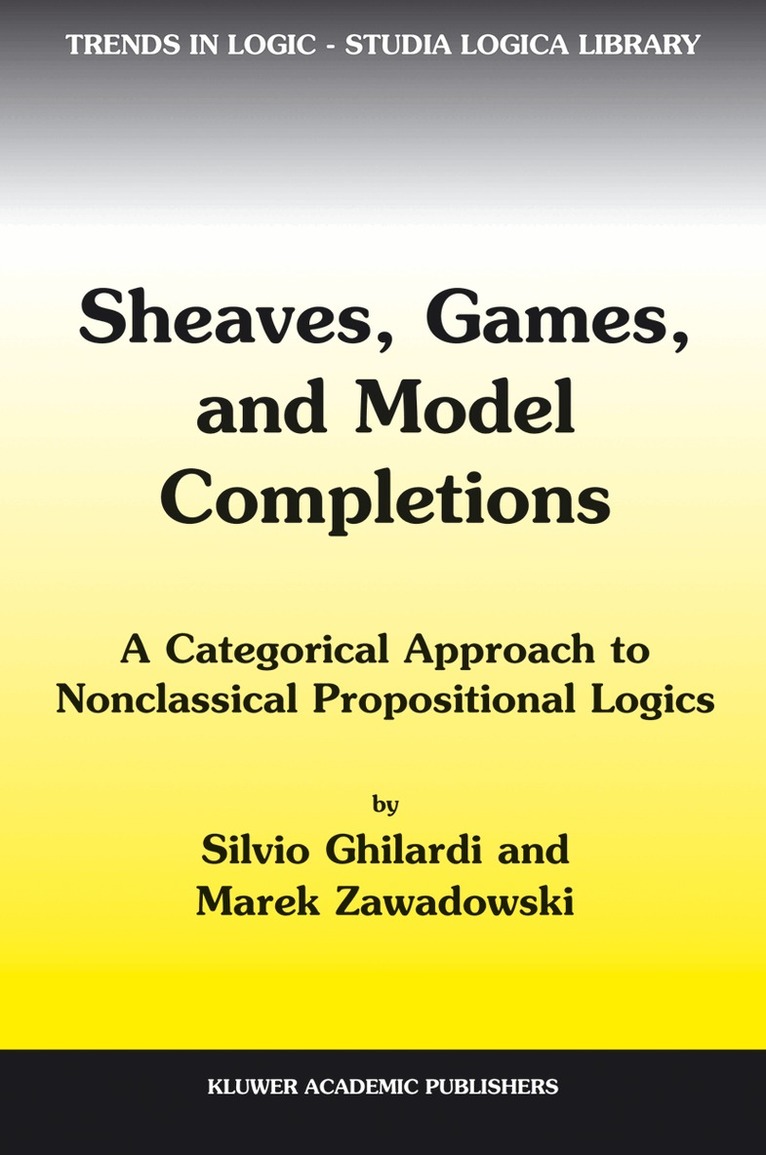
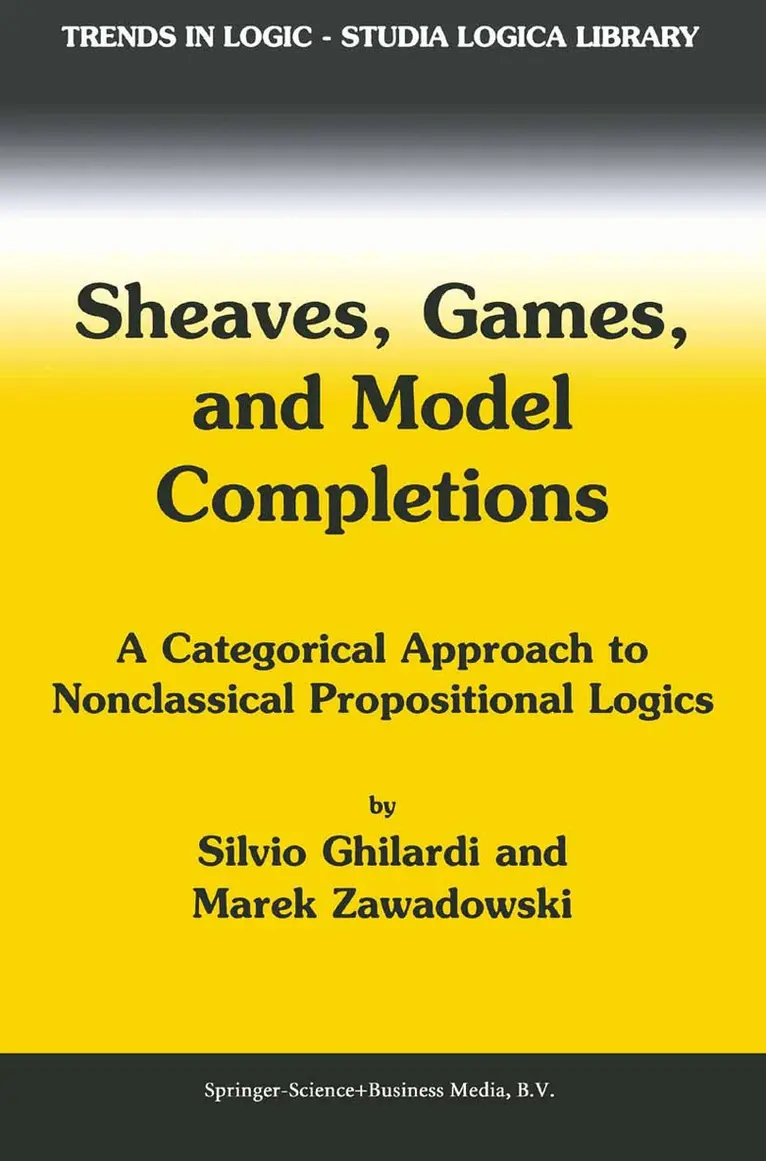
This book is an example of fruitful interaction between (non-classical) propo sitionallogics and (classical) model theory which was made possible due to categorical logic. Its main aim consists in investigating the existence of model completions for equational theories arising from propositional logics (such as the theory of Heyting algebras and various kinds of theories related to proposi tional modal logic ). The existence of model-completions turns out to be related to proof-theoretic facts concerning interpretability of second order propositional logic into ordinary propositional logic through the so-called 'Pitts' quantifiers' or 'bisimulation quantifiers'. On the other hand, the book develops a large number of topics concerning the categorical structure of finitely presented al gebras, with related applications to propositional logics, both standard (like Beth's theorems) and new (like effectiveness of internal equivalence relations, projectivity and definability of dual connectives such as difference). A special emphasis is put on sheaf representation, showing that much of the nice categor ical structure of finitely presented algebras is in fact only a restriction of natural structure in sheaves. Applications to the theory of classifying toposes are also covered, yielding new examples. The book has to be considered mainly as a research book, reporting recent and often completely new results in the field; we believe it can also be fruitfully used as a complementary book for graduate courses in categorical and algebraic logic, universal algebra, model theory, and non-classical logics. 1.
Häftad, Engelska, 2012
292 kr
Skickas inom 5-8 vardagar
Häftad, Engelska, 2009
562 kr
Skickas inom 10-15 vardagar
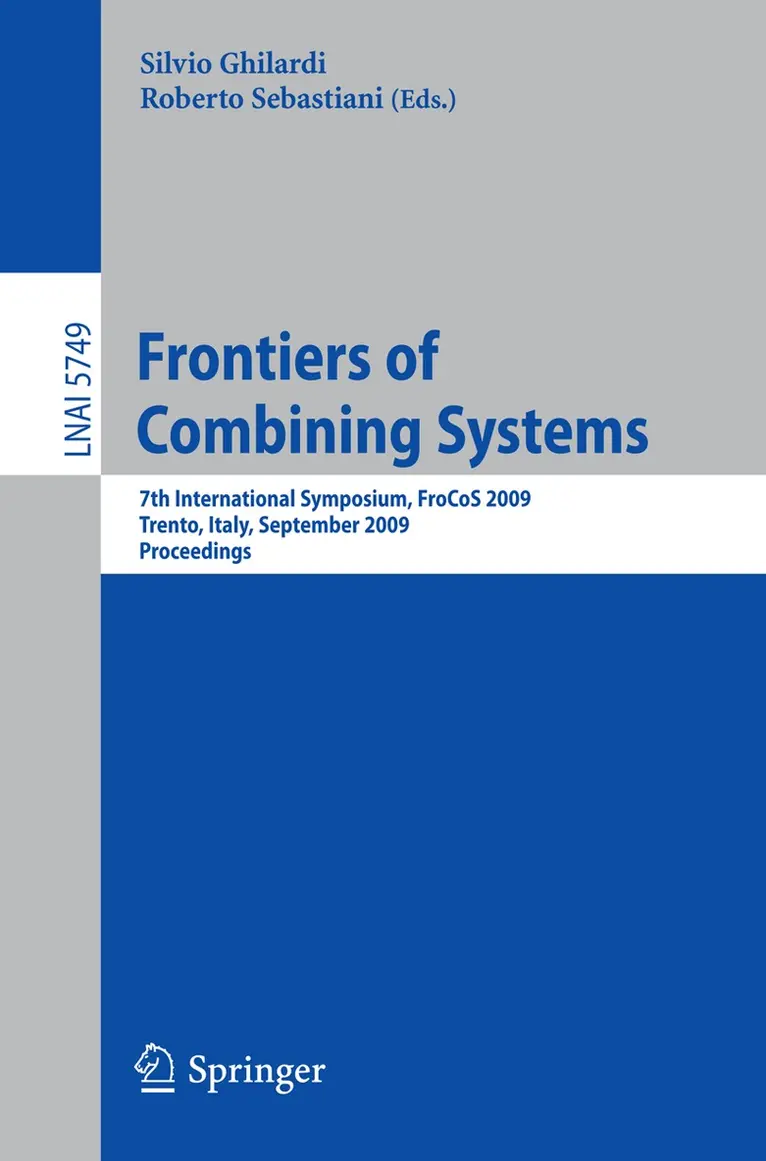
This book constitutes the refereed proceedings of the 7th International Symposium on Frontiers of Combining Systems, FroCoS 2007, held in Trento, Italy, September 16-18, 2009. The 20 revised full papers presented were carefully reviewed and selected. The papers are organized in topical sections on combinations of logics, theories, and decision procedures; constraint solving and programming; combination issues in rewriting and programming as well as in logical frameworks and theorem proving systems.
E-bok
PDF, Engelska, 2009734 kr
Läs direkt efter köp
This book constitutes the refereed proceedings of the 7th International Symposium on Frontiers of Combining Systems, FroCoS 2007, held in Trento, Italy, September 16-18, 2009. The 20 revised full papers presented were carefully reviewed and selected. The papers are organized in topical sections on combinations of logics, theories, and decision procedures; constraint solving and programming; combination issues in rewriting and programming as well as in logical frameworks and theorem proving systems.
Häftad, Engelska, 2010
1 084 kr
Skickas inom 10-15 vardagar
This book is an example of fruitful interaction between (non-classical) propo sitionallogics and (classical) model theory which was made possible due to categorical logic. Its main aim consists in investigating the existence of model completions for equational theories arising from propositional logics (such as the theory of Heyting algebras and various kinds of theories related to proposi tional modal logic ). The existence of model-completions turns out to be related to proof-theoretic facts concerning interpretability of second order propositional logic into ordinary propositional logic through the so-called 'Pitts' quantifiers' or 'bisimulation quantifiers'. On the other hand, the book develops a large number of topics concerning the categorical structure of finitely presented al gebras, with related applications to propositional logics, both standard (like Beth's theorems) and new (like effectiveness of internal equivalence relations, projectivity and definability of dual connectives such as difference). A special emphasis is put on sheaf representation, showing that much of the nice categor ical structure of finitely presented algebras is in fact only a restriction of natural structure in sheaves. Applications to the theory of classifying toposes are also covered, yielding new examples. The book has to be considered mainly as a research book, reporting recent and often completely new results in the field; we believe it can also be fruitfully used as a complementary book for graduate courses in categorical and algebraic logic, universal algebra, model theory, and non-classical logics. 1.
E-bok
PDF, Engelska, 20131 416 kr
Läs direkt efter köp
This book is an example of fruitful interaction between (non-classical) propo sitionallogics and (classical) model theory which was made possible due to categorical logic. Its main aim consists in investigating the existence of model completions for equational theories arising from propositional logics (such as the theory of Heyting algebras and various kinds of theories related to proposi tional modal logic ). The existence of model-completions turns out to be related to proof-theoretic facts concerning interpretability of second order propositional logic into ordinary propositional logic through the so-called ''Pitts'' quantifiers'' or ''bisimulation quantifiers''. On the other hand, the book develops a large number of topics concerning the categorical structure of finitely presented al gebras, with related applications to propositional logics, both standard (like Beth''s theorems) and new (like effectiveness of internal equivalence relations, projectivity and definability of dual connectives such as difference). A special emphasis is put on sheaf representation, showing that much of the nice categor ical structure of finitely presented algebras is in fact only a restriction of natural structure in sheaves. Applications to the theory of classifying toposes are also covered, yielding new examples. The book has to be considered mainly as a research book, reporting recent and often completely new results in the field; we believe it can also be fruitfully used as a complementary book for graduate courses in categorical and algebraic logic, universal algebra, model theory, and non-classical logics. 1.