Simon Colton – författare
Visar alla böcker från författaren Simon Colton. Handla med fri frakt och snabb leverans.
5 produkter
Automated Theory Formation in Pure Mathematics
Av Simon Colton
E-bok, 2012
1459 kr
Lägg i varukorg
In recent years, Artificial Intelligence researchers have largely focused their efforts on solving specific problems, with less emphasis on ''the big picture'' - automating large scale tasks which require human-level intelligence to undertake. The subject of this book, automated theory formation in …
Automated Theory Formation in Pure Mathematics
Av Simon Colton
Häftad, 2012
1096 kr
Lägg i varukorg
In recent years, Artificial Intelligence researchers have largely focused their efforts on solving specific problems, with less emphasis on 'the big picture' - automating large scale tasks which require human-level intelligence to undertake. The subject of this book, automated theory formation in …
Automated Theory Formation in Pure Mathematics
Av Simon Colton
Inbunden, 2002
1096 kr
Lägg i varukorg
In recent years, Artificial Intelligence researchers have largely focused their efforts on solving specific problems, with less emphasis on 'the big picture' - automating large scale tasks which require human-level intelligence to undertake. The subject of this book, automated theory formation in …
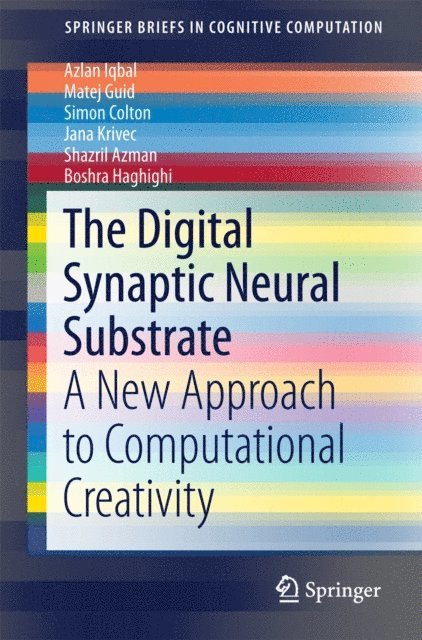
Digital Synaptic Neural Substrate
A New Approach to Computational Creativity
Av Azlan Iqbal, Matej Guid m. fl.
Häftad, 2016
552 kr
Lägg i varukorg
This book describes a new computational approach to creativity. With chess as the domain of investigation, the authors show experimentally how a computer can be imbued with the 'spark' of creativity that enables it to compose chess problems or puzzles that are both challenging and aesthetically …
Digital Synaptic Neural Substrate
A New Approach to Computational Creativity
Av Boshra Haghighi, Shazril Azman m. fl.
E-bok, 2016
718 kr
Lägg i varukorg
This book describes a new computational approach to creativity. With chess as the domain of investigation, the authors show experimentally how a computer can be imbued with the ''spark'' of creativity that enables it to compose chess problems or puzzles that are both challenging and aesthetically …