Simon Rabinovitch – författare
Visar alla böcker från författaren Simon Rabinovitch. Handla med fri frakt och snabb leverans.
6 produkter
6 produkter
371 kr
Skickas inom 5-8 vardagar
A comparative legal history of Jewish sovereignty and religious freedom, illuminating the surprising ways that collective and individual rights have evolved over the past two centuriesWinner, Irving Abella Award in History, presented by the Canadian Jewish Literary Awards It is a common assumption that in Israel, Jews have sovereignty, and in most other places where Jews live today, they have religious freedom instead. As Simon Rabinovitch shows in this original work, the situation is much more complicated. Jews today possess different kinds of legal rights in states around the world; some stem from religious freedom protections, and others evolved from a longer history of Jewish autonomy. By comparing conflicts between Jewish collective and individual rights in courts and laws across the globe, from the French Revolution to today, this book provides a nuanced legal history of Jewish sovereignty and religious freedom. Rabinovitch weaves key themes in Jewish legal history with the individual stories of litigants, exploring ideas about citizenship and belonging; who is a Jew; what makes a Jewish family; and how to define Jewish space. He uses recent court cases to explore problems of conflicting rights, and then situates each case in a wider historical context. This unique comparative history creates a global picture of modern legal development in which Jews continue to use the law to carve out surprising forms of sovereignty.
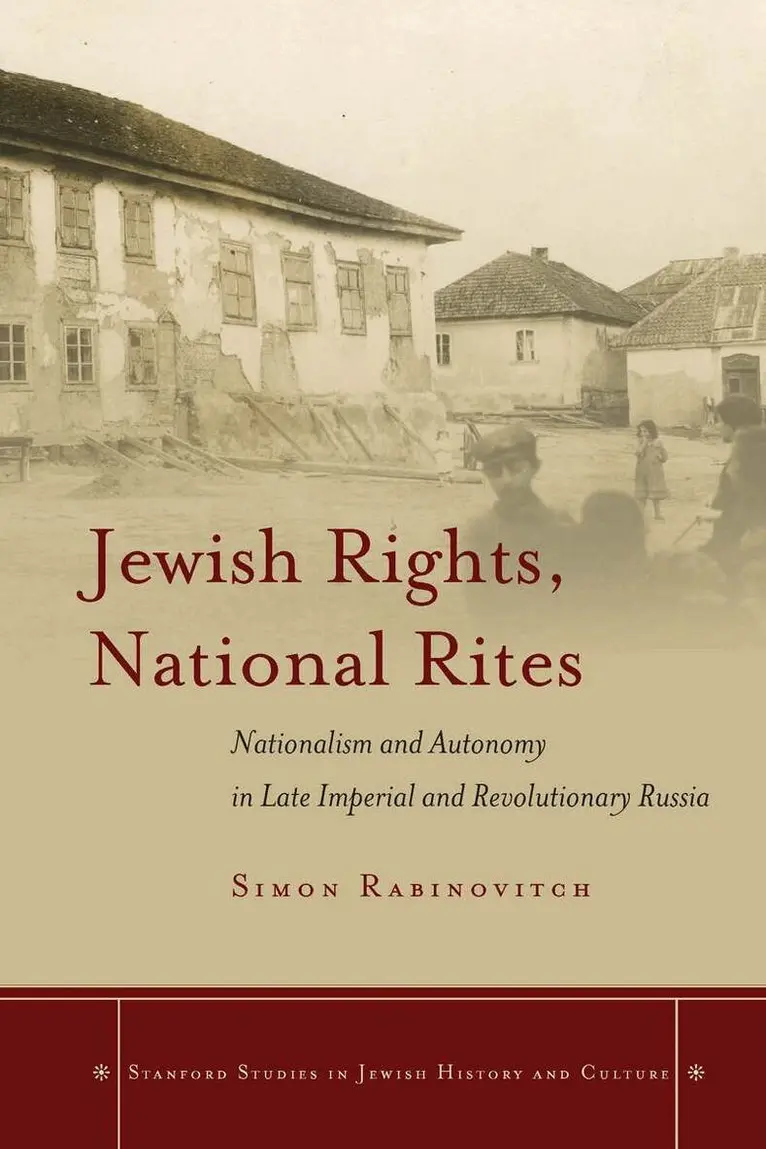
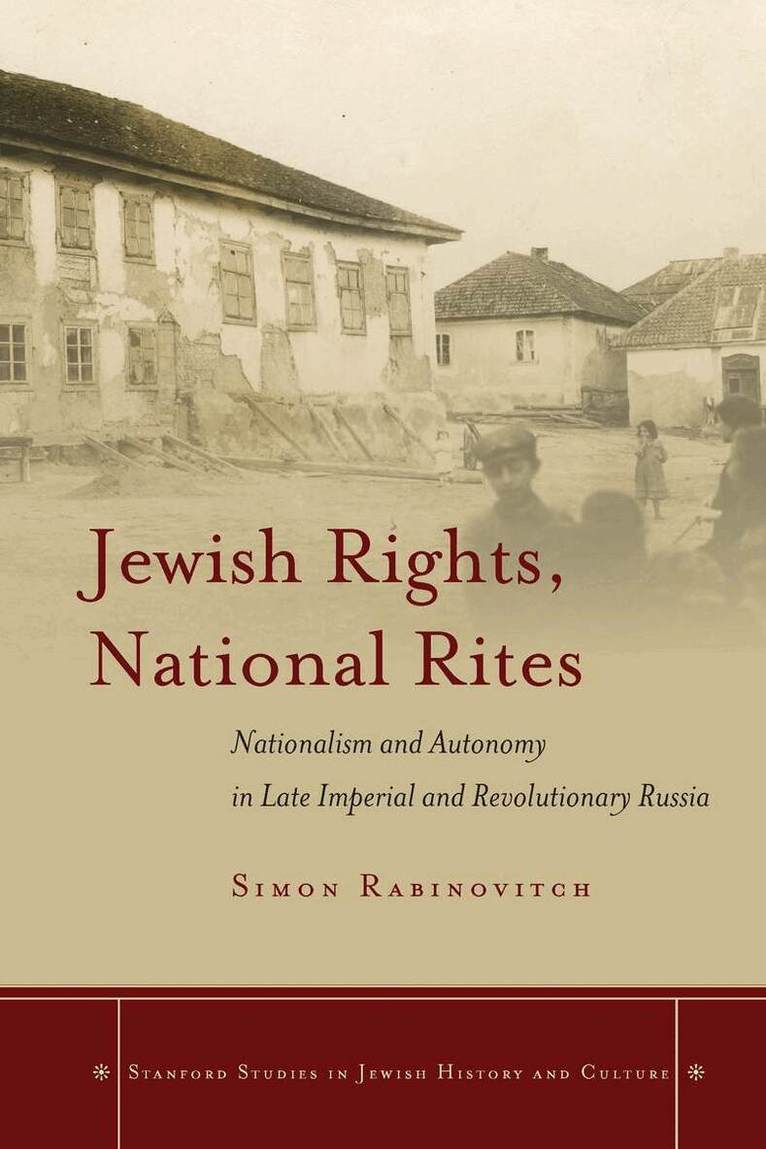
Jewish Rights, National Rites
Nationalism and Autonomy in Late Imperial and Revolutionary Russia
Inbunden, Engelska, 2014
1 532 kr
Skickas inom 5-8 vardagar
In its full-color poster for elections to the All-Russian Jewish Congress in 1917, the Jewish People's Party depicted a variety of Jews in seeking to enlist the support of the broadest possible segment of Russia's Jewish population. It forsook neither traditional religious and economic life like the Jewish socialist parties, nor life in Europe like the Zionists. It embraced Hebrew, Yiddish, and Russian as fulfilling different roles in Jewish life. It sought the democratization of Jewish communal self-government and the creation of new Russian Jewish national-cultural and governmental institutions. Most importantly, the self-named "folkists" believed that Jewish national aspirations could be fulfilled through Jewish autonomy in Russia and Eastern Europe more broadly. Ideologically and organizationally, this party's leadership would profoundly influence the course of Russian Jewish politics.Jewish Rights, National Rights provides a completely new interpretation of the origins of Jewish nationalism in Russia. It argues that Jewish nationalism, and Jewish politics generally, developed in a changing legal environment where the idea that nations had rights was beginning to take hold, and centered on the demand for Jewish autonomy in Eastern Europe. Drawing on numerous archives and libraries in the United States, Russia, Ukraine, and Israel, Simon Rabinovitch carefully reconstructs the political movement for Jewish autonomy, its personalities, institutions, and cultural projects. He explains how Jewish autonomy was realized following the February Revolution of 1917, and for the first time assesses voting patterns in November 1917 to determine the extent of public support for Jewish nationalism at the height of the Russian revolutionary period.
606 kr
Skickas inom 5-8 vardagar
Defining Israel: The Jewish State, Democracy, and the Law is the first book in any language devoted to the controversial passage of Israel's nation-state law. Israel has no constitution, and though it calls itself the Jewish state there is no agreement among Israelis on how that fact should be reflected in the government's laws or by its courts. Since the 1990s a number of civil society groups and legislators have drafted constitutions and proposed Basic Laws with constitutional standing that would clarify what it means for Israel to be a "Jewish and democratic state." Are these bills liberal or chauvinist? Are they a defense of the Knesset or an attack on the independence of the courts? Is their intention democratic or anti-democratic? The fight over the nation-state law-whether to have one and what should be in it-toppled the 19th Knesset's governing coalition and, even after its passage on July 29, 2018, remains a point of contention among Israel's lawmakers and increasingly the Israeli public. Defining Israel brings together influential scholars, journalists, and politicians, observers and participants, opponents and proponents, Jews and Arabs, all debating the merits and meaning of Israel's nation-state law. Together with translations of each draft law, the final law, and other key documents, the essays and sources in Defining Israel are essential to understand the ongoing debate over what it means for Israel to be a Jewish and democratic state.
Jewish Rights, National Rites
Nationalism and Autonomy in Late Imperial and Revolutionary Russia
Häftad, Engelska, 2016
380 kr
Skickas inom 10-15 vardagar
In its full-color poster for elections to the All-Russian Jewish Congress in 1917, the Jewish People's Party depicted a variety of Jews in seeking to enlist the support of the broadest possible segment of Russia's Jewish population. It forsook neither traditional religious and economic life like the Jewish socialist parties, nor life in Europe like the Zionists. It embraced Hebrew, Yiddish, and Russian as fulfilling different roles in Jewish life. It sought the democratization of Jewish communal self-government and the creation of new Russian Jewish national-cultural and governmental institutions. Most importantly, the self-named "folkists" believed that Jewish national aspirations could be fulfilled through Jewish autonomy in Russia and Eastern Europe more broadly. Ideologically and organizationally, this party's leadership would profoundly influence the course of Russian Jewish politics.Jewish Rights, National Rights provides a completely new interpretation of the origins of Jewish nationalism in Russia. It argues that Jewish nationalism, and Jewish politics generally, developed in a changing legal environment where the idea that nations had rights was beginning to take hold, and centered on the demand for Jewish autonomy in Eastern Europe. Drawing on numerous archives and libraries in the United States, Russia, Ukraine, and Israel, Simon Rabinovitch carefully reconstructs the political movement for Jewish autonomy, its personalities, institutions, and cultural projects. He explains how Jewish autonomy was realized following the February Revolution of 1917, and for the first time assesses voting patterns in November 1917 to determine the extent of public support for Jewish nationalism at the height of the Russian revolutionary period.
686 kr
Skickas inom 5-8 vardagar
522 kr
Skickas inom 3-6 vardagar
The question of how to preserve, construct or transform Jewish peoplehood consumed Jewish intellectuals in the late nineteenth and early twentieth centuries. Despite a rich array of writing from Jewish nationalists, liberals, and socialists about the vitality of Jewish existence in the diaspora, the key works have never been collected in a single volume, and few reliable English translations exist. This anthology brings together a variety of thinkers who offered competing visions of peoplehood within the established and developing Jewish diaspora centers of Europe and America. Writing in Russian, Yiddish, Hebrew, French, and English, these Jewish intellectuals sought to recast Jewish existence, whether within multiethnic empires, liberal democracies, or socialist forms of government, in national terms.Volume editor Simon Rabinovitch provides an introductory essay, as well as short introductions and annotations to each document that contextualize and make accessible this wealth of primary sources for scholars and students.