Simon Swynfen Jervis – författare
Visar alla böcker från författaren . Handla med fri frakt och snabb leverans.
2 produkter
2 produkter
Inbunden, Engelska, 2019
753 kr
Skickas inom 5-8 vardagar
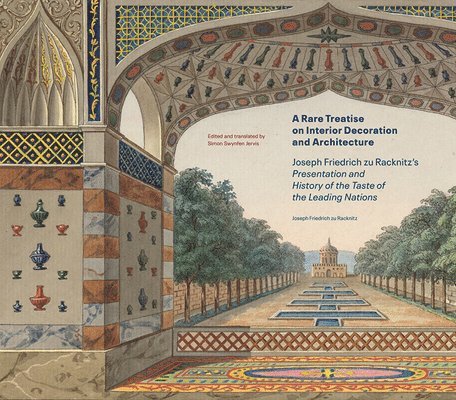
Baron Joseph Friedrich von Racknitz's pioneering Presentation and History of the Taste of the Leading Nations in Relation to the Interior Decoration of Rooms and to Architecture (Darstellung und Geschichte des Geschmacks der vorzuglichsten Voelker in Beziehung auf die innere Auszierung der Zimmer und auf die Baukunst) is little known today. Racknitz, a German aristocrat, traced an early global history of design and ornament through discussions of what he distinguished as twenty-four regional historical tastes. He included a diverse group of ancient classical civilizations, European nations and peoples, Eastern civilizations, and more exotic reaches of the world.This sensitive and informed translation by Simon Swynfen Jervis includes reproductions of the original color plates and essays on Racknitz's biography, his publication, and the deeper German Enlightenment context, making this an essential volume for eighteenth- and nineteenth-century architecture, decorative arts, and garden design.
Inbunden, Engelska, 2024
495 kr
Skickas
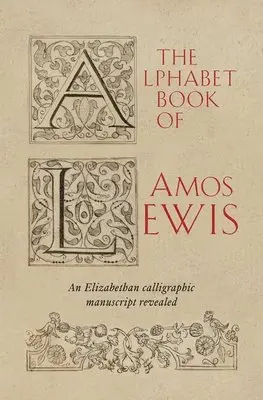
The calligraphic manuscript presented here in facsimile was made in about 1585 in a bid for the patronage of an Elizabethan magnate, Sir John Petre of Thorndon Hall in Essex. Its creator, Amos Lewis, hoped that it would give pleasure to Petre's son.A Protestant clergyman, Lewis must have despaired of employment in the Catholic Petre household. His book is unfinished; the 'Z' text ends in pencil draft. But incompletion saved it: had it entered the schoolroom it would have become thumbed and shabby and been discarded. This precious survival is the earliest known attempt at an original writing book by an Englishman. The first printed English writing book was A Book Containing divers sortes of hands (London, 1570) by John de Beau Chesne, a Frenchman.The Alphabet Book is a delightful miniature. Lewis combined varied scripts, ornament, Renaissance grotesques, strapwork, flowers and foliage, fine roman capital letters set against moresques, and polychrome Petre heraldry to emulate printed Continental writing books. It begins and ends with poems, Latin and English, in which he presses his suit.The context is European: printed writing manuals first appeared in Venice and Rome in the 1520s. Lewis's main model was a book by a Swiss master, Urban Wyss, published in Zurich in 1549. His Latin texts to individual letters, stressing the value of learning, draw on proverbial wisdom gathered in Erasmus's compilations of adages first published in 1500 and since expanded by others, notably in Germany. Lewis's Alphabet Book indeed opens a window into that flowering of humanistic culture which was central to learning and letters in the age of Shakespeare.Now that the digital revolution is perceived as a threat to handwriting Lewis's manuscript Alphabet Book is also a reminder that during an earlier technological revolution, that of printing with moveable type, books promoted skill, even virtuosity, in handwriting.