Smail Tedjini – författare
1 407 kr
Läs direkt efter köp
2 199 kr
Läs direkt efter köp
This book concerns a new paradigm in the field of UHF RFID systems: the positive exploitation of nonlinear signals generated by the chips integrated into the RFID tags.
After having recalled the main principles in RFID technology and its current challenges notably with the emergence of Internet of Things or the smart connected environments, the purpose is to focus on the presence of nonlinearities produced by the nonlinear circuits of RFID chips: effects, nuisances and solutions but also and especially use of the phenomena.
The presentation covers all aspects from the characterization of the nonlinear behavior of RFID tags and the associated platforms (distinguishing conducted and radiated measurement) to the design of new types of tags where nonlinearities are exploited in order to offer new capabilities or enhanced performance.
2 122 kr
Läs direkt efter köp
This book concerns a new paradigm in the field of UHF RFID systems: the positive exploitation of nonlinear signals generated by the chips integrated into the RFID tags.
After having recalled the main principles in RFID technology and its current challenges notably with the emergence of Internet of Things or the smart connected environments, the purpose is to focus on the presence of nonlinearities produced by the nonlinear circuits of RFID chips: effects, nuisances and solutions but also and especially use of the phenomena.
The presentation covers all aspects from the characterization of the nonlinear behavior of RFID tags and the associated platforms (distinguishing conducted and radiated measurement) to the design of new types of tags where nonlinearities are exploited in order to offer new capabilities or enhanced performance.
1 416 kr
Skickas inom 5-8 vardagar
1 629 kr
Läs direkt efter köp
Comprehensive resource reviewing the state of the artin wireless identification and sensing systems, proposing several examples of applications
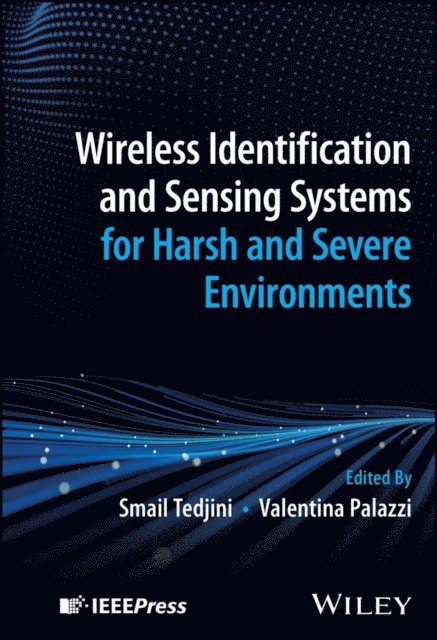
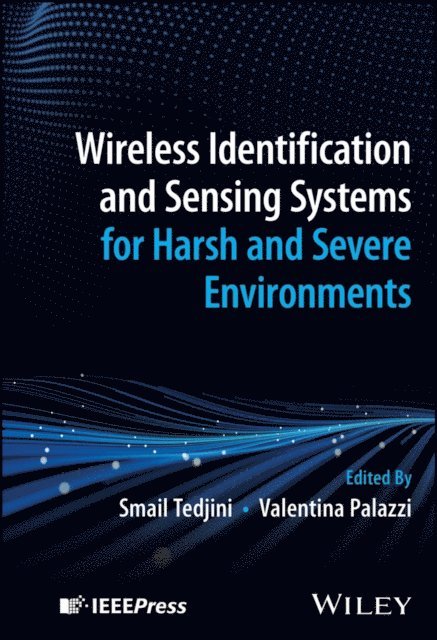
While complying with RF standard and regulations, Wireless Identification and Sensing Systems for Harsh and Severe Environments covers the recent advances in wireless and radio-frequency identification (RFID) systems where severe electromagnetic behavior and harsh conditions are taken into consideration, providing the reader with design rules and methodologies to obtain satisfactory performance and avoid the typical oversights and mistakes that can be made when first approaching this topic.
In addition to examples of real implementations, the book gives a general overview of RFID and wireless technologies as well as their pros and cons in terms of expected performance and future directions of technologies. The perspective and evolution towards IoT solutions and artificial intelligence (AI) are pointed out.
The book furthermore addresses chipless RFID frameworks from the theoretical perspective as well as that of implementation, including examples from scientific literature and commercial solutions. It also describes surface acoustic wave (SAW) sensors in wired and wireless configurations and developments needed to implement the technology.
Wireless Identification and Sensing Systems for Harsh and Severe Environments includes discussion of:
Frequency diversity for robust Ultra-High Frequency (UHF)-RFID communication, a key technology for future sensor and actuator devices in the Internet of Things, and harmonic transponders for tracking and sensingResonator and reflective delay line configurations, and chipless RFID technology for operations in harsh environments Potential of battery-less near-field communication (NFC) sensors using mobile phones as readers in severe environmentsChipless RFID channel modeling, considering the spatial multipath channel, 3D bi-static Radar Cross Section (RCS) tag model, and analogue effectsProviding comprehensive coverage of the subject and examples of successful implementations of wireless solutions exploiting RFID technologies and enabling systems for the Internet of Things (IoT), Wireless Identification and Sensing Systems for Harsh and Severe Environments is an essential resource for engineers and PhD students in wireless and RFID technologies.
1 629 kr
Läs direkt efter köp
Comprehensive resource reviewing the state of the artin wireless identification and sensing systems, proposing several examples of applications
While complying with RF standard and regulations, Wireless Identification and Sensing Systems for Harsh and Severe Environments covers the recent advances in wireless and radio-frequency identification (RFID) systems where severe electromagnetic behavior and harsh conditions are taken into consideration, providing the reader with design rules and methodologies to obtain satisfactory performance and avoid the typical oversights and mistakes that can be made when first approaching this topic.
In addition to examples of real implementations, the book gives a general overview of RFID and wireless technologies as well as their pros and cons in terms of expected performance and future directions of technologies. The perspective and evolution towards IoT solutions and artificial intelligence (AI) are pointed out.
The book furthermore addresses chipless RFID frameworks from the theoretical perspective as well as that of implementation, including examples from scientific literature and commercial solutions. It also describes surface acoustic wave (SAW) sensors in wired and wireless configurations and developments needed to implement the technology.
Wireless Identification and Sensing Systems for Harsh and Severe Environments includes discussion of:
Frequency diversity for robust Ultra-High Frequency (UHF)-RFID communication, a key technology for future sensor and actuator devices in the Internet of Things, and harmonic transponders for tracking and sensingResonator and reflective delay line configurations, and chipless RFID technology for operations in harsh environments Potential of battery-less near-field communication (NFC) sensors using mobile phones as readers in severe environmentsChipless RFID channel modeling, considering the spatial multipath channel, 3D bi-static Radar Cross Section (RCS) tag model, and analogue effectsProviding comprehensive coverage of the subject and examples of successful implementations of wireless solutions exploiting RFID technologies and enabling systems for the Internet of Things (IoT), Wireless Identification and Sensing Systems for Harsh and Severe Environments is an essential resource for engineers and PhD students in wireless and RFID technologies.
1 128 kr
Skickas inom 10-15 vardagar
Chipless RFID based on RF Encoding Particle: Realization, Coding and Reading System explores the field of chipless identification based on the RF Encoding Particle (REP). The book covers the possibility of collecting information remotely with RF waves (RFID) with totally passive tags without wire, batteries, and chips, and even printed on paper. Despite the many benefits of RFID, deployment is still hindered by several economic and technological factors. Among these barriers are the high cost of tags, lack of reliability and security in the information contained in the RFID chip, and how tags are 'recycled.'
This book focuses on the development of chipless RFID tags, representing a new family of low cost tags. With this technology information is extracted from the electromagnetic response of the tag, which depends only on its geometry. Various solutions have been developed by the authors to increase the amount of information, reduce the surface of the tag, or improve the robustness of detection. Considerations such as realization using paper substrate, the development of a low cost detection system, and measurements in a real environment have been addressed for practical implementation.
Introduces the chipless RFID REP approach as compared to classical chipless RFID, RFID, and barcode technologies Includes a demonstration of the practical and economic potential of chipless RFID technology, with detailed presentations and discussions of different test benches and comparisons Presents in detail numerous examples of chipless tags that are able to tackle specific problems: sensitivity of detection, encoding density, robustness of detection, problem of tag orientation, tags and reader cost, and compliance with emission standards Focuses on the development of chipless RFID tags, representing a new family of low cost tags1 827 kr
Skickas inom 5-8 vardagar
1 138 kr
Tillfälligt slut