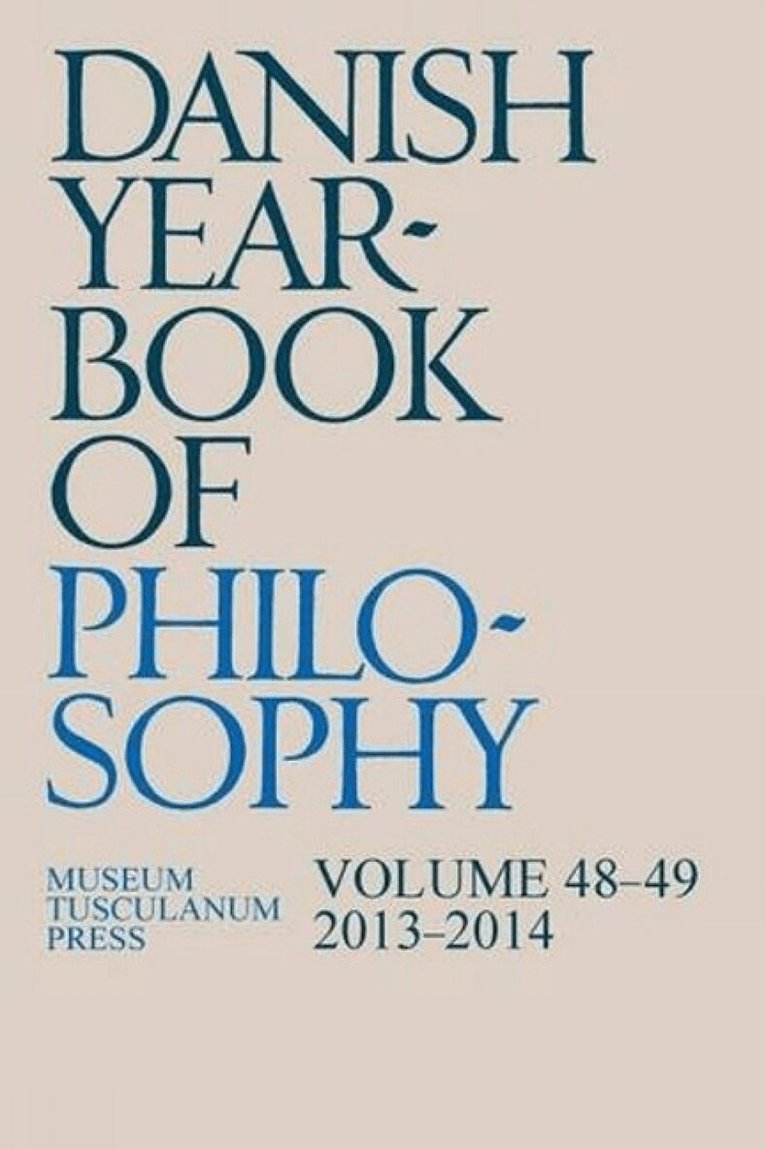
The Danish Yearbook of Philosophy publishes contributions in English, German and French. The journal contains mainly articles with element of Danish philosophy or of writers connected to the Danish philosophy.
Transcendental history denotes a possible philosophical discipline on a par with transcendental logic. Through two mutually complementary endeavours, namely the working out of a notion and the defending of a thesis, Gosvig Olesen examines the history of philosophy in areas where the possibility of the transcendental history will emerge. The notion that is worked out is the notion of historical time. The thesis that is being defended is that the human cognition's transcendental condition is history. Notion as well as thesis place the dissertation in the philosophical genre traditionally known as transcendental philosophy.
Im Austausch in erster Linie mit der Transzendentalphilosophie und der spekulativen Philosophie geht es um zwei Zielsetzungen: Um den Begriff der geschichtlichen Zeit und die These, dass Geschichte die transzendentale Bedingung der menschlichen Erkenntnis bildet. Søren Gosvig Olesen unterscheidet zwischen Geschichte im transzendentalen und im empirischen Sinne. Den Ausdruck "transzendentale Geschichte" findet man im Werk herausragender Philosophen des 20. und 21. Jahrhunderts, so bei Jacques Derrida und bei Giorgio Agamben. Das Augenmerk liegt dabei auf der Tatsache, dass ein solcher Begriff dort auftaucht, wo Philosophen einen Sinn für Geschichte erworben haben, der unter "Geschichte" anderes als nur den Gegenstand einer Fachwissenschaft versteht. Diese Entwicklung wird u. a. in Heideggers "Geschichtlichkeit" und "Seinsgeschichte", mit Gadamers "innerer Geschichte", aber auch mit Merleau-Pontys "Urgeschichte" deutlich.
The Danish Yearbook of Philosophy publishes contributions in English, German and French. The journal contains mainly articles with element of Danish philosophy or of writers connected to the Danish philosophy.
Transcendental history denotes a possible philosophical discipline on a par with transcendental logic. Through two mutually complementary endeavours, namely the working out of a notion and the defending of a thesis, Gosvig Olesen examines the history of philosophy in areas where the possibility of the transcendental history will emerge. The notion that is worked out is the notion of historical time. The thesis that is being defended is that the human cognition's transcendental condition is history. Notion as well as thesis place the dissertation in the philosophical genre traditionally known as transcendental philosophy.
Im Austausch in erster Linie mit der Transzendentalphilosophie und der spekulativen Philosophie geht es um zwei Zielsetzungen: Um den Begriff der geschichtlichen Zeit und die These, dass Geschichte die transzendentale Bedingung der menschlichen Erkenntnis bildet. Søren Gosvig Olesen unterscheidet zwischen Geschichte im transzendentalen und im empirischen Sinne. Den Ausdruck "transzendentale Geschichte" findet man im Werk herausragender Philosophen des 20. und 21. Jahrhunderts, so bei Jacques Derrida und bei Giorgio Agamben. Das Augenmerk liegt dabei auf der Tatsache, dass ein solcher Begriff dort auftaucht, wo Philosophen einen Sinn für Geschichte erworben haben, der unter "Geschichte" anderes als nur den Gegenstand einer Fachwissenschaft versteht. Diese Entwicklung wird u. a. in Heideggers "Geschichtlichkeit" und "Seinsgeschichte", mit Gadamers "innerer Geschichte", aber auch mit Merleau-Pontys "Urgeschichte" deutlich.