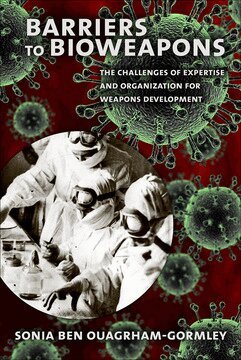
[Barriers to Bioweapons] is a must-read for nonproliferation experts and should be a standard text for understanding biological weapons development for some time to come.â•David W. Kearn, Perspectives on PoliticsIn both the popular imagination and among lawmakers and national security experts, there exists the belief that with sufficient motivation and material resources, states or terrorist groups can produce bioweapons easily, cheaply, and successfully. In Barriers to Bioweapons, Sonia Ben Ouagrham-Gormley challenges this perception by showing that bioweapons development is a difficult, protracted, and expensive endeavor, rarely achieving the expected results whatever the magnitude of investment.Her findings are based on extensive interviews she conducted with former U.S. and Soviet-era bioweapons scientists and on careful analysis of archival data and other historical documents related to various state and terrorist bioweapons programs.Bioweapons development relies on living organisms that are sensitive to their environment and handling conditions, and therefore behave unpredictably. These features place a greater premium on specialized knowledge. Ben Ouagrham-Gormley posits that lack of access to such intellectual capital constitutes the greatest barrier to the making of bioweapons. She integrates theories drawn from economics, the sociology of science, organization, and management with her empirical research. The resulting theoretical framework rests on the idea that the pace and success of a bioweapons development program can be measured by its ability to ensure the creation and transfer of scientific and technical knowledge. The specific organizational, managerial, social, political, and economic conditions necessary for success are difficult to achieve, particularly in covert programs where the need to prevent detection imposes managerial and organizational conditions that conflict with knowledge production.
This volume addresses the critical question of how scientific collaboration can remain possible in an era of deepening geopolitical tension, without denying difference or enforcing false consensus. It is the outcome of an ongoing, real transnational forum on biogovernance commons, and offers a rare, inside account of the experimental effort to rebuild trust in the governance of the life sciences across the United States, the United Kingdom, China, and beyond.Drawing on sustained dialogue among scientists, ethicists, lawyers, and policy scholars, the volume introduces the idea of the ‘commons’ as a practice of commoning: the ongoing work of making differences intelligible, negotiating conflict, and sustaining cooperation under constraint. Through richly grounded case studies—from genetic data governance and biobanking to biosecurity, CRISPR, and global health—it shows how regulatory impasse is often produced not by incompatible values, but by fractured relations, politicised language, and unequal epistemic authority.Neither a blueprint for harmonisation nor a polemic about China, the volume demonstrates how meaningful collaboration can be rebuilt when formal channels narrow. At once empirically revealing and conceptually innovative, it speaks to scholars, policymakers, and practitioners seeking new ways to govern science responsibly in a divided world.
[Barriers to Bioweapons] is a must-read for nonproliferation experts and should be a standard text for understanding biological weapons development for some time to come.â•David W. Kearn, Perspectives on PoliticsIn both the popular imagination and among lawmakers and national security experts, there exists the belief that with sufficient motivation and material resources, states or terrorist groups can produce bioweapons easily, cheaply, and successfully. In Barriers to Bioweapons, Sonia Ben Ouagrham-Gormley challenges this perception by showing that bioweapons development is a difficult, protracted, and expensive endeavor, rarely achieving the expected results whatever the magnitude of investment.Her findings are based on extensive interviews she conducted with former U.S. and Soviet-era bioweapons scientists and on careful analysis of archival data and other historical documents related to various state and terrorist bioweapons programs.Bioweapons development relies on living organisms that are sensitive to their environment and handling conditions, and therefore behave unpredictably. These features place a greater premium on specialized knowledge. Ben Ouagrham-Gormley posits that lack of access to such intellectual capital constitutes the greatest barrier to the making of bioweapons. She integrates theories drawn from economics, the sociology of science, organization, and management with her empirical research. The resulting theoretical framework rests on the idea that the pace and success of a bioweapons development program can be measured by its ability to ensure the creation and transfer of scientific and technical knowledge. The specific organizational, managerial, social, political, and economic conditions necessary for success are difficult to achieve, particularly in covert programs where the need to prevent detection imposes managerial and organizational conditions that conflict with knowledge production.
This volume addresses the critical question of how scientific collaboration can remain possible in an era of deepening geopolitical tension, without denying difference or enforcing false consensus. It is the outcome of an ongoing, real transnational forum on biogovernance commons, and offers a rare, inside account of the experimental effort to rebuild trust in the governance of the life sciences across the United States, the United Kingdom, China, and beyond.Drawing on sustained dialogue among scientists, ethicists, lawyers, and policy scholars, the volume introduces the idea of the ‘commons’ as a practice of commoning: the ongoing work of making differences intelligible, negotiating conflict, and sustaining cooperation under constraint. Through richly grounded case studies—from genetic data governance and biobanking to biosecurity, CRISPR, and global health—it shows how regulatory impasse is often produced not by incompatible values, but by fractured relations, politicised language, and unequal epistemic authority.Neither a blueprint for harmonisation nor a polemic about China, the volume demonstrates how meaningful collaboration can be rebuilt when formal channels narrow. At once empirically revealing and conceptually innovative, it speaks to scholars, policymakers, and practitioners seeking new ways to govern science responsibly in a divided world.