Soon-Won Park – författare
Visar alla böcker från författaren Soon-Won Park. Handla med fri frakt och snabb leverans.
5 produkter
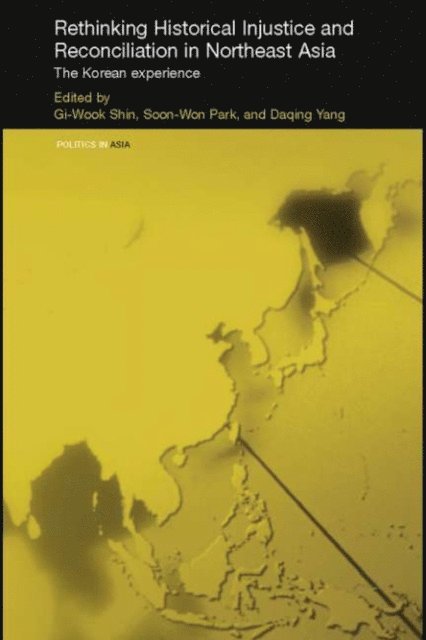
Rethinking Historical Injustice and Reconciliation in Northeast Asia
The Korean Experience
Av Gi-Wook Shin, Soon-Won Park m. fl.
Häftad, 2008
1186 kr
Lägg i varukorg
Despite witnessing phenomenal economic growth and the spread of democratization in recent decades, as well as impressive intra-regional exchanges and interactions in the economic and cultural spheres, the Northeast Asian region still experience wounds from past wrongs that were committed in times …
Rethinking Historical Injustice and Reconciliation in Northeast Asia
The Korean Experience
Av Gi-Wook Shin, Soon-Won Park m. fl.
Inbunden, 2006
2578 kr
Lägg i varukorg
Despite witnessing phenomenal economic growth and the spread of democratization in recent decades, as well as impressive intra-regional exchanges and interactions in the economic and cultural spheres, the Northeast Asian region still experience wounds from past wrongs that were committed in times …
Colonial Industrialization and Labor in Korea
The Onoda Cement Factory
Inbunden, 1999
405 kr
Lägg i varukorg
This book is a study of labor relations and the first generation of skilled workers in colonial Korea, a subject crucial to the understanding of modernization in twentieth-century Korea. Born in rural Korea, these workers confronted both the colonial experience and the modern workplace as they …
Rethinking Historical Injustice and Reconciliation in Northeast Asia
The Korean Experience
Av Daqing Yang, Soon-Won Park m. fl.
E-bok, 2007
1106 kr
Lägg i varukorg
Despite witnessing phenomenal economic growth and the spread of democratization in recent decades, as well as impressive intra-regional exchanges and interactions in the economic and cultural spheres, the Northeast Asian region still experience wounds from past wrongs that were committed in times …
Rethinking Historical Injustice and Reconciliation in Northeast Asia
The Korean Experience
Av Daqing Yang, Soon-Won Park m. fl.
E-bok, 2007
1106 kr
Lägg i varukorg
Despite witnessing phenomenal economic growth and the spread of democratization in recent decades, as well as impressive intra-regional exchanges and interactions in the economic and cultural spheres, the Northeast Asian region still experience wounds from past wrongs that were committed in times …