Sophie Thériault - Böcker
Visar alla böcker från författaren Sophie Thériault. Handla med fri frakt och snabb leverans.
8 produkter
8 produkter
609 kr
Skickas inom 3-6 vardagar
The novel coronavirus SARS-CoV-2, which causes the disease known as COVID-19, has infected people in 212 countries so far and on every continent except Antarctica. Vast changes to our home lives, social interactions, government functioning and relations between countries have swept the world in a few months and are difficult to hold in one’s mind at one time. That is why a collaborative effort such as this edited, multidisciplinary collection is needed. This book confronts the vulnerabilities and interconnectedness made visible by the pandemic and its consequences, along with the legal, ethical and policy responses. These include vulnerabilities for people who have been harmed or will be harmed by the virus directly and those harmed by measures taken to slow its relentless march; vulnerabilities exposed in our institutions, governance and legal structures; and vulnerabilities in other countries and at the global level where persistent injustices harm us all. Hopefully, COVID-19 will forces us to deeply reflect on how we govern and our policy priorities; to focus preparedness, precaution, and recovery to include all, not just some. Published in English with some chapters in French.
1 094 kr
Skickas inom 3-6 vardagar
The novel coronavirus SARS-CoV-2, which causes the disease known as COVID-19, has infected people in 212 countries so far and on every continent except Antarctica. Vast changes to our home lives, social interactions, government functioning and relations between countries have swept the world in a few months and are difficult to hold in one’s mind at one time. That is why a collaborative effort such as this edited, multidisciplinary collection is needed. This book confronts the vulnerabilities and interconnectedness made visible by the pandemic and its consequences, along with the legal, ethical and policy responses. These include vulnerabilities for people who have been harmed or will be harmed by the virus directly and those harmed by measures taken to slow its relentless march; vulnerabilities exposed in our institutions, governance and legal structures; and vulnerabilities in other countries and at the global level where persistent injustices harm us all. Hopefully, COVID-19 will forces us to deeply reflect on how we govern and our policy priorities; to focus preparedness, precaution, and recovery to include all, not just some. Published in English with some chapters in French.
1 932 kr
Skickas inom 10-15 vardagar
This book offers a comparative study of the management of legal pluralism. The authors describe and analyse the way state and non-state legal systems acknowledge legal pluralism – defined as the coexistence of a state and non-state legal systems in the same space in respect of the same subject matter for the same population - and determine its consequences for their own purposes. The book sheds light on the management processes deployed by legal systems in Africa, Canada, Central Europe and the South Pacific, the multitudinous factors circumscribing the action of systems and individuals with respect to legal pluralism, and the effects of management strategies and processes on systems as well as on individuals. The book offers fresh practical and analytical insight on applied legal pluralism, a fast-growing field of scholarship and professional practice. Drawing from a wealth of original empirical data collected in several countries by a multilingual and multidisciplinary team, it provides a thorough account of the intricate patterns of state and non-state practices with respect to legal pluralism.As the book’s non-prescriptive approach helps to uncover and evaluate several biases or assumptions on the part of policy makers, scholars and development agencies regarding the nature and the consequences of legal pluralism, it will appeal to a wide range of scholars and practitioners in law, development studies, political science and social sciences.
633 kr
Skickas inom 10-15 vardagar
This book offers a comparative study of the management of legal pluralism. The authors describe and analyse the way state and non-state legal systems acknowledge legal pluralism – defined as the coexistence of a state and non-state legal systems in the same space in respect of the same subject matter for the same population - and determine its consequences for their own purposes. The book sheds light on the management processes deployed by legal systems in Africa, Canada, Central Europe and the South Pacific, the multitudinous factors circumscribing the action of systems and individuals with respect to legal pluralism, and the effects of management strategies and processes on systems as well as on individuals. The book offers fresh practical and analytical insight on applied legal pluralism, a fast-growing field of scholarship and professional practice. Drawing from a wealth of original empirical data collected in several countries by a multilingual and multidisciplinary team, it provides a thorough account of the intricate patterns of state and non-state practices with respect to legal pluralism.As the book’s non-prescriptive approach helps to uncover and evaluate several biases or assumptions on the part of policy makers, scholars and development agencies regarding the nature and the consequences of legal pluralism, it will appeal to a wide range of scholars and practitioners in law, development studies, political science and social sciences.
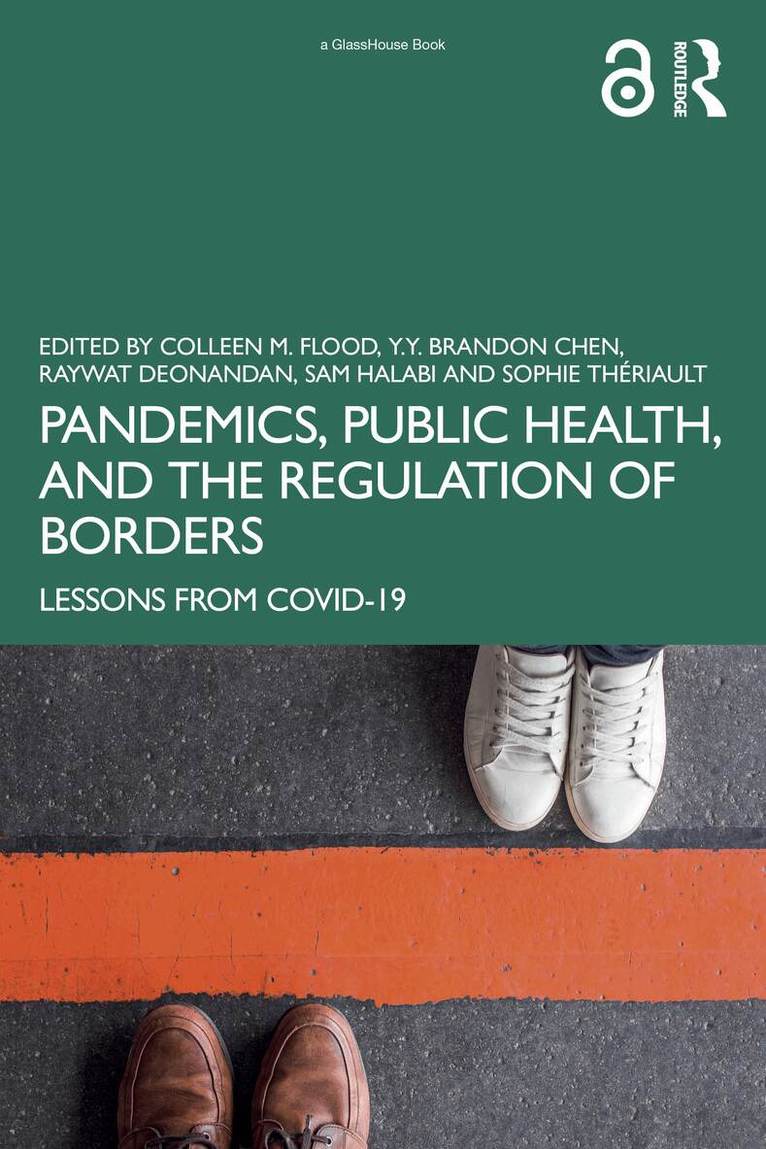
Pandemics, Public Health, and the Regulation of Borders
Lessons from COVID-19
Inbunden, Engelska, 2024
1 932 kr
Skickas inom 10-15 vardagar
This book examines how the COVID-19 pandemic has engendered a new and challenging environment in which borders drawn around people, places, and social structures have hardened and new ones have emerged.Over the course of the COVID-19 pandemic, borders closed or became unwelcoming at the international, national, sub-national, and local levels. Debate persists as to whether those countries and territories that tightly managed their borders, like New Zealand, Australia, or Hong Kong, got it ‘right’ compared to those that did not. Without doubt, a majority of those who suffered and died throughout the pandemic have been those from vulnerable populations. Yet on the other hand, efforts taken to manage the spread of the disease, such as through border management, have also disproportionately affected those who are most vulnerable. How then is the right balance to be struck, acknowledging, too, the economic and other imperatives that may dissuade governments from taking public health steps? This book considers how international organizations, countries, and institutions within those countries should conceive of, and manage, borders as the world continues to struggle with COVID-19 and prepares for the next pandemic. Engaging a range of international, and sub-national, examples, the book thematizes the main issues at stake in the control and management of borders in the interests of public health.This book will be of considerable interest to academics in the fields of health law, anthropology, economics, history, medicine, public health, and political science, as well as policymakers and public health planners at national and sub-national levels.
528 kr
Skickas inom 10-15 vardagar
This book examines how the COVID-19 pandemic has engendered a new and challenging environment in which borders drawn around people, places, and social structures have hardened and new ones have emerged.Over the course of the COVID-19 pandemic, borders closed or became unwelcoming at the international, national, sub-national, and local levels. Debate persists as to whether those countries and territories that tightly managed their borders, like New Zealand, Australia, or Hong Kong, got it ‘right’ compared to those that did not. Without doubt, a majority of those who suffered and died throughout the pandemic have been those from vulnerable populations. Yet on the other hand, efforts taken to manage the spread of the disease, such as through border management, have also disproportionately affected those who are most vulnerable. How then is the right balance to be struck, acknowledging, too, the economic and other imperatives that may dissuade governments from taking public health steps? This book considers how international organizations, countries, and institutions within those countries should conceive of, and manage, borders as the world continues to struggle with COVID-19 and prepares for the next pandemic. Engaging a range of international, and sub-national, examples, the book thematizes the main issues at stake in the control and management of borders in the interests of public health.This book will be of considerable interest to academics in the fields of health law, anthropology, economics, history, medicine, public health, and political science, as well as policymakers and public health planners at national and sub-national levels.
2 167 kr
Skickas inom 10-15 vardagar
This book maps the encounters between Indigenous Peoples and local communities with mining companies in various postcolonial contexts.Combining comparative and multidisciplinary analysis, the contributors to this volume shine a light on how the mining industry might adapt its practices to the political and legal contexts where they operate. Understanding these processes and how communities respond to these encounters is critical to documenting where and how encounters with mining may benefit or negatively impact Indigenous Peoples. The experiences and reflections shared by Indigenous and non-Indigenous contributors will enhance our understanding of evolving practices and of the different strategies and discourses developed by Indigenous Peoples to deal with mining projects. By mobilizing in-depth fieldwork in five regions—Australia, Canada, Sweden, New Caledonia, and Brazil—this body of work highlights voices often marginalized in mining development studies, including those of Indigenous Peoples and women.This book will be of great interest to students and scholars of mining and the extractive industries, sustainable development, natural resource management, and Indigenous Peoples.The Open Access version of this book, available at http://www.taylorfrancis.com, has been made available under a Creative Commons Attribution-Non Commercial-No Derivatives (CC-BY-NC-ND) 4.0 license.
628 kr
Skickas inom 10-15 vardagar
This book maps the encounters between Indigenous Peoples and local communities with mining companies in various postcolonial contexts.Combining comparative and multidisciplinary analysis, the contributors to this volume shine a light on how the mining industry might adapt its practices to the political and legal contexts where they operate. Understanding these processes and how communities respond to these encounters is critical to documenting where and how encounters with mining may benefit or negatively impact Indigenous Peoples. The experiences and reflections shared by Indigenous and non-Indigenous contributors will enhance our understanding of evolving practices and of the different strategies and discourses developed by Indigenous Peoples to deal with mining projects. By mobilizing in-depth fieldwork in five regions—Australia, Canada, Sweden, New Caledonia, and Brazil—this body of work highlights voices often marginalized in mining development studies, including those of Indigenous Peoples and women.This book will be of great interest to students and scholars of mining and the extractive industries, sustainable development, natural resource management, and Indigenous Peoples.The Open Access version of this book, available at http://www.taylorfrancis.com, has been made available under a Creative Commons Attribution-Non Commercial-No Derivatives (CC-BY-NC-ND) 4.0 license.