Stanley Wenocur - Böcker
Visar alla böcker från författaren Stanley Wenocur. Handla med fri frakt och snabb leverans.
3 produkter
3 produkter
1 147 kr
Skickas inom 5-8 vardagar
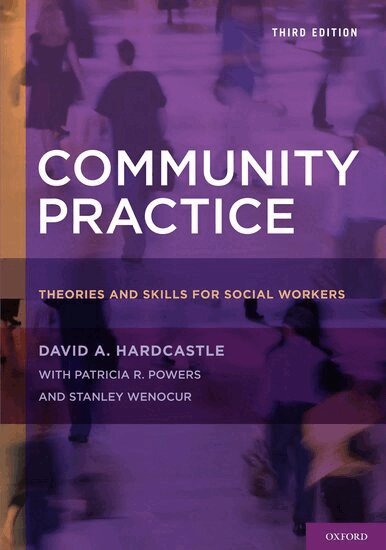
For almost two decades, Community Practice has been a definitive text for social workers, community practitioners, and students eager to help individuals contribute to and use community resources or work to change oppressive community structures. In this third edition, a wealth of new charts and cases spotlight the linkages between theoretical orientations and practical skills, with an enhanced emphasis on the inherently political nature of social work andcommunity practice. Boxes, examples, and exercises illustrate the range of skills and strategies available to savvy community practitioners in the 21st century, including networking, marketing and staging, political advocacy, and leveraging information and communication technologies. Other features include:- New material on community practice ethics, critical practice skills, community assessment and assets inventory and mapping, social problem analysis, and applying community practice skills to casework practice- Consideration of post-9/11 community challenges- Discussion on the changing ethnic composition of America and what this means for practitioners- An exploration of a vastly changed political landscape following the election of President Obama, the Great Recession, the rise of the Tea Party, and the increasing political and corporate use of pseudo-grassroots endeavors- A completely revamped instructor's manual available online at www.oup.com/us/companion.websites/communitypracticeThis fully revised classic text provides a comprehensive and integrated overview of the community theory and skills fundamental to all areas of social work practice. Broad in scope and intensive in analysis, it is suitable for undergraduate as well as graduate study. Community Practice offers students and practitioners the tools necessary to promote the welfare of individuals and communities by tapping into the ecological foundations of community and social work practice.
From Charity to Enterprise
The Development of American Social Work in a Market Economy
Häftad, Engelska, 2001
304 kr
Skickas inom 7-10 vardagar
How did social work evolve as a profession in the United States? Stanley Wenocur and Michael Reisch examine the history of social work and provide a theoretical model of professionalization for analyzing its development. They offer a provocative view of American social work as an enterprise seeking exclusive control over the definition, production, and distribution of an essential commodition. Now in paperback for the first time, From Charity to Enterprise sets the professionalization of social work into a dynamic social context. The explicit political and economic framework of Wenocur and Reisch's model enables the authors to examine how various subgroups within social work lost or gained control of the professional enterprise at various points.
2 029 kr
Skickas inom 10-15 vardagar
Social Work With Groups describes continuity and change in group work. It revisits the theoretical ideas of group work and group work topics of the past decade, focusing on the continuity of group work theory and practice. At the same time it emphasizes the need for change to more effectively work with deal with people in new groups in need--people with AIDS, gangs, persons in grief, and minorities, as well as groups always in need but now with new and additional needs--families, children, adolescents. This book deals with how to meet the needs of existing and emerging populations. It shows a good combination of theory and practice of group work in a variety of settings and using traditional techniques with new groups.Chapters in this book revisit the theoretical ideas of group work such as stages of development and the question of self-determination in groups. The sections of theory are the basis for the more practical emphasis of what today’s group worker is doing and how they are doing it. Social Work With Groups is very practice oriented. As such, anybody who uses groups to help people will find much to read and reflect upon. With its across-the-board appeal, persons new to group work will delight in the practical information, and experienced group workers will find the revisiting of the issues a helpful and refreshing approach. Clinical social workers and faculty with an interest in theory and theoretical approaches to group work will appreciate the theory addressed in the book. Social change oriented practitioners searching for new methods of empowerment among the people will find helpful suggestions in this book for social, political, and grassroots activism.