
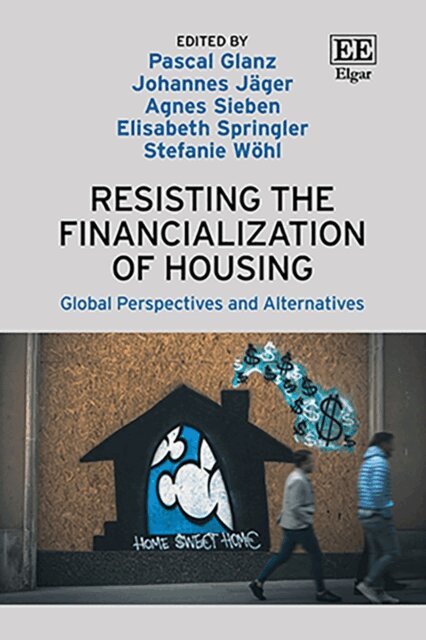
This insightful book explores the highly contextual nature of resistance to the financialization of housing. Examining global housing systems, it highlights the difficulty of transferring strategies across regions, and explains why financialization is used as an umbrella term for numerous distinct processes.Leading experts assess a variety of 'culprits' behind the financialization of housing, evaluating the role of institutions, social movements, grass roots initiatives and broader economic contexts. They advocate for an integrated method of analyzing these entry points and argue that stages of financialization must be understood as multi-level processes. Drawing on critical political economy and post-Keynesian economics, the book ultimately calls for a wider understanding of capitalist dynamics in order to synthesize various strategies for resisting financialization.Resisting the Financialization of Housing is an essential resource for scholars and students of sociology, social policy, public policy, inequalities and sustainable development. Government policymakers and financial regulators will also benefit from its actionable recommendations.
Against the backdrop of combating the financial and economic crisis in the European Union for the past decade, this volume strives to explore the manifold impacts the prevailing crisis management has on the further alignment of European Integration. The efforts targeted at overcoming the financial and economic crisis evoked far-reaching consequences on the societal, economic, and political level within European member states, which in turn challenge the institutional alignment, democratic legitimacy and economic coherence of the European Union. Taking into account current developments in the EU, the contributions presented in this volume focus on the ‘fault lines’ in the integration process, i.e. questions of policy coherence, democratic accountability, financialization, militarization, migration, gendered social and economic asymmetries as well as the rise of populist and extreme right-wing parties. The volume focuses on how these different developments come together by relating aspects of transdisciplinary research to uncover the fault lines in the European integration project in the subsequent chapters. ContentEconomic and Democratic Governance • Right Wing Populism and Right Extreme Parties • Financialization and Militarization • Social Exclusion, Welfare and Migration Policies EditorsProf. (FH) Dr. Stefanie Wöhl, University of Applied Sciences BFI Vienna. Prof. (FH) Dr. Elisabeth Springler, University of Applied Sciences BFI Vienna. Mag. Martin Pachel, University of Applied Sciences BFI Vienna. Dr. Bernhard Zeilinger, University of Applied Sciences BFI Vienna.
This insightful book explores the highly contextual nature of resistance to the financialization of housing. Examining global housing systems, it highlights the difficulty of transferring strategies across regions, and explains why financialization is used as an umbrella term for numerous distinct processes.Leading experts assess a variety of 'culprits' behind the financialization of housing, evaluating the role of institutions, social movements, grass roots initiatives and broader economic contexts. They advocate for an integrated method of analyzing these entry points and argue that stages of financialization must be understood as multi-level processes. Drawing on critical political economy and post-Keynesian economics, the book ultimately calls for a wider understanding of capitalist dynamics in order to synthesize various strategies for resisting financialization.Resisting the Financialization of Housing is an essential resource for scholars and students of sociology, social policy, public policy, inequalities and sustainable development. Government policymakers and financial regulators will also benefit from its actionable recommendations.
Against the backdrop of combating the financial and economic crisis in the European Union for the past decade, this volume strives to explore the manifold impacts the prevailing crisis management has on the further alignment of European Integration. The efforts targeted at overcoming the financial and economic crisis evoked far-reaching consequences on the societal, economic, and political level within European member states, which in turn challenge the institutional alignment, democratic legitimacy and economic coherence of the European Union. Taking into account current developments in the EU, the contributions presented in this volume focus on the ‘fault lines’ in the integration process, i.e. questions of policy coherence, democratic accountability, financialization, militarization, migration, gendered social and economic asymmetries as well as the rise of populist and extreme right-wing parties. The volume focuses on how these different developments come together by relating aspects of transdisciplinary research to uncover the fault lines in the European integration project in the subsequent chapters. ContentEconomic and Democratic Governance • Right Wing Populism and Right Extreme Parties • Financialization and Militarization • Social Exclusion, Welfare and Migration Policies EditorsProf. (FH) Dr. Stefanie Wöhl, University of Applied Sciences BFI Vienna. Prof. (FH) Dr. Elisabeth Springler, University of Applied Sciences BFI Vienna. Mag. Martin Pachel, University of Applied Sciences BFI Vienna. Dr. Bernhard Zeilinger, University of Applied Sciences BFI Vienna.