Stepan S. Batsanov – författare
Visar alla böcker från författaren Stepan S. Batsanov. Handla med fri frakt och snabb leverans.
7 produkter
7 produkter
Inbunden, Engelska, 1994
1 082 kr
Skickas inom 10-15 vardagar
In the 1950s explosives began to be used to generate ultrahigh pressures in condensed substances in order to modify their properties and structure. Notwithstanding the short duration of an explosion, its energy proved to be high enough to perform physical-chemical transformations of substances, and the new method gained wide industrial applications. It has both advan tages and drawbacks in comparison with the traditional method of static compression. The latter method, notorious for its cumbersome and expensive machin ery, allows one to maintain high pressure as long as one pleases and to regu late the temperature of the sample arbitrarily. But, the pressure available is rather limited and for any increase of this limit one has to pay by the progres sive shrinking of the working volume of a press. The dynamic method has the advantages of low cost and practically no restrictions of magnitude of pressure and the size of a processed sample, but the temperature in a compressed body is no longer controlled by an experi mentor. Rather, it is firmly dictated by the level of loading, according to the equation of state. Hence, it is difficult to recover metastable products and impossible to prepare solids with a low concentration of defects as the dura tion of explosion is too short for their elimination.
Häftad, Engelska, 2010
1 082 kr
Skickas inom 10-15 vardagar
In the 1950s explosives began to be used to generate ultrahigh pressures in condensed substances in order to modify their properties and structure. Notwithstanding the short duration of an explosion, its energy proved to be high enough to perform physical-chemical transformations of substances, and the new method gained wide industrial applications. It has both advan tages and drawbacks in comparison with the traditional method of static compression. The latter method, notorious for its cumbersome and expensive machin ery, allows one to maintain high pressure as long as one pleases and to regu late the temperature of the sample arbitrarily. But, the pressure available is rather limited and for any increase of this limit one has to pay by the progres sive shrinking of the working volume of a press. The dynamic method has the advantages of low cost and practically no restrictions of magnitude of pressure and the size of a processed sample, but the temperature in a compressed body is no longer controlled by an experi mentor. Rather, it is firmly dictated by the level of loading, according to the equation of state. Hence, it is difficult to recover metastable products and impossible to prepare solids with a low concentration of defects as the dura tion of explosion is too short for their elimination.
Inbunden, Engelska, 2012
2 138 kr
Skickas inom 10-15 vardagar
A concise description of models and quantitative parameters in structural chemistry and their interrelations, with 280 tables and >3000 references giving the most up-to-date experimental data on energy characteristics of atoms, molecules and crystals (ionisation potentials, electron affinities, bond energies, heats of phase transitions, band and lattice energies), optical properties (refractive index, polarisability), spectroscopic characteristics and geometrical parameters (bond distances and angles, coordination numbers) of substances in gaseous, liquid and solid states, in glasses and melts, for various thermodynamic conditions. Systems of metallic, covalent, ionic and van der Waals radii, effective atomic charges and other empirical and semi-empirical models are critically revised. Special attention is given to new and growing areas: structural studies of solids under high pressures and van der Waals molecules in gases. The book is addressed to researchers, academics, postgraduates and advanced-course students in crystallography, materials science, physical chemistry of solids.
Häftad, Engelska, 2014
1 751 kr
Skickas inom 10-15 vardagar
A concise description of models and quantitative parameters in structural chemistry and their interrelations, with 280 tables and >3000 references giving the most up-to-date experimental data on energy characteristics of atoms, molecules and crystals (ionisation potentials, electron affinities, bond energies, heats of phase transitions, band and lattice energies), optical properties (refractive index, polarisability), spectroscopic characteristics and geometrical parameters (bond distances and angles, coordination numbers) of substances in gaseous, liquid and solid states, in glasses and melts, for various thermodynamic conditions. Systems of metallic, covalent, ionic and van der Waals radii, effective atomic charges and other empirical and semi-empirical models are critically revised. Special attention is given to new and growing areas: structural studies of solids under high pressures and van der Waals molecules in gases. The book is addressed to researchers, academics, postgraduates and advanced-course students in crystallography, materials science, physical chemistry of solids.
Häftad, Engelska, 2016
540 kr
Skickas inom 10-15 vardagar
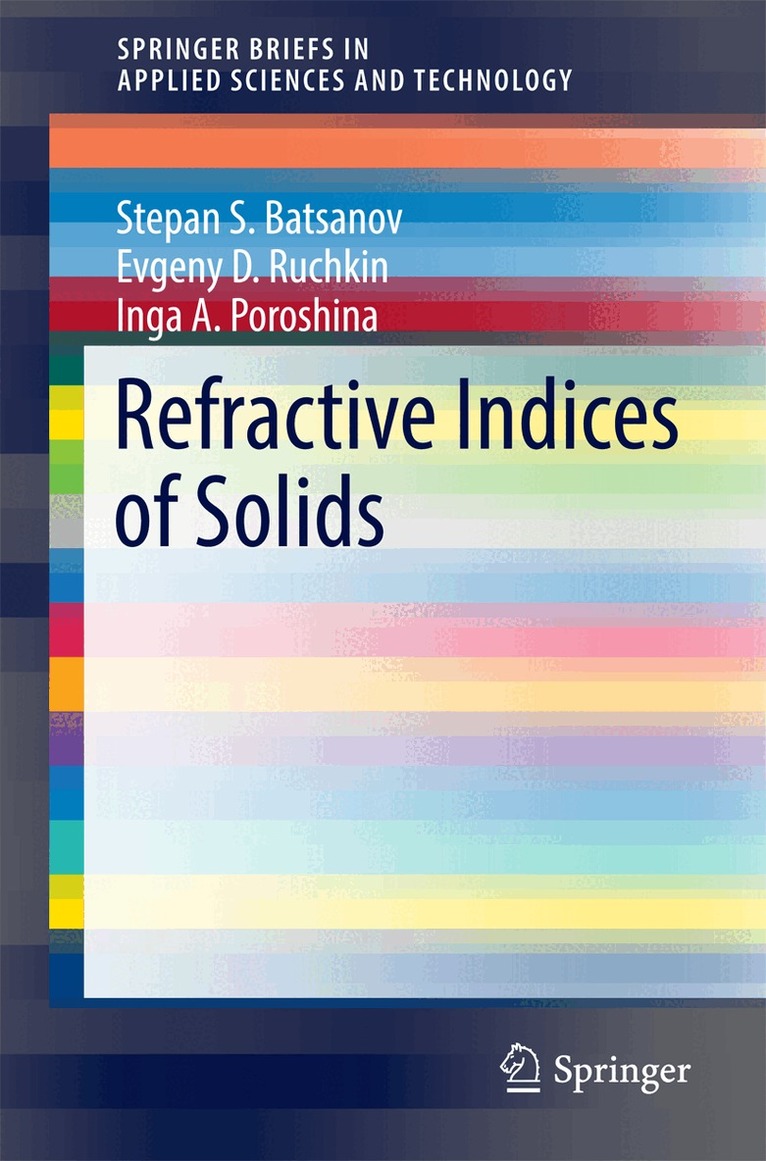
This book highlights the basics of crystal optics methods and refractive index (RI) measurement techniques in various solids, as well as their scientific and technological applications. In addition to new techniques for cases when traditional techniques are impractical, such as for highly refracting powders, anomalous dispersion of light in the studied solid, or for colloids, it also describes conventional methods of RI measurement.
Inbunden, Engelska, 2018
1 819 kr
Skickas inom 10-15 vardagar
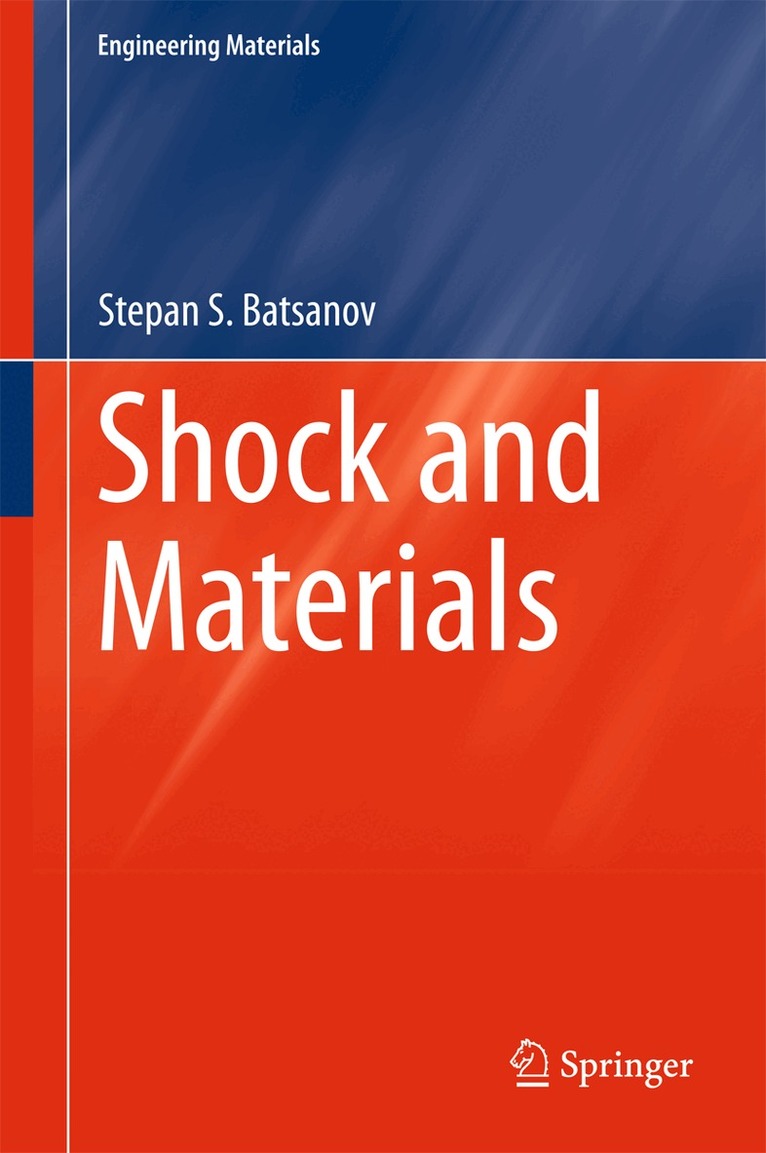
This book highlights how the properties and structure of materials are affected by dynamic high pressures generated by explosions, projectile impacts, laser compression, electric discharge or ball milling.
Häftad, Engelska, 2019
1 819 kr
Skickas inom 10-15 vardagar
This book highlights how the properties and structure of materials are affected by dynamic high pressures generated by explosions, projectile impacts, laser compression, electric discharge or ball milling.