Stephan Gerhard Huber - Böcker
Visar alla böcker från författaren Stephan Gerhard Huber. Handla med fri frakt och snabb leverans.
6 produkter
6 produkter
697 kr
Skickas inom 10-15 vardagar
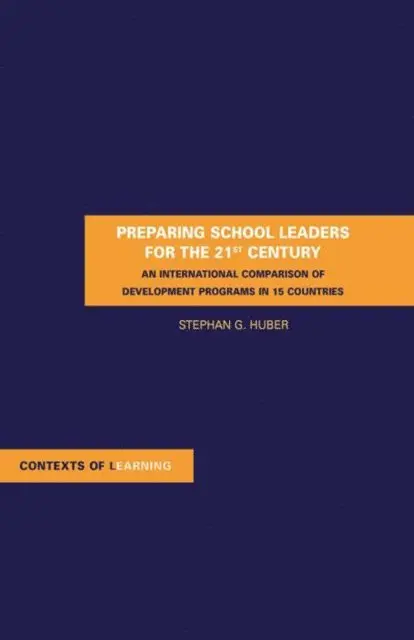
The quality and success of schools depend upon school leadership. Increasingly, in many countries worldwide, this belief has led to designing and implementing appropriate training and development programs for educational leaders. In an international comparative research project, current school leader training and development programs in fifteen countries across Europe, Asia, Australia, and North America are analyzed, compared, and discussed. Preparing School Leaders for the 21st Century provides insights and constructive ideas, for those planning and carrying out school leadership development in different countries and those conducting research in this field. * Part one in the book reflects on roles, tasks, competences, and conceptions of school leadership, exploring the changing context in which school leaders find themselves, focusing on the new demands on the school leaders and suitable leadership theories. * Part two provides a comparative discussion of the various leadership development models, identifying similarities and differences, based on a set of criteria selected and going beyond a mere juxtaposition. In describing common issues and challenges, it also looks for common solutions, and considers what the different countries might be able to learn from each other, and successfully transfer. * Part three identifies current international trends deduced from these programs. Nineteen recommendations for designing future programs are outlined, and instructive examples of best and promising practice are given. * Part four comprises well structured country reports, which provide information about the education system and school system of those countries, about recent changes and their impact on school leadership, about the overall school leader training and development approach.
1 229 kr
Kommande
Der Begriff der Innovation adressiert das Neue, zielt auf Verbesserung bestehender Lösungen für technologische oder soziale Herausforderungen und setzt die Generierung, Übersetzung und Anwendung neuen Wissens voraus. Grundlage für Innovation sind Kreativität und Offenheit im individuellen, kollektiven und organisationalen Kontext. In Organisationen ist Innovation daher eng mit organisationalem Lernen verknüpft. Im vorliegenden Jahrbuch wird das Thema Organisation und Innovation aus organisationspädagogischer Perspektive sowohl theoretisch als auch empirisch anhand folgender Schwerpunkte diskutiert: · Gesellschaftliche Transformation und organisationale Innovation · Organisationale Gestaltung und Innovation · Organisationales Lernen und Innovation · Organisationale Innovation zwischen Erfolg und Scheitern
605 kr
Skickas inom 10-15 vardagar
Kooperation
Aktuelle Forschung zur Kooperation in und zwischen Schulen sowie mit anderen Partnern
Häftad, Tyska, 2019
706 kr
Skickas inom 5-8 vardagar
Schule gemeinsam gestalten - Entwicklung von Kompetenzen für pädagogische Führung
Beiträge zu Leadership in der Lehrerbildung
Häftad, Tyska, 2021
541 kr
Skickas inom 5-8 vardagar
2 635 kr
Skickas inom 10-15 vardagar
The quality and success of schools depend upon school leadership. Increasingly, in many countries worldwide, this belief has led to designing and implementing appropriate training and development programs for educational leaders. In an international comparative research project, current school leader training and development programs in fifteen countries across Europe, Asia, Australia, and North America are analyzed, compared, and discussed. Preparing School Leaders for the 21st Century provides insights and constructive ideas, for those planning and carrying out school leadership development in different countries and those conducting research in this field. * Part one in the book reflects on roles, tasks, competences, and conceptions of school leadership, exploring the changing context in which school leaders find themselves, focusing on the new demands on the school leaders and suitable leadership theories. * Part two provides a comparative discussion of the various leadership development models, identifying similarities and differences, based on a set of criteria selected and going beyond a mere juxtaposition. In describing common issues and challenges, it also looks for common solutions, and considers what the different countries might be able to learn from each other, and successfully transfer. * Part three identifies current international trends deduced from these programs. Nineteen recommendations for designing future programs are outlined, and instructive examples of best and promising practice are given. * Part four comprises well structured country reports, which provide information about the education system and school system of those countries, about recent changes and their impact on school leadership, about the overall school leader training and development approach.