Stéphane Roux – författare
Visar alla böcker från författaren Stéphane Roux. Handla med fri frakt och snabb leverans.
6 produkter
6 produkter
Häftad, Engelska, 1991
1 073 kr
Skickas inom 10-15 vardagar
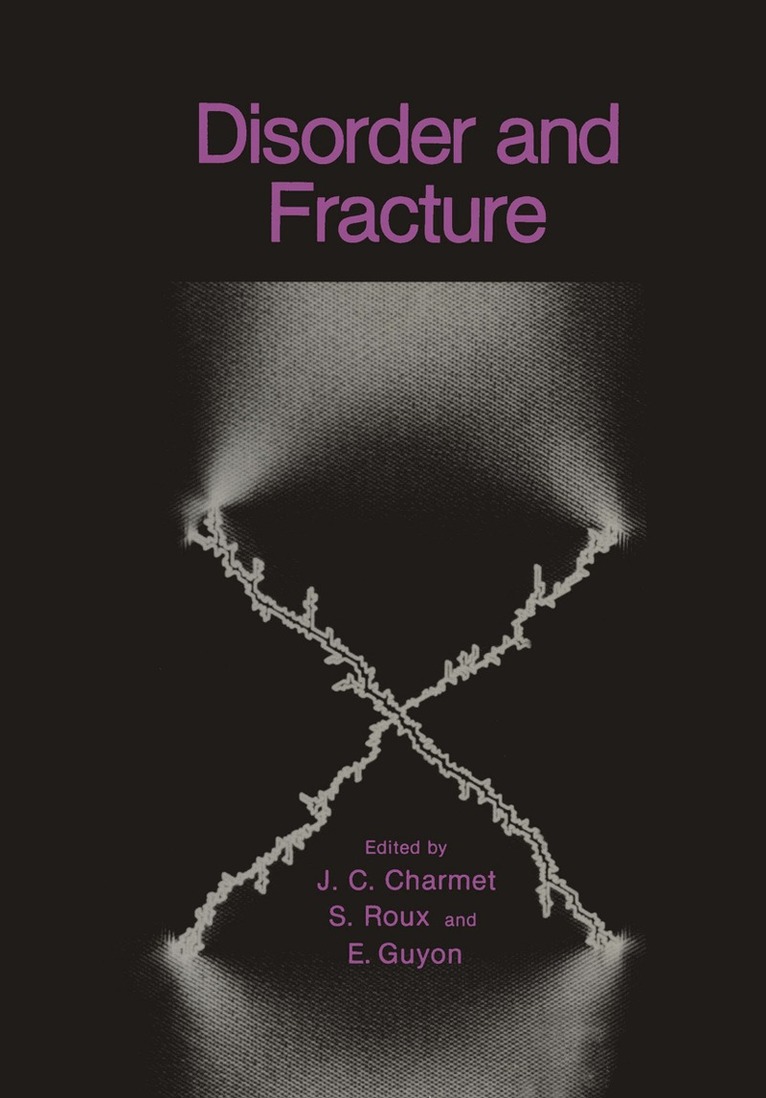
Fracture, and particularly brittle fracture, is a good example of an instability. For a homogeneous solid, subjected to a uniform stress field, a crack may appear anywhere in the structure once the threshold stress is reached. However, once a crack has been nucleated in some place, further damage in the solid will in most cases propagate from the initial crack, and not somewhere else in the solid. In this sense fracture is an unstable process. This property makes the process extremely sensitive to any heterogeneity present in the medium, which selects the location of the first crack nucleated. In particular, fracture appears to be very sensitive to disorder, which can favor or impede local cracks. Therefore, in most realistic cases, a good description of fracture mechanics should include the effect of disorder. Recently this need has motivated work in this direction starting from the usual description of fracture mechanics. Parallel with this first trend, statistical physics underwent a very important development in the description of disordered systems. In particular, let us mention the emergence of some "new" concepts (such as fractals, scaling laws, finite size effects, and so on) in this field. However, many models considered were rather simple and well adapted to theoretical or numerical introduction into a complex body of problems. An example of this can be found in percolation theory. This area is now rather well understood and accurately described.
Inbunden, Engelska, 2001
866 kr
Skickas inom 10-15 vardagar
This wide-ranging survey of the physical aspects of fracture shows that the old barriers between different scales will soon themselves fracture. It is no longer unrealistic to imagine that a crack initiated through a molecular dynamics description could be propagated at the grain level thanks to dislocation dynamics included in a crystal plasticity model, itself implemented in a finite element code. Linking what happens at the atomic scale to fracture of structures as large as a dam is the new emerging challenge. The volume includes papers on most materials of practical interest from concrete to ceramics through metallic alloys, glasses, polymers and composite materials. The classical fields of fracture mechanisms are addressed. Brittle and ductile fractures are considered. The text is carefully balanced between experiments, simulations and theoretical models, and between the contributions by the various communities. New topics of damage and fracture mechanics are also explored, such as the effect of disorder and statistical aspects, dynamic fracture, friction and fracture of interfaces.
Häftad, Engelska, 2001
544 kr
Skickas inom 10-15 vardagar
The main scope of this Cargese NATO Advanced Study Institute (June 5-17 2000) was to bring together a number of international experts, covering a large spectrum of the various Physical Aspects of Fracture. As a matter of fact, lecturers as well as participants were coming from various scientific communities: mechanics, physics, materials science, with the common objective of progressing towards a multi-scale description of fracture. This volume includes papers on most materials of practical interest: from concrete to ceramics through metallic alloys, glasses, polymers and composite materials. The classical fields of damage and fracture mechanisms are addressed (critical and sub-critical quasi-static crack propagation, stress corrosion, fatigue, fatigue-corrosion . . . . as well as dynamic fracture). Brittle and ductile fractures are considered and a balance has been carefully kept between experiments, simulations and theoretical models, and between the contributions of the various communities. New topics in damage and fracture mechanics - the effect of disorder and statistical aspects, dynamic fracture, friction and fracture of interfaces - were also explored. This large overview on the Physical Aspects of Fracture shows that the old barriers built between the different scales will soon "fracture". It is no more unrealistic to imagine that a crack initiated through a molecular dynamics description could be propagated at the grain level thanks to dislocation dynamics included in a crystal plasticity model, itself implemented in a finite element code. Linking what happens at the atomic scale to fracture of structures as large as a dam is the new emerging challenge.
E-bok
PDF, Engelska, 20131 367 kr
Läs direkt efter köp
Fracture, and particularly brittle fracture, is a good example of an instability. For a homogeneous solid, subjected to a uniform stress field, a crack may appear anywhere in the structure once the threshold stress is reached. However, once a crack has been nucleated in some place, further damage in the solid will in most cases propagate from the initial crack, and not somewhere else in the solid. In this sense fracture is an unstable process. This property makes the process extremely sensitive to any heterogeneity present in the medium, which selects the location of the first crack nucleated. In particular, fracture appears to be very sensitive to disorder, which can favor or impede local cracks. Therefore, in most realistic cases, a good description of fracture mechanics should include the effect of disorder. Recently this need has motivated work in this direction starting from the usual description of fracture mechanics. Parallel with this first trend, statistical physics underwent a very important development in the description of disordered systems. In particular, let us mention the emergence of some "new" concepts (such as fractals, scaling laws, finite size effects, and so on) in this field. However, many models considered were rather simple and well adapted to theoretical or numerical introduction into a complex body of problems. An example of this can be found in percolation theory. This area is now rather well understood and accurately described.
Inbunden, Tyska, 2024
410 kr
Skickas inom 3-6 vardagar
E-bok
PDF, Engelska, 2012687 kr
Läs direkt efter köp
The main scope of this Cargese NATO Advanced Study Institute (June 5-17 2000) was to bring together a number of international experts, covering a large spectrum of the various Physical Aspects of Fracture. As a matter of fact, lecturers as well as participants were coming from various scientific communities: mechanics, physics, materials science, with the common objective of progressing towards a multi-scale description of fracture. This volume includes papers on most materials of practical interest: from concrete to ceramics through metallic alloys, glasses, polymers and composite materials. The classical fields of damage and fracture mechanisms are addressed (critical and sub-critical quasi-static crack propagation, stress corrosion, fatigue, fatigue-corrosion . . . . as well as dynamic fracture). Brittle and ductile fractures are considered and a balance has been carefully kept between experiments, simulations and theoretical models, and between the contributions of the various communities. New topics in damage and fracture mechanics - the effect of disorder and statistical aspects, dynamic fracture, friction and fracture of interfaces - were also explored. This large overview on the Physical Aspects of Fracture shows that the old barriers built between the different scales will soon "fracture". It is no more unrealistic to imagine that a crack initiated through a molecular dynamics description could be propagated at the grain level thanks to dislocation dynamics included in a crystal plasticity model, itself implemented in a finite element code. Linking what happens at the atomic scale to fracture of structures as large as a dam is the new emerging challenge.