Stephen Coombes – författare
Visar alla böcker från författaren Stephen Coombes. Handla med fri frakt och snabb leverans.
8 produkter
8 produkter
148 kr
Skickas
This is the first of two volumes of music from the big country. Following the success of 'French Romantic Repertoire' and 'Russian Romantic Repertoire', Stephen Coombs has once again selected music from a diverse range of styles and composers, this time from America. They are presented in this volume designed to stretch pianists and delight audiences the world over.**ABRSM selected piece (Piano 2019-2020): Lullaby, Op. 10**Trinity College London selected piece (Piano 2012-2014): Summer Song (MacDowell)
Del 75 - Texts in Applied Mathematics
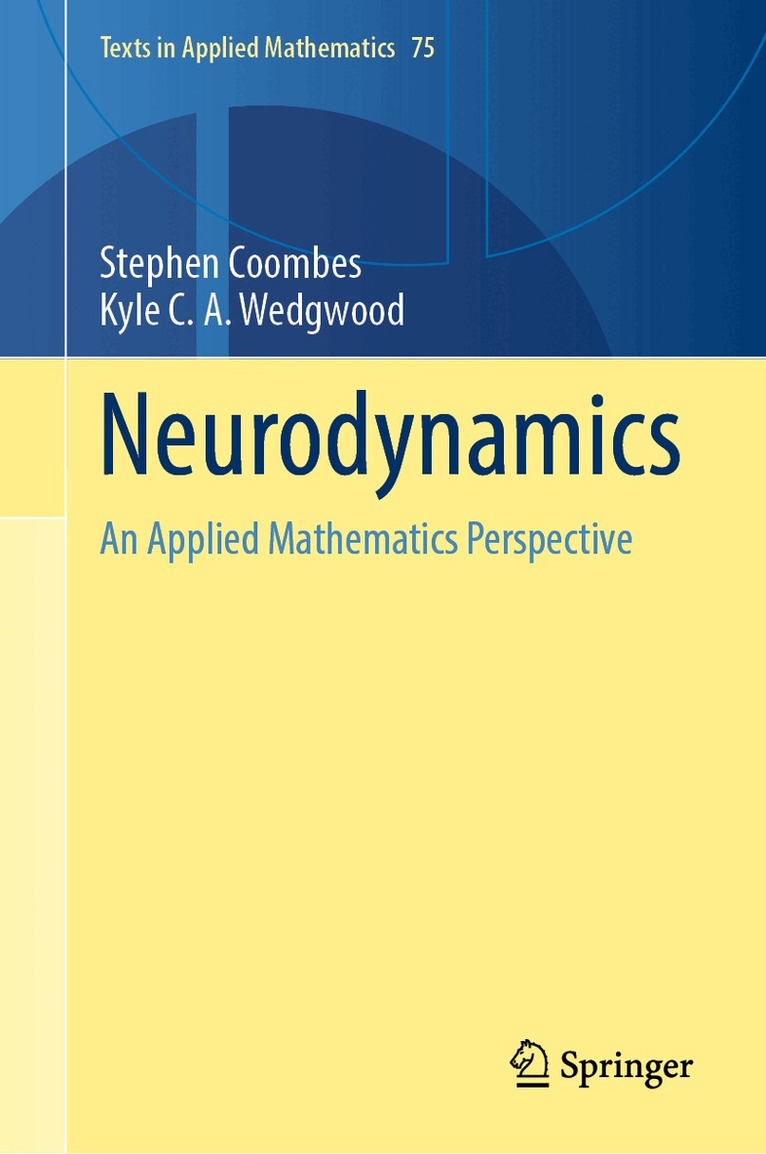
Neurodynamics
An Applied Mathematics Perspective
Inbunden, Engelska, 2023
873 kr
Skickas inom 10-15 vardagar
This book is about the dynamics of neural systems and should be suitable for those with a background in mathematics, physics, or engineering who want to see how their knowledge and skill sets can be applied in a neurobiological context. No prior knowledge of neuroscience is assumed, nor is advanced understanding of all aspects of applied mathematics! Rather, models and methods are introduced in the context of a typical neural phenomenon and a narrative developed that will allow the reader to test their understanding by tackling a set of mathematical problems at the end of each chapter. The emphasis is on mathematical- as opposed to computational-neuroscience, though stresses calculation above theorem and proof. The book presents necessary mathematical material in a digestible and compact form when required for specific topics. The book has nine chapters, progressing from the cell to the tissue, and an extensive set of references. It includes Markov chain models for ions,differential equations for single neuron models, idealised phenomenological models, phase oscillator networks, spiking networks, and integro-differential equations for large scale brain activity, with delays and stochasticity thrown in for good measure. One common methodological element that arises throughout the book is the use of techniques from nonsmooth dynamical systems to form tractable models and make explicit progress in calculating solutions for rhythmic neural behaviour, synchrony, waves, patterns, and their stability. This book was written for those with an interest in applied mathematics seeking to expand their horizons to cover the dynamics of neural systems. It is suitable for a Masters level course or for postgraduate researchers starting in the field of mathematical neuroscience.
E-bok
Engelska, 2023840 kr
Läs direkt efter köp
This book is about the dynamics of neural systems and should be suitable for those with a background in mathematics, physics, or engineering who want to see how their knowledge and skill sets can be applied in a neurobiological context. No prior knowledge of neuroscience is assumed, nor is advanced understanding of all aspects of applied mathematics! Rather, models and methods are introduced in the context of a typical neural phenomenon and a narrative developed that will allow the reader to test their understanding by tackling a set of mathematical problems at the end of each chapter. The emphasis is on mathematical- as opposed to computational-neuroscience, though stresses calculation above theorem and proof. The book presents necessary mathematical material in a digestible and compact form when required for specific topics. The book has nine chapters, progressing from the cell to the tissue, and an extensive set of references. It includes Markov chain models for ions,differential equations for single neuron models, idealised phenomenological models, phase oscillator networks, spiking networks, and integro-differential equations for large scale brain activity, with delays and stochasticity thrown in for good measure. One common methodological element that arises throughout the book is the use of techniques from nonsmooth dynamical systems to form tractable models and make explicit progress in calculating solutions for rhythmic neural behaviour, synchrony, waves, patterns, and their stability. This book was written for those with an interest in applied mathematics seeking to expand their horizons to cover the dynamics of neural systems. It is suitable for a Masters level course or for postgraduate researchers starting in the field of mathematical neuroscience.
Engelska, 2023
625 kr
Skickas inom 5-8 vardagar
Del 75 - Texts in Applied Mathematics
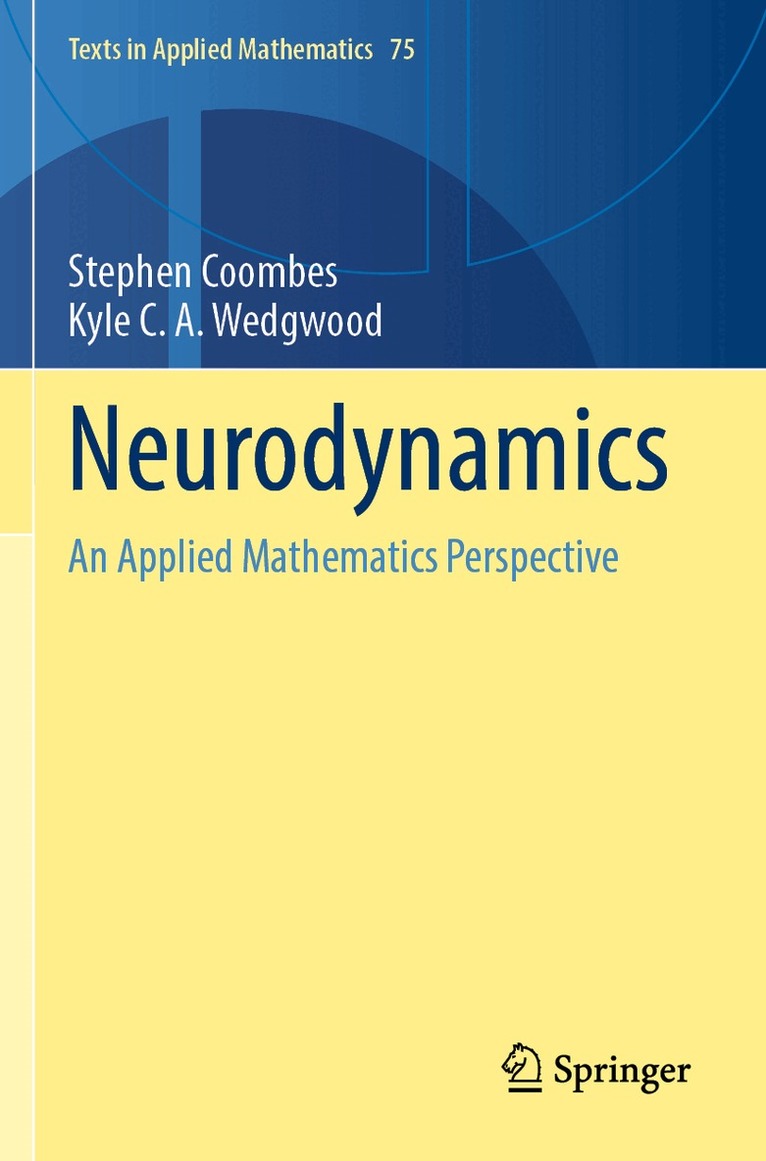
Neurodynamics
An Applied Mathematics Perspective
Häftad, Engelska, 2024
657 kr
Skickas inom 10-15 vardagar
This book is about the dynamics of neural systems and should be suitable for those with a background in mathematics, physics, or engineering who want to see how their knowledge and skill sets can be applied in a neurobiological context. No prior knowledge of neuroscience is assumed, nor is advanced understanding of all aspects of applied mathematics! Rather, models and methods are introduced in the context of a typical neural phenomenon and a narrative developed that will allow the reader to test their understanding by tackling a set of mathematical problems at the end of each chapter. The emphasis is on mathematical- as opposed to computational-neuroscience, though stresses calculation above theorem and proof. The book presents necessary mathematical material in a digestible and compact form when required for specific topics. The book has nine chapters, progressing from the cell to the tissue, and an extensive set of references. It includes Markov chain models for ions,differential equations for single neuron models, idealised phenomenological models, phase oscillator networks, spiking networks, and integro-differential equations for large scale brain activity, with delays and stochasticity thrown in for good measure. One common methodological element that arises throughout the book is the use of techniques from nonsmooth dynamical systems to form tractable models and make explicit progress in calculating solutions for rhythmic neural behaviour, synchrony, waves, patterns, and their stability. This book was written for those with an interest in applied mathematics seeking to expand their horizons to cover the dynamics of neural systems. It is suitable for a Masters level course or for postgraduate researchers starting in the field of mathematical neuroscience.
Inbunden, Engelska, 2014
1 198 kr
Skickas inom 10-15 vardagar
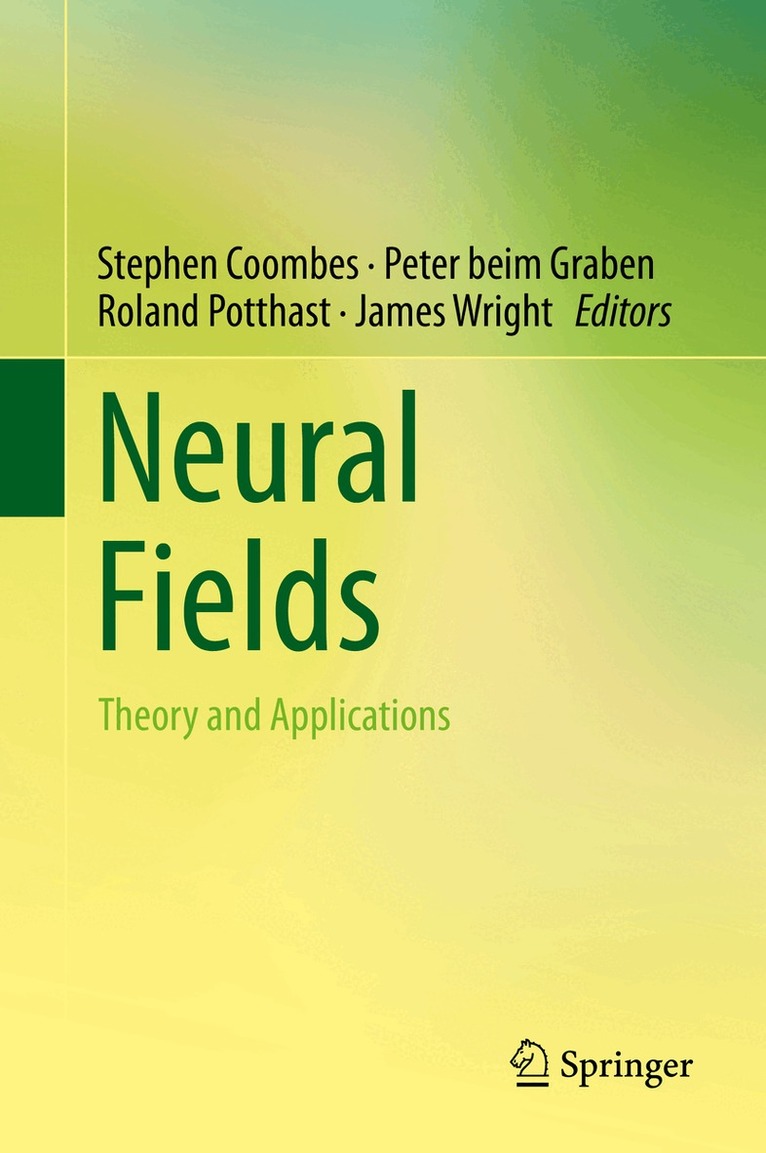
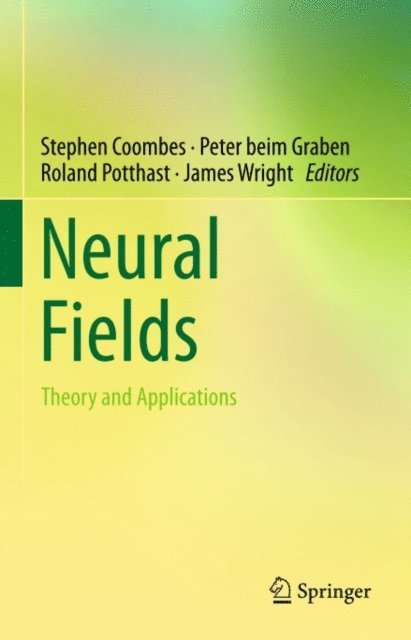
Neural field theory has a long-standing tradition in the mathematical and computational neurosciences.
E-bok
PDF, Engelska, 20141 474 kr
Läs direkt efter köp
Neural field theory has a long-standing tradition in the mathematical and computational neurosciences. Beginning almost 50 years ago with seminal work by Griffiths and culminating in the 1970ties with the models of Wilson and Cowan, Nunez and Amari, this important research area experienced a renaissance during the 1990ties by the groups of Ermentrout, Robinson, Bressloff, Wright and Haken. Since then, much progress has been made in both, the development of mathematical and numerical techniques and in physiological refinement und understanding. In contrast to large-scale neural network models described by huge connectivity matrices that are computationally expensive in numerical simulations, neural field models described by connectivity kernels allow for analytical treatment by means of methods from functional analysis. Thus, a number of rigorous results on the existence of bump and wave solutions or on inverse kernel construction problems are nowadays available. Moreover, neural fields provide an important interface for the coupling of neural activity to experimentally observable data, such as the electroencephalogram (EEG) or functional magnetic resonance imaging (fMRI). And finally, neural fields over rather abstract feature spaces, also called dynamic fields, found successful applications in the cognitive sciences and in robotics. Up to now, research results in neural field theory have been disseminated across a number of distinct journals from mathematics, computational neuroscience, biophysics, cognitive science and others. There is no comprehensive collection of results or reviews available yet. With our proposed book Neural Field Theory, we aim at filling this gap in the market. We received consent from some of the leading scientists in the field, who are willing to write contributions for the book, among them are two of the founding-fathers of neural field theory: Shun-ichi Amari and Jack Cowan.
Häftad, Engelska, 2016
1 198 kr
Skickas inom 10-15 vardagar
Neural field theory has a long-standing tradition in the mathematical and computational neurosciences. Beginning almost 50 years ago with seminal work by Griffiths and culminating in the 1970ties with the models of Wilson and Cowan, Nunez and Amari, this important research area experienced a renaissance during the 1990ties by the groups of Ermentrout, Robinson, Bressloff, Wright and Haken. Since then, much progress has been made in both, the development of mathematical and numerical techniques and in physiological refinement und understanding. In contrast to large-scale neural network models described by huge connectivity matrices that are computationally expensive in numerical simulations, neural field models described by connectivity kernels allow for analytical treatment by means of methods from functional analysis. Thus, a number of rigorous results on the existence of bump and wave solutions or on inverse kernel construction problems are nowadays available. Moreover, neural fields provide an important interface for the coupling of neural activity to experimentally observable data, such as the electroencephalogram (EEG) or functional magnetic resonance imaging (fMRI). And finally, neural fields over rather abstract feature spaces, also called dynamic fields, found successful applications in the cognitive sciences and in robotics. Up to now, research results in neural field theory have been disseminated across a number of distinct journals from mathematics, computational neuroscience, biophysics, cognitive science and others. There is no comprehensive collection of results or reviews available yet. With our proposed book Neural Field Theory, we aim at filling this gap in the market. We received consent from some of the leading scientists in the field, who are willing to write contributions for the book, among them are two of the founding-fathers of neural field theory: Shun-ichi Amari and Jack Cowan.