Stephen Day - Böcker
Visar alla böcker från författaren Stephen Day. Handla med fri frakt och snabb leverans.
8 produkter
8 produkter
1 075 kr
Skickas inom 10-15 vardagar
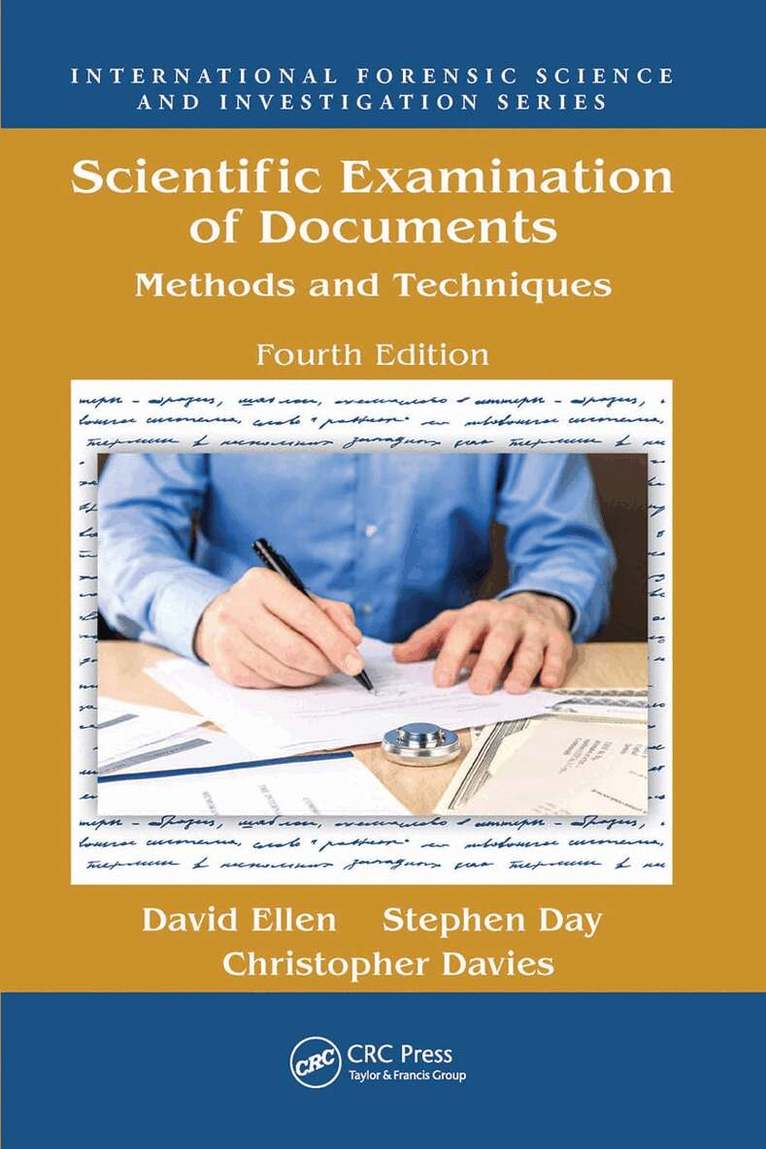
Revised and expanded to reflect the most recent innovations in the field, The Scientific Examination of Documents, Fourth Edition is a handy, accessible volume detailing current best-practices for forensic document examination. Since the first edition published in 1989, there have been drastic changes in the field of forensic document examination—both from the use of the analytic techniques available to the professional examiner—and the changes to technology in office and printing equipment and inks. The purpose of analyzing any material used in the production of a questioned document, such as an ink or a piece of paper, is to compare it with another material elsewhere in the questioned document itself—or on another document—to determine whether or not they share a common origin. There may also be a need to provide information for the investigator about the possible origins of the document. This latest edition reflects the myriad changes and advances that have occurred in the last 10 to 15 years. Topics covered include: current thinking on handwriting interpretation; accidental and deliberate modification of handwriting; the proper collection of samples; a discussion of shredded documents; professional accreditation standards, qualifications, and training; and modern digital imaging and analysis of documents and handwriting utilizing software and imaging, including reconstruction of an image from erasures, obliteration and other document altering methods. A new section addresses cognitive bias and Chapter 8 is completely updated to cover the advances in print and photocopied documents, based on current technology, and analytical developments in the comparison of such documents.Key features: Discusses issues regarding handwritten, photocopied, and printed documents—including inkjet versus digital printing Presents the advances and capabilities modern office fax, photocopy, and printing technologies—and implications for document examination Details and reinforces the importance of ensuring proper scientific methods during an examination Addresses current Raman spectroscopy, UV-VIS, mass spectroscopy, and SEM analysis techniques Highlights the importance, and implications, of biological and fingerprint evidence from documents that can be collected, examined, and utilized in a case The Scientific Examination of Documents, Fourth Edition serves as an invaluable resource to established professionals, those just entering the field, and legal and investigative professionals outside the discipline who have a professional interest dealing with questioned documents in the course of their work.
288 kr
Skickas inom 3-6 vardagar
184 kr
Skickas inom 7-10 vardagar
Prepare Your Child to Earn, Save, and Spend Wisely· A fun, game-like approach to start children on a path to solid values and healthy habits surrounding money· Proven, research-based practice for establishing a household mini-economy· Makes financial education engaging and effectiveSome of the toughest choices we make in adult life are about money, and so often we feel uninformed, unsure, and ill-prepared. We want better for our kids, but how do we teach them the things we never quite learned?Teach a Kid to Save is your go-to, hands-on, research-based guide to teaching your kids about the wise use of money and the value of work through an innovative, interactive mini-economy. In the mini-economy, kids have jobs, earn a play-money income, make a plan for their money, shop at the household store, and even create their own businesses. The mini-economy gives kids a chance to practice making meaningful choices about money and work, helping them build healthy lifelong habits. With chapters on work, rest, generosity, saving, spending, and entrepreneurship, as well as a quick-start guide, templates, visual aids, conversation starters, and a special appendix for homeschools, Teach a Kid to Save is the all-in-one resource you've been waiting for.
859 kr
Skickas inom 7-10 vardagar
Intended for undergraduate and graduate courses in plant development, this book explains how the cells of a plant acquire and maintain their specific fates. Plant development is a continuous process occurring throughout the life cycle, with similar regulatory mechanisms acting at different stages and in different parts of the plant. Rather than focussing on the life cycle, the book is structured around these underlying mechanisms, using case studies to provide students with a framework to understand the many factors, both environmental and endogenous, that combine to regulate development and generate the enormous diversity of plant forms. New approach to the study of plant development and a refreshing look at this fast-moving area. Authors focus their discussion on the basic mechanisms which underpin plant development, tackling the fundamental question of how a single cell becomes a complex flowering plant from a cellular perspective. An up-to-date, modern text in plant development for advanced level undergraduates and postgraduates in plant science. Thought-provoking treatment of a difficult subject, the text will satisfy the needs of advanced level undergraduates and postgraduates in plant science. Experimental case studies throughout. The artwork from the book is available at www.blackwellpublishing.com/leyser
447 kr
Skickas inom 5-8 vardagar
2 103 kr
Skickas inom 10-15 vardagar
Revised and expanded to reflect the most recent innovations in the field, The Scientific Examination of Documents, Fourth Edition is a handy, accessible volume detailing current best-practices for forensic document examination. Since the first edition published in 1989, there have been drastic changes in the field of forensic document examination—both from the use of the analytic techniques available to the professional examiner—and the changes to technology in office and printing equipment and inks. The purpose of analyzing any material used in the production of a questioned document, such as an ink or a piece of paper, is to compare it with another material elsewhere in the questioned document itself—or on another document—to determine whether or not they share a common origin. There may also be a need to provide information for the investigator about the possible origins of the document. This latest edition reflects the myriad changes and advances that have occurred in the last 10 to 15 years. Topics covered include: current thinking on handwriting interpretation; accidental and deliberate modification of handwriting; the proper collection of samples; a discussion of shredded documents; professional accreditation standards, qualifications, and training; and modern digital imaging and analysis of documents and handwriting utilizing software and imaging, including reconstruction of an image from erasures, obliteration and other document altering methods. A new section addresses cognitive bias and Chapter 8 is completely updated to cover the advances in print and photocopied documents, based on current technology, and analytical developments in the comparison of such documents.Key features: Discusses issues regarding handwritten, photocopied, and printed documents—including inkjet versus digital printing Presents the advances and capabilities modern office fax, photocopy, and printing technologies—and implications for document examination Details and reinforces the importance of ensuring proper scientific methods during an examination Addresses current Raman spectroscopy, UV-VIS, mass spectroscopy, and SEM analysis techniques Highlights the importance, and implications, of biological and fingerprint evidence from documents that can be collected, examined, and utilized in a caseThe Scientific Examination of Documents, Fourth Edition serves as an invaluable resource to established professionals, those just entering the field, and legal and investigative professionals outside the discipline who have a professional interest dealing with questioned documents in the course of their work.
952 kr
Skickas inom 7-10 vardagar
This book introduces magnetic bearings--mechatronic devices that produce contact-free electromagnetic force to support a load, such as a moving train or a spinning rotor. Compared to traditional bearings, magnetic bearings offer several advantages: no friction, low heat generation, no required lubrication, quiet operation, and fast and stable rotation. For these reasons, magnetic bearings have been used in rotary ventricular assist devices (VADs) to increase design life, reduce or eliminate material wear and bearing maintenance, as well as to increase biocompatibility by eliminating high fluid stresses and heat generation, both of which are associated with hemolysis, platelet activation and aggregation, and thrombus growth. The book covers the principles of these bearings, how they are used in integrated control and electronics systems, and useful information on several major brands of current assist devices.
286 kr
Skickas inom 5-8 vardagar