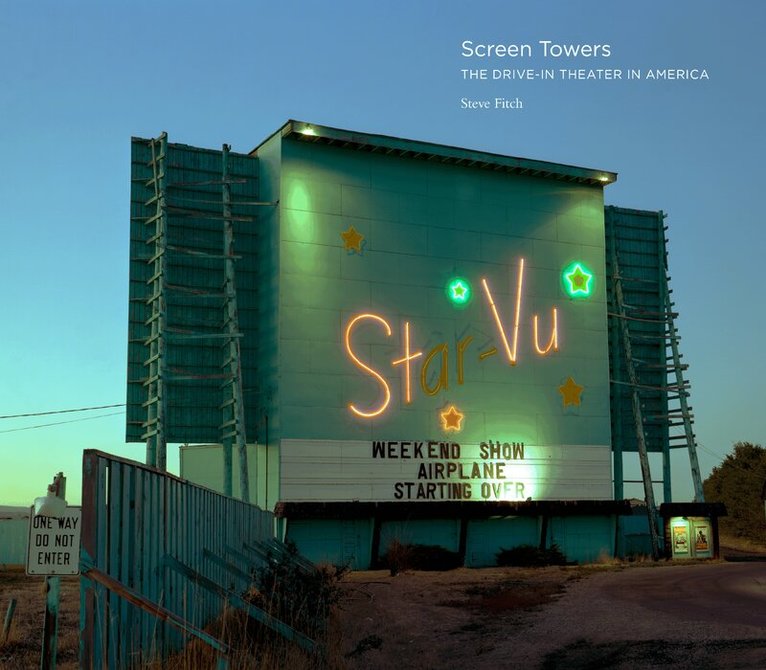
Beginning in 1933 and expanding greatly after World War II, mid-century America saw a boom in the construction of large outdoor screen towers on which a projected movie image could be viewed from a parked car. This was the era of the drive-in movie theater, which saw the marriage of the automobile and the Hollywood movie. At its peak during the 1950s and 1960s more than 4,000 drive-in theaters dotted the American landscape, coast to coast.Starting in 1971, Steve Fitch traveled throughout the United States photographing many of these theaters, concentrating on the often stunning neon and painted murals that decorated the back, street-facing side of the tower that supported the white, rectangular screen. These dramatic murals often depicted scenes that related to the local history of the surrounding community, and they could be seen from many miles away. Working with black-and-white film, he mostly photographed at dusk or night, making striking images that captured the seductive beauty of these roadside monuments. Then, in 1980, Fitch began working in color with a large-format 8” x 10” view camera. Interested in the collecting and comparing possibilities of photography, he began to shift his emphasis to making pictures of the actual white screen itself and the inside spaces of the theater. By the early 1980s, many of the drive-ins were being abandoned or even torn down. The era of the drive-in theater was nearing its end, although today there remain about 300 operating drive-ins in America keeping alive the thrill of watching a movie outdoors, under the stars, in the comfort of one’s car.
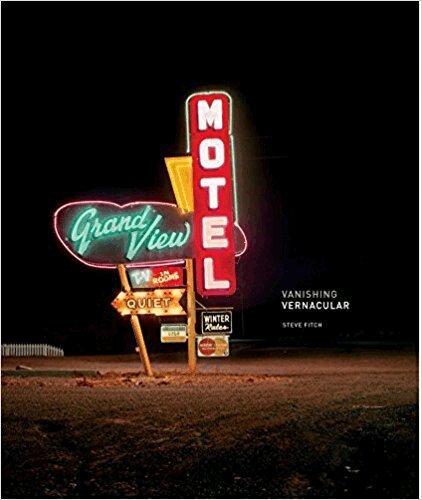
Steve Fitch is among America’s most well-known chroniclers of the American West since the days of Easy Rider. He has been photographing examples of the West’s changing vernacular landscape and vanishing roadside landmarks for more than 40 years. In his new book, he presents both the ancient and the modern by way of petroglyphs, neon motel signs and hand-painted business signs, drive-in movie theater screens, and radio and cell towers. All of them are now endangered because of the advent of the Interstate Highway System and corporate franchises.In this fascinating and comprehensive account, we are able to join in Fitch’s expansive journey, truly an odyssey, as represented in the book’s 120 unforgettable photographs, all sequenced to mimic the open road—both during day and night. Fitch explains the project in his informative introduction, in which, interestingly, he suggests that the petroglyphs of the ancient Pueblo people have endured far better and longer than anything made during the last sixty years. Curator Toby Jurovics, in his insightful concluding essay, positions Fitch’s work in relation to that of the practitioners of the photographic style known as the “New Topographics” and Fitch’s own view of photography as a visual form of cultural anthropology. Vanishing Vernacular: Western Landmarks is sure to become a modern-day classic, a book that will be all the more revered as America and Americans move farther away from the highways of the past. That economy and roadside culture are vanishing like endangered species, but Fitch was along for the ride. In sharing that past, he has been witness to his own form of historic preservation.