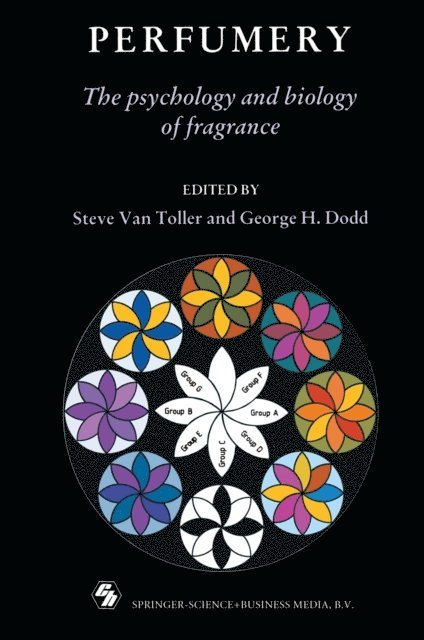
Steve Van Toller – författare
Visar alla böcker från författaren . Handla med fri frakt och snabb leverans.
5 produkter
5 produkter
Häftad, Engelska, 1990
1 403 kr
Skickas inom 10-15 vardagar
THE SENSE OF SMELL The nose is normally mistakenly assumed to be the organ of smell reception. It is not. The primary function of the nose is to regulate the temperature and humidity of inspired air, thereby protecting the delicate linings of the lungs. This is achieved by the breathed air passing through narrow passageways formed by three nasal turbinates in each nostril. The turbinates are covered by spongy vascular cells which can expand or contract to open or close the nasal pathways. The olfactory receptors, innervated by the 1st cranial nerve, are located at the top of the nose. There are about 50 million smell receptors in the human olfactory epithelia, the total size of which, in humans, is about that of a small postage stamp, with half being at the top of the left and half at the top of the right nostril. The receptive surfaces of olfactory cells are ciliated and extend into a covering layer of mucus. There is a constant turnover of olfactory cells. Their average active life has been estimated to be about 28 days.
E-bok
PDF, Engelska, 2013732 kr
Läs direkt efter köp
This book aims to give health professionals a balanced and indepen dent overview of massage and aromatherapy. I have written it because, despite growing interest, there is a dearth of professional literature on this subject. This book aims to cover a number of topics which are under-represented in existing publications. These include: • scientific research in massage and aromatherapy; • the use of the therapies in medical settings; • the knowledge base of massage and aromatherapy; • professional and managerial issues; • safety. Understanding of these subjects is essential for any reasoned evalu ation of massage and aromatherapy. Yet this book is probably the first to provide information suitable for this task. At the current time of writing, almost all books on massage and aroma therapy have been written with the lay public in mind. The texts recommended to students and practitioners by the foremost schools and institutions are exactly the same as those available in health food shops as general introductions for prospective patients. Not surprisingly, such books generally fail to include in-depth discussions of professional issues.
Häftad, Engelska, 1996
560 kr
Skickas inom 10-15 vardagar
E-bok
PDF, Engelska, 20121 123 kr
Läs direkt efter köp
in 1951 Oellinek, 1951), until the conference held at the University of Warwick in 1986 there has previously never been a joint meeting of the industrial and academic disciplines relating to the sense of smell. Each year brings the launchings of many new perfumes; the respective national perfumery societies hold meetings; conferences on the sense of smell take place. These events involve the exchange of important knowledge relating to perfumes but the information remains largely isolated. The Warwick Olfaction Research Group is unusual in that it is led by two people, one of whom is a practising perfumer with an understanding of what it means to be asked to create a perfume, and the other a psychologist with an expertise in the area of emotion. Our interaction (Dodd and Van Toller, 1983) was a potent stimulus to hold the First International Conference on the Psychology of Perfumery. The main purpose of the meeting was to see if there was a framework that would knit the area together into a coherent set of ideas and also to give new perspectives to the study of perfumes. We invited speakers from all areas of the discipline. Thus, the meeting brought together people from the fragrance industry, academics and aromatherapists into a forum for debate. Besides the scientific basis of smell and perfumery, other important topics, including the important one of educating the general public about; olfaction and perfume, were discussed.
E-bok
PDF, Engelska, 20131 703 kr
Läs direkt efter köp
THE SENSE OF SMELL The nose is normally mistakenly assumed to be the organ of smell reception. It is not. The primary function of the nose is to regulate the temperature and humidity of inspired air, thereby protecting the delicate linings of the lungs. This is achieved by the breathed air passing through narrow passageways formed by three nasal turbinates in each nostril. The turbinates are covered by spongy vascular cells which can expand or contract to open or close the nasal pathways. The olfactory receptors, innervated by the 1st cranial nerve, are located at the top of the nose. There are about 50 million smell receptors in the human olfactory epithelia, the total size of which, in humans, is about that of a small postage stamp, with half being at the top of the left and half at the top of the right nostril. The receptive surfaces of olfactory cells are ciliated and extend into a covering layer of mucus. There is a constant turnover of olfactory cells. Their average active life has been estimated to be about 28 days.