Steven J. Osterlind - Böcker
Visar alla böcker från författaren Steven J. Osterlind. Handla med fri frakt och snabb leverans.
7 produkter
7 produkter
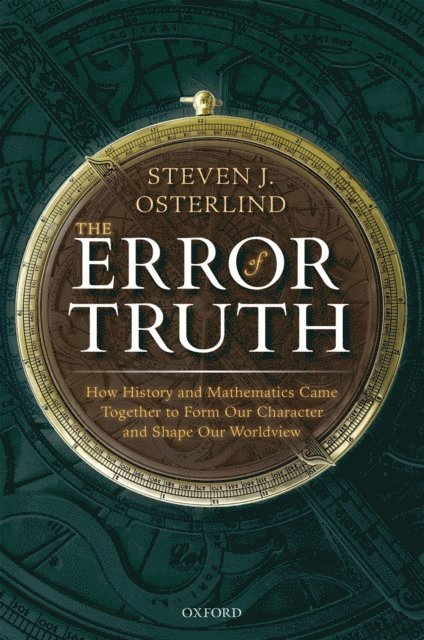
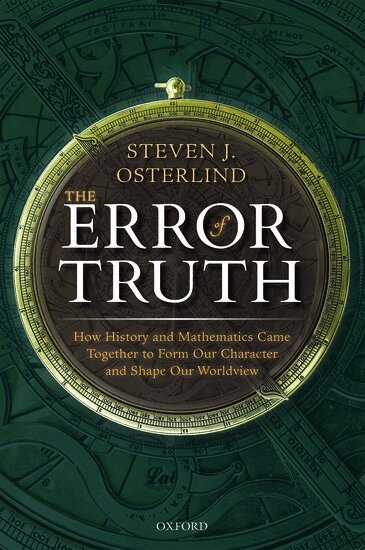
The Error of Truth
How History and Mathematics Came Together to Form Our Character and Shape Our Worldview
Inbunden, Engelska, 2019
425 kr
Skickas inom 5-8 vardagar
Quantitative thinking is our inclination to view natural and everyday phenomena through a lens of measurable events, with forecasts, odds, predictions, and likelihood playing a dominant part. The Error of Truth recounts the astonishing and unexpected tale of how quantitative thinking came to be, and its rise to primacy in the nineteenth and early twentieth centuries. Additionally, it considers how seeing the world through a quantitative lens has shaped our perception of the world we live in, and explores the lives of the individuals behind its early establishment. This worldview was unlike anything humankind had before, and it came about because of a momentous human achievement: we had learned how to measure uncertainty. Probability as a science was conceptualised. As a result of probability theory, we now had correlations, reliable predictions, regressions, the bellshaped curve for studying social phenomena, and the psychometrics of educational testing. Significantly, these developments happened during a relatively short period in world history— roughly, the 130-year period from 1790 to 1920, from about the close of the Napoleonic era, through the Enlightenment and the Industrial Revolutions, to the end of World War I. At which time, transportation had advanced rapidly, due to the invention of the steam engine, and literacy rates had increased exponentially. This brief period in time was ready for fresh intellectual activity, and it gave a kind of impetus for the probability inventions. Quantification is now everywhere in our daily lives, such as in the ubiquitous microchip in smartphones, cars, and appliances; in the Bayesian logic of artificial intelligence, as well as applications in business, engineering, medicine, economics, and elsewhere. Probability is the foundation of quantitative thinking. The Error of Truth tells its story— when, why, and how it happened.
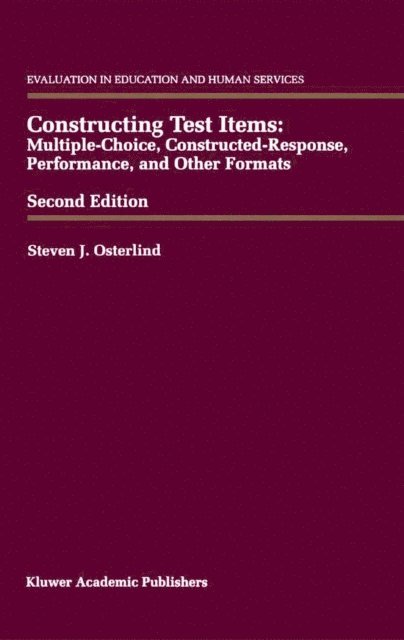
Constructing Test Items
Multiple-Choice, Constructed-Response, Performance and Other Formats
Inbunden, Engelska, 1997
1 533 kr
Skickas inom 10-15 vardagar
Constructing test items for standardized tests of achievement, ability, and aptitude is a task of considerable importance. The interpretability of a test's scores flows directly from the quality of its items and exercises. Concomitant with score interpretability is the notion that including only carefully crafted items on a test is the primary method by which the skilled test developer reduces unwanted error variance, or errors of measurement, and thereby increases a test score's reliability. The aim of this text is to increase the test constructor's awareness of this source of measurement error, and then to describe methods for identifying and minimizing it during item construction and later review. Persons involved in assessment are keenly aware of the increased attention given to alternative formats for test items in recent years. Yet, the text argues that in many writers' zeal to be "curriculum-relevant" or "authentic" or "realistic", the items are often developed seemingly without conscious thought to the interpretations that may be garnered from them.It also argues that the format for such alternative items and exercises also requires rigour in their construction and even offers some solutions, as one chapter is devoted to these alternative formats. The book addresses issues in constructing test items by focusing on four ideas. First, it describes the characteristics and functions of test items. A second feature of this book is the presentation of editorial guidelines for writing test items in all of the commonly used item formats, including constructed-response formats and performance tests. A third aspect is the presentation of methods for determining the quality of test items. Finally, it presents a compendium of important issues about test items, including procedures for ordering items in a test, ethical and legal concerns over using copyrighted test items, item scoring schemes, computer-generated items and more.
476 kr
Skickas inom 5-8 vardagar
Steven J. Osterlind discusses five strategies for detecting bias: analysis of variance, transformed item difficulties, chi square, item characteristic curve, and distractor response.
Del 161 - Quantitative Applications in the Social Sciences
Differential Item Functioning
Häftad, Engelska, 2009
767 kr
Skickas inom 3-6 vardagar
This new edition presents an up-to-date description of differential item functioning. It describes varying procedures for addressing DIF in practical testing contexts. The authors present useful examples and studies of DIF that readers may employ as a guide in their own work. They also cover major statistical packages that can be employed in DIF analysis (e.g., SPSS, SAS, M+, Minitab, and Systat).
This text is ideal for the measurement professional or advanced student who deals with educational or psychological assessment.
521 kr
Skickas inom 10-15 vardagar
Constructing Test Items : Multiple-Choice, Constructed-Response, Performance and Other Formats
Engelska, 2014
616 kr
Skickas inom 5-8 vardagar
Constructing Test Items
Multiple-Choice, Constructed-Response, Performance and Other Formats
Häftad, Engelska, 2013
1 533 kr
Skickas inom 10-15 vardagar
Finally, this book presents a compendium of important issues about test items, including procedures for ordering items in a test, ethical and legal concerns over using copyrighted test items, item scoring schemes, computer-generateditems and more.