Steven Kay – författare
1 518 kr
Skickas
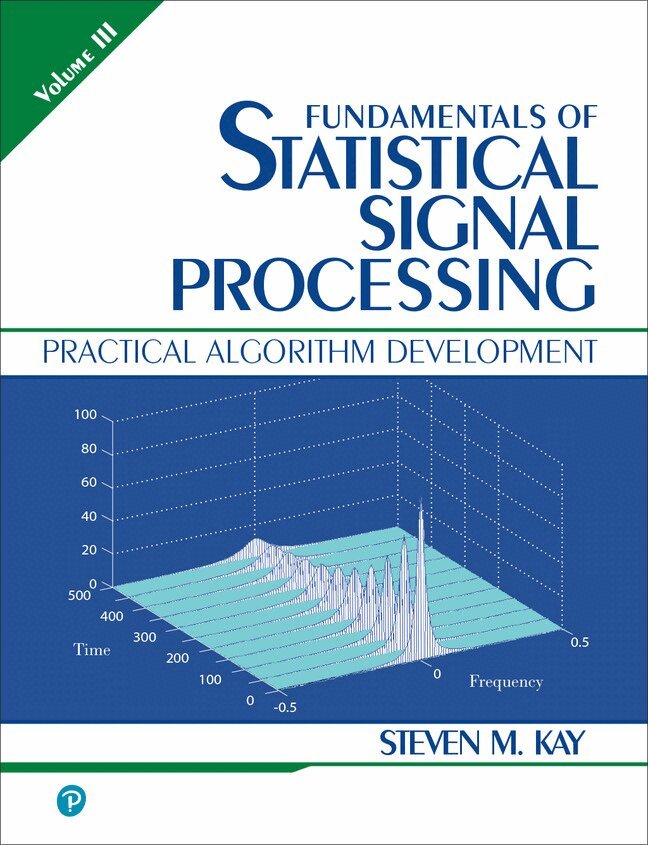
In Fundamentals of Statistical Signal Processing, Volume III: Practical Algorithm Development, author Steven M. Kay shows how to convert theories of statistical signal processing estimation and detection into software algorithms that can be implemented on digital computers. This final volume of Kay’s three-volume guide builds on the comprehensive theoretical coverage in the first two volumes. Here, Kay helps readers develop strong intuition and expertise in designing well-performing algorithms that solve real-world problems.
Kay begins by reviewing methodologies for developing signal processing algorithms, including mathematical modeling, computer simulation, and performance evaluation. He links concepts to practice by presenting useful analytical results and implementations for design, evaluation, and testing. Next, he highlights specific algorithms that have “stood the test of time,” offers realistic examples from several key application areas, and introduces useful extensions. Finally, he guides readers through translating mathematical algorithms into MATLAB® code and verifying solutions.
Topics covered include
Step by step approach to the design of algorithms Comparing and choosing signal and noise models Performance evaluation, metrics, tradeoffs, testing, and documentation Optimal approaches using the “big theorems” Algorithms for estimation, detection, and spectral estimation Complete case studies: Radar Doppler center frequency estimation, magnetic signal detection, and heart rate monitoring
Exercises are presented throughout, with full solutions.
This new volume is invaluable to engineers, scientists, and advanced students in every discipline that relies on signal processing; researchers will especially appreciate its timely overview of the state of the practical art. Volume III complements Dr. Kay’s Fundamentals of Statistical Signal Processing, Volume I: Estimation Theory (Prentice Hall, 1993; ISBN-13: 978-0-13-345711-7), and Volume II: Detection Theory (Prentice Hall, 1998; ISBN-13: 978-0-13-504135-2).
2 088 kr
Skickas inom 3-6 vardagar
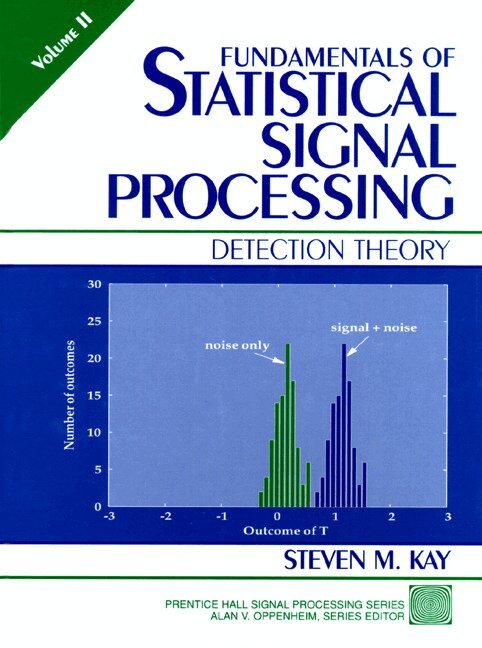
The most comprehensive overview of signal detection available.
This is a thorough, up-to-date introduction to optimizing detection algorithms for implementation on digital computers. It focuses extensively on real-world signal processing applications, including state-of-the-art speech and communications technology as well as traditional sonar/radar systems.
Start with a quick review of the fundamental issues associated with mathematical detection, as well as the most important probability density functions and their properties. Next, review Gaussian, Chi-Squared, F, Rayleigh, and Rician PDFs, quadratic forms of Gaussian random variables, asymptotic Gaussian PDFs, and Monte Carlo Performance Evaluations.
Three chapters introduce the basics of detection based on simple hypothesis testing, including the Neyman-Pearson Theorem, handling irrelevant data, Bayes Risk, multiple hypothesis testing, and both deterministic and random signals.
The author then presents exceptionally detailed coverage of composite hypothesis testing to accommodate unknown signal and noise parameters. These chapters will be especially useful for those building detectors that must work with real, physical data. Other topics covered include:
Detection in nonGaussian noise, including nonGaussian noise characteristics, known deterministic signals, and deterministic signals with unknown parameters Detection of model changes, including maneuver detection and time-varying PSD detection Complex extensions, vector generalization, and array processingThe book makes extensive use of MATLAB, and program listings are included wherever appropriate. Designed for practicing electrical engineers, researchers, and advanced students, it is an ideal complement to Steven M. Kay's Fundamentals of Statistical Signal Processing, Vol. 1: Estimation Theory (ISBN: 0-13-345711-7).
1 403 kr
Skickas inom 5-8 vardagar
1 258 kr
Läs direkt efter köp
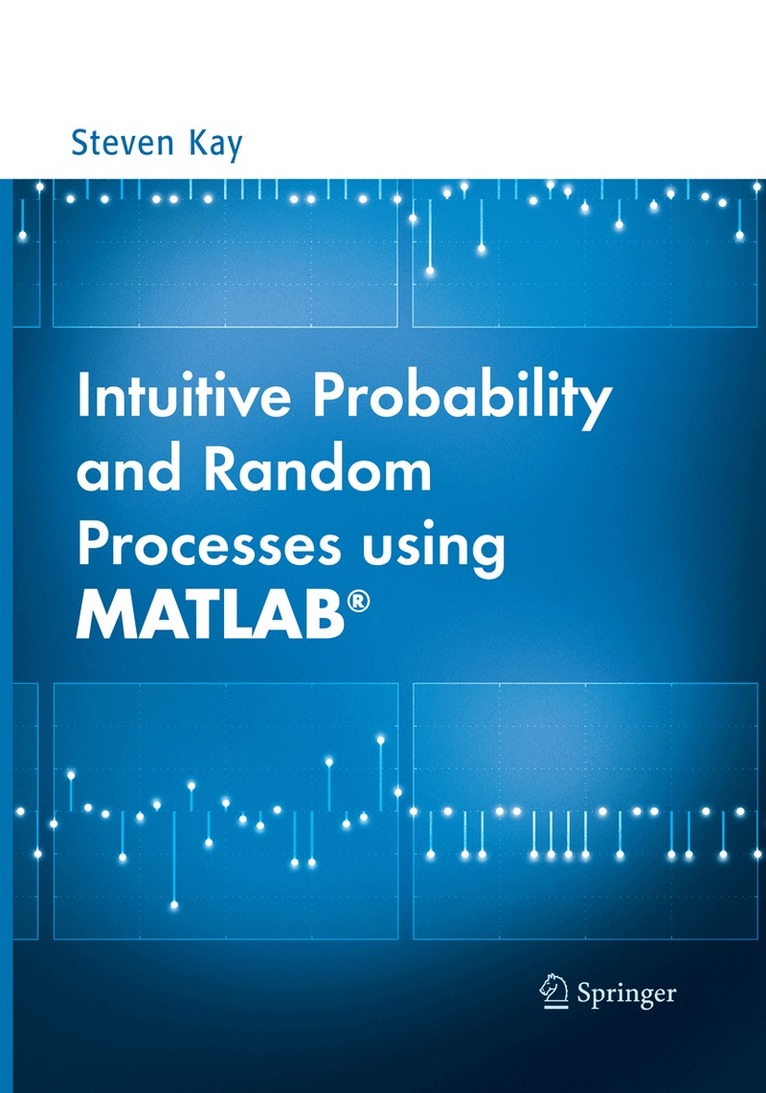
Intuitive Probability and Random Processes using MATLAB® is an introduction to probability and random processes that merges theory with practice. Based on the author’s belief that only "hands-on" experience with the material can promote intuitive understanding, the approach is to motivate the need for theory using MATLAB examples, followed by theory and analysis, and finally descriptions of "real-world" examples to acquaint the reader with a wide variety of applications. The latter is intended to answer the usual question "Why do we have to study this?" Other salient features are:
*heavy reliance on computer simulation for illustration and student exercises
*the incorporation of MATLAB programs and code segments
*discussion of discrete random variables followed by continuous random variables to minimize confusion
*summary sections at the beginning of each chapter
*in-line equation explanations
*warnings on common errors and pitfalls
*over 750 problems designed to help the reader assimilate and extend the concepts
Intuitive Probability and Random Processes using MATLAB® is intended for undergraduate and first-year graduate students in engineering. The practicing engineer as well as others having the appropriate mathematical background will also benefit from this book.
About the Author
Steven M. Kay is a Professor of Electrical Engineering at the University of Rhode Island and a leading expert in signal processing. He has received the Education Award "for outstanding contributions in education and in writing scholarly books and texts..." from the IEEE Signal Processing society and has been listed as among the 250 most cited researchers in the world in engineering.
155 kr
Skickas inom 5-8 vardagar
186 kr
Skickas inom 5-8 vardagar
134 kr
Skickas inom 5-8 vardagar
127 kr
Skickas inom 5-8 vardagar
48 kr
Läs direkt efter köp
44 kr
Läs direkt efter köp
54 kr
Läs direkt efter köp
44 kr
Läs direkt efter köp
55 kr
Läs direkt efter köp
978 kr
Skickas inom 10-15 vardagar
11 kr
Läs direkt efter köp
160 kr
Skickas inom 5-8 vardagar
131 kr
Skickas inom 5-8 vardagar