Steven R. Pritzker – författare
Visar alla böcker från författaren Steven R. Pritzker. Handla med fri frakt och snabb leverans.
3 produkter
3 produkter
E-bok
PDF, Engelska, 19997 075 kr
Läs direkt efter köp
The Encyclopedia of Creativity is the sourcebook for individuals seeking specialized information about creativity and motivation. Subjects include theories of creativity, techniques for enhancing creativity, individuals who have made significant contributions to creativity, physiological aspects of creativity, and virtually any topic that touches upon the subject. Entries are placed in alphabetical order with cross-references to other topics and entries where appropriate. Each entry is written in simple easy-to-understand terms summarizing the most important aspects of creative research and writing relating to the specific topic. A bibliography in the back of each article suggests additional sources for more information. The text is visually enhanced throughout by illustrations and photographs.- A source-book of specialized information about creativity and motivation- Includes virtually any topic dealing with creativity- Entries are placed in alphabetical order with cross-references- Written in easy-to-understand terms- Illustrations and photographs throughout- Contains select biographies of internationally renowned creative individuals from throughout history
Inbunden, Engelska, 2020
18 700 kr
Skickas inom 10-15 vardagar
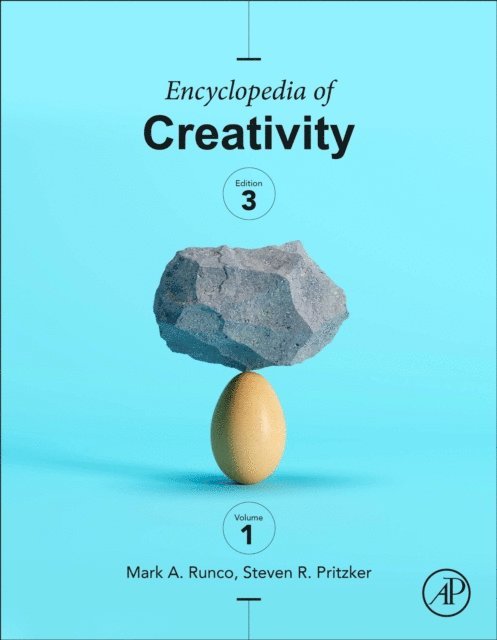
Creativity influences each of our lives and is essential for the advancement of society. The first edition of the successful Encyclopedia of Creativity helped establish the study of creativity as a field of research in itself. The second edition, published in 2011, was named a 2012 Outstanding Academic Title by the American Library Association's Choice publication. Featuring 232 chapters, across 2 volumes, the third edition of this important work provides updated information on the full range of creativity research. There has been an enormous increase in research on the topic throughout the world in many different disciplines. Some areas covered in this edition include the arts and humanities, business, education, mental and physical health, neuroscience, psychology, the creative process and technology. Fundamental subjects are discussed such as the definition of creativity, the development and expression of creativity across the lifespan, the environmental conditions that encourage or discourage creativity, the relationship of creativity to mental health, intelligence and learning styles, and the process of being creative. Creativity is discussed within specific disciplines including acting, architecture, art, dance, film, government, interior design, magic, mathematics, medicine, photography, science, sports, tourism and writing.A wide range of topics are covered. Here is a partial overview by topic:Business and organizational creativity: Advertising, Creative Economies, Creativity Consulting and Coaching, Corporate Creativity, Creativity Exercises, Entrepreneurship, Group Dynamics, Innovation, Leadership, Management of Creative People, Patents, Teams, and Training. The Cognitive Aspects of Creativity: Altered and Transitional States, Analogies, Attention, Breadth of Attention, Cognitive Style, Divergent Thinking, Flow and Optimal Experience, Knowledge, Logic and Reasoning, Metacognition, Mental Models, Memory, Metaphors, Mind Wandering, Mindfulness, Problem-Finding, Problem-Solving, and Remote Associates.The Creative Process: Attribution, Constraints, Discovery, Insight, Inspiration, Intentionality, Motivation, Risk-Taking, and Tolerance for Ambiguity.Education: Children’s Creativity, , Education, Intelligence, Knowledge, Metacognition, Play, Prodigies, Programs And Courses, Talent And Teaching Creativity.Neuroscience Research: Cellular Matter, Grey Matter, Cellular Density; EEG, Functional Magnetic Resonance Imaging (Fmri), Music and The Brain, Pupillometry, Systems, The Cerebellum and Transcranial Electrical Stimulation.Psychology: The Big 5 Personality Characteristics, Bipolar Mood Disorders, Childhood Trauma, Depression, Deviance, Dreams, Emotions, Expressive Arts, Grit, Introversion, Jungian Theory, Mad Genius Controversy, Openness, Schizotypy, Suicide, Therapy and Counseling Trauma and Transcendence and Transforming Illness and Visual Art.Social Aspects of Creativity: Awards, Birth Order, Criticism, Consensual Assessment, Diversity, Eminence, Families, Friendships and Social Networks, Geeks, Mentors, Millennials, Networking, Rewards, And Sociology.Society and Creativity: Awards, Climate For Creativity, Cross-Cultural Creativity, Destruction Of Creativity, Law And Society, Social Psychology, Social Transformation, Voting, War, and Zeitgeist.Technology: Chats, Computational Creativity, Computerized Text Analysis, Gaming, Memes, Networks and Maps, and Virtual Reality.
E-bok
PDF, Engelska, 202022 982 kr
Läs direkt efter köp
Creativity influences each of our lives and is essential for the advancement of society. The first edition of the successful Encyclopedia of Creativity helped establish the study of creativity as a field of research in itself. The second edition, published in 2011, was named a 2012 Outstanding Academic Title by the American Library Association''s Choice publication.Featuring 232 chapters, across 2 volumes, the third edition of this important work provides updated information on the full range of creativity research. There has been an enormous increase in research on the topic throughout the world in many different disciplines. Some areas covered in this edition include the arts and humanities, business, education, mental and physical health, neuroscience, psychology, the creative process and technology.Fundamental subjects are discussed such as the definition of creativity, the development and expression of creativity across the lifespan, the environmental conditions that encourage or discourage creativity, the relationship of creativity to mental health, intelligence and learning styles, and the process of being creative. Creativity is discussed within specific disciplines including acting, architecture, art, dance, film, government, interior design, magic, mathematics, medicine, photography, science, sports, tourism and writing.A wide range of topics are covered. Here is a partial overview by topic:Business and organizational creativity: Advertising, Creative Economies, Creativity Consulting and Coaching, Corporate Creativity, Creativity Exercises, Entrepreneurship, Group Dynamics, Innovation, Leadership, Management of Creative People, Patents, Teams, and Training.The Cognitive Aspects of Creativity: Altered and Transitional States, Analogies, Attention, Breadth of Attention, Cognitive Style, Divergent Thinking, Flow and Optimal Experience, Knowledge, Logic and Reasoning, Metacognition, Mental Models, Memory, Metaphors, Mind Wandering, Mindfulness, Problem-Finding, Problem-Solving, and Remote Associates.The Creative Process: Attribution, Constraints, Discovery, Insight, Inspiration, Intentionality, Motivation, Risk-Taking, and Tolerance for Ambiguity.Education: Children''s Creativity, , Education, Intelligence, Knowledge, Metacognition, Play, Prodigies, Programs And Courses, Talent And Teaching Creativity.Neuroscience Research: Cellular Matter, Grey Matter, Cellular Density; EEG, Functional Magnetic Resonance Imaging (Fmri), Music and The Brain, Pupillometry, Systems, The Cerebellum and Transcranial Electrical Stimulation.Psychology: The Big 5 Personality Characteristics, Bipolar Mood Disorders, Childhood Trauma, Depression, Deviance, Dreams, Emotions, Expressive Arts, Grit, Introversion, Jungian Theory, Mad Genius Controversy, Openness, Schizotypy, Suicide, Therapy and Counseling Trauma and Transcendence and Transforming Illness and Visual Art.Social Aspects of Creativity: Awards, Birth Order, Criticism, Consensual Assessment, Diversity, Eminence, Families, Friendships and Social Networks, Geeks, Mentors, Millennials, Networking, Rewards, And Sociology.Society and Creativity: Awards, Climate For Creativity, Cross-Cultural Creativity, Destruction Of Creativity, Law And Society, Social Psychology, Social Transformation, Voting, War, and Zeitgeist.Technology: Chats, Computational Creativity, Computerized Text Analysis, Gaming, Memes, Networks and Maps, and Virtual Reality.