Stuart Kauffman – författare
Visar alla böcker från författaren Stuart Kauffman. Handla med fri frakt och snabb leverans.
2 produkter
2 produkter
Häftad, Engelska, 2010
287 kr
Skickas inom 10-15 vardagar
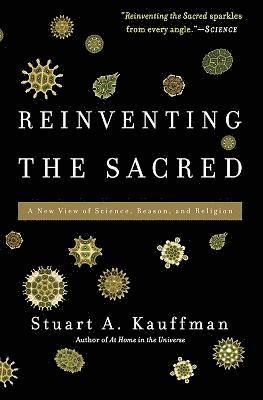
Consider the complexity of a living cell after 3.8 billion years of evolution. Is it more awesome to suppose that a transcendent God fashioned the cell at a stroke, or to realize that it evolved with no Almighty Hand, but arose on its own in the changing biosphere? In this bold and fresh look at science and religion, complexity theorist Stuart Kauffman argues that the qualities of divinity that we revere,creativity, meaning, purposeful action,are properties of the universe that can be investigated methodically. He offers stunning evidence for this idea in an abundance of fields, from cell biology to the philosophy of mind, and uses it to find common ground between belief systems often at odds with one another. A daring and ambitious argument for a new understanding of natural divinity, Reinventing the Sacred challenges readers both scientifically and philosophically.
Häftad, Engelska, 2023
230 kr
Skickas inom 7-10 vardagar
A long tradition explains technological change as recombination. Within this tradition, this Element develops an innovative combinatorial model of technological change and tests it with 2,000 years of global GDP data and with data from US patents filed between 1835 and 2010. The model explains 1) the pace of technological change for a least the past two millennia, 2) patent citations and 3) the increasing complexity of tools over time. It shows that combining and modifying pre-existing goods to produce new goods generates the observed historical pattern of technological change. A long period of stasis was followed by sudden super-exponential growth in the number of goods. In this model, the sudden explosion of about 250 years ago is a combinatorial explosion that was a long time in coming, but inevitable once the process began at least two thousand years ago. This Element models the Industrial Revolution as a combinatorial explosion.