Su-Ting Han – författare
2 187 kr
Skickas inom 10-15 vardagar
Photo-Electroactive Non-Volatile Memories for Data Storage and Neuromorphic Computing summarizes advances in the development of photo-electroactive memories and neuromorphic computing systems, suggests possible solutions to the challenges of device design, and evaluates the prospects for commercial applications. Sections covers developments in electro-photoactive memory, and photonic neuromorphic and in-memory computing, including discussions on design concepts, operation principles and basic storage mechanism of optoelectronic memory devices, potential materials from organic molecules, semiconductor quantum dots to two-dimensional materials with desirable electrical and optical properties, device challenges, and possible strategies.
This comprehensive, accessible and up-to-date book will be of particular interest to graduate students and researchers in solid-state electronics. It is an invaluable systematic introduction to the memory characteristics, operation principles and storage mechanisms of the latest reported electro-photoactive memory devices.
Reviews the most promising materials to enable emerging computing memory and data storage devices, including one- and two-dimensional materials, metal oxides, semiconductors, organic materials, and more Discusses fundamental mechanisms and design strategies for two- and three-terminal device structures Addresses device challenges and strategies to enable translation of optical and optoelectronic technologies3 006 kr
Läs direkt efter köp
3 165 kr
Skickas inom 5-8 vardagar
2 832 kr
Läs direkt efter köp
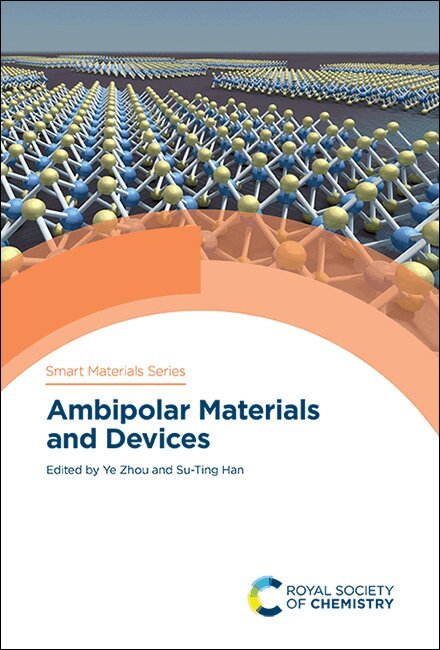
Ambipolar materials represent a class of materials where positive and negative charge carriers can both transport concurrently. In recent years, a diverse range of materials have been synthesized and utilized for implementing ambipolar charge transport, with applications in high‐density data storage, field effect transistors, nanotransitors, photonic memory, biomaterial-based memories and artificial synapses. This book highlights recent development of ambipolar materials involving materials design, fundamental principles, interface modifications, device structures, ambipolar characteristics and promising applications. Challenges and prospects for investigating ambipolar materials in electronics and optoelectronics are also discussed. With contributions from global leaders in the field, this title will appeal to graduate students and researchers who want to understand the design, materials characteristics, device operation principles, specialized device application and mechanisms of the latest ambipolar materials.
2 832 kr
Läs direkt efter köp
Ambipolar materials represent a class of materials where positive and negative charge carriers can both transport concurrently. In recent years, a diverse range of materials have been synthesized and utilized for implementing ambipolar charge transport, with applications in high‐density data storage, field effect transistors, nanotransitors, photonic memory, biomaterial-based memories and artificial synapses. This book highlights recent development of ambipolar materials involving materials design, fundamental principles, interface modifications, device structures, ambipolar characteristics and promising applications. Challenges and prospects for investigating ambipolar materials in electronics and optoelectronics are also discussed. With contributions from global leaders in the field, this title will appeal to graduate students and researchers who want to understand the design, materials characteristics, device operation principles, specialized device application and mechanisms of the latest ambipolar materials.