Subhas K. Sikdar – författare
Visar alla böcker från författaren Subhas K. Sikdar. Handla med fri frakt och snabb leverans.
10 produkter
10 produkter
Advances in Carbon Management Technologies
Biomass Utilization, Manufacturing, and Electricity Management, Volume 2
Inbunden, Engelska, 2021
2 108 kr
Skickas inom 10-15 vardagar
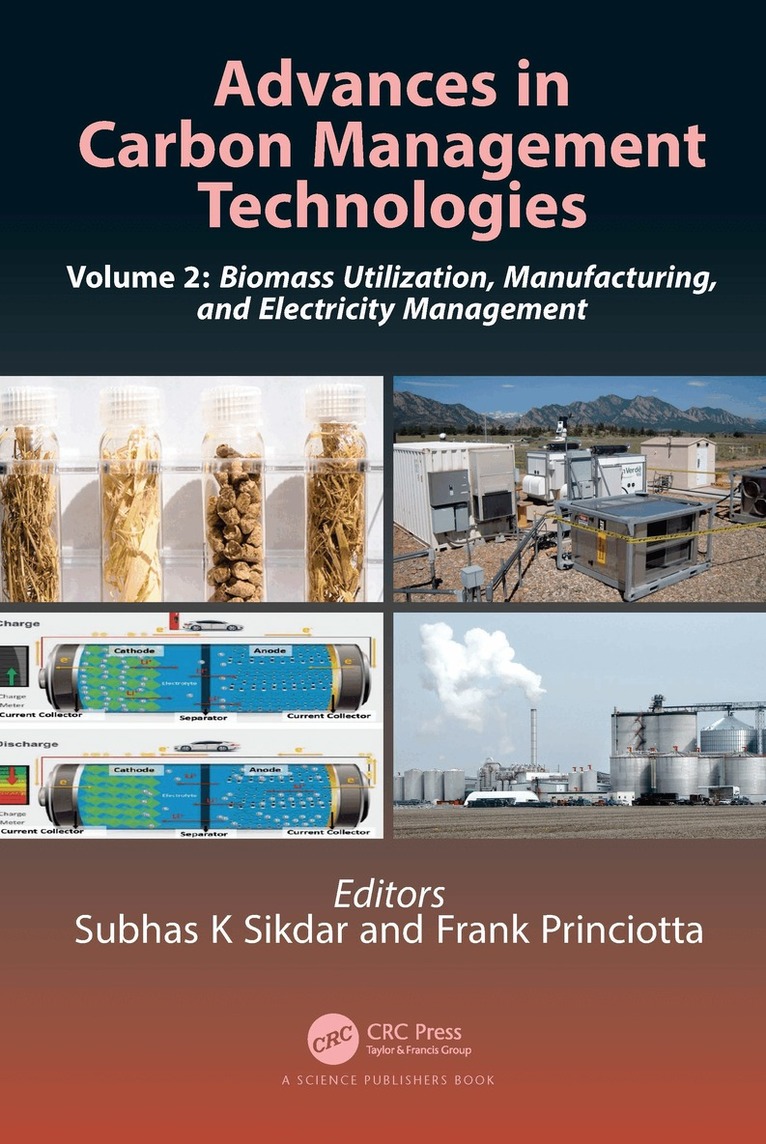
Volume 2 of Advances in Carbon Management Technologies has 21 chapters. It presents the introductory chapter again, for framing the challenges that confront the proposed solutions discussed in this volume. Section 4 presents various ways biomass and biomass wastes can be manipulated to provide a low-carbon footprint of the generation of power, heat and co-products, and of recovery and reuse of biomass wastes for beneficial purposes. Section 5 provides potential carbon management solutions in urban and manufacturing environments. This section also provides state-of the-art of battery technologies for the transportation sector. The chapters in section 6 deals with electricity and the grid, and how decarbonization can be practiced in the electricity sector.The overall topic of advances in carbon management is too broad to be covered in a book of this size. It was not intended to cover every possible aspect that is relevant to the topic. Attempts were made, however, to highlight the most important issues of decarbonization from technological viewpoints. Over the years carbon intensity of products and processes has decreased, but the proportion of energy derived from fossil fuels has been stubornly stuck at about 80%. This has occurred despite very rapid development of renewable fuels, because at the same time the use of fossil fuels has also increased. Thus, the challenges are truly daunting. It is hoped that the technology choices provided here will show the myriad ways that solutions will evolve. While policy decisions are the driving forces for technology development, the book was not designed to cover policy solutions.
Advances in Carbon Management Technologies
Biomass Utilization, Manufacturing, and Electricity Management, Volume 2
Häftad, Engelska, 2022
725 kr
Skickas inom 10-15 vardagar
Volume 2 of Advances in Carbon Management Technologies has 21 chapters. It presents the introductory chapter again, for framing the challenges that confront the proposed solutions discussed in this volume. Section 4 presents various ways biomass and biomass wastes can be manipulated to provide a low-carbon footprint of the generation of power, heat and co-products, and of recovery and reuse of biomass wastes for beneficial purposes. Section 5 provides potential carbon management solutions in urban and manufacturing environments. This section also provides state-of the-art of battery technologies for the transportation sector. The chapters in section 6 deals with electricity and the grid, and how decarbonization can be practiced in the electricity sector.The overall topic of advances in carbon management is too broad to be covered in a book of this size. It was not intended to cover every possible aspect that is relevant to the topic. Attempts were made, however, to highlight the most important issues of decarbonization from technological viewpoints. Over the years carbon intensity of products and processes has decreased, but the proportion of energy derived from fossil fuels has been stubornly stuck at about 80%. This has occurred despite very rapid development of renewable fuels, because at the same time the use of fossil fuels has also increased. Thus, the challenges are truly daunting. It is hoped that the technology choices provided here will show the myriad ways that solutions will evolve. While policy decisions are the driving forces for technology development, the book was not designed to cover policy solutions.
Del 62 - NATO Science Partnership Subseries: 2
Tools and Methods for Pollution Prevention
Inbunden, Engelska, 1999
1 061 kr
Skickas inom 10-15 vardagar
Tools are needed to define, measure and assess pollution in processes and products, to direct and measure improvements in designing cleaner processes and products, and to design benign processes and products. Life cycle assessment, process simulation and integration, material substitution and environmental impact assessment are some of these tools. Advances have been made recently in incorporating environmental criteria in process and product design, some renditions of which are commercially available. This is a compilation of methods, tools and models that can be used to design products and manufacturing processes that prevent pollution from occurring in the first place, rather than treating the wastes after they are formed. There is also a critique of social barriers to pollution prevention.
1 061 kr
Skickas inom 10-15 vardagar
Tools are needed to define, measure and assess pollution in processes and products, to direct and measure improvements in designing cleaner processes and products, and to design benign processes and products. Life cycle assessment, process simulation and integration, material substitution and environmental impact assessment are some of these tools. Advances have been made recently in incorporating environmental criteria in process and product design, some renditions of which are commercially available. This is a compilation of methods, tools and models that can be used to design products and manufacturing processes that prevent pollution from occurring in the first place, rather than treating the wastes after they are formed. There is also a critique of social barriers to pollution prevention.
1 061 kr
Skickas inom 10-15 vardagar
This book is a state of the art treatise on what has been done so far on measuring sustainability for decision making. Contributions will appeal to engineers and scientists engaged in technology development, assessment, and verification. Researchers working on engineering sustainability are likely to get ideas for further research in quantifying sustainability for industrial systems. Concepts described can be applied across all scales, from process technology to global sustainability; and challenges and limitations are also addressed. Readers will discover important insights about simulation-based approaches to process design and quantitative measurement techniques of sustainability for business and technology systems. Most of the examples and case studies are from chemical enterprises but the methodologies presented could be applicable to any system for which quantitative data for indicators are available, and the choice of the set ofindicators of sustainability are comprehensive.
1 061 kr
Skickas inom 10-15 vardagar
This book is a state of the art treatise on what has been done so far on measuring sustainability for decision making. Researchers working on engineering sustainability are likely to get ideas for further research in quantifying sustainability for industrial systems.
1 588 kr
Skickas inom 10-15 vardagar
This book was made possible by the exceptional support provided by NATO Sci entific and Environmental Division, University of Maribor (Slovenia), Govern ment of the Republic of Slovenia, British and the United States Embassies (Ljubl jana, the Republic of Slovenia). The authors, as listed in this book, took the time to prepare excellent manu scripts focusing on various issues related to technological choices for sustainabil ity. These manuscripts were rigorously reviewed and refereed by scientists and engineers before inclusion in this book. An introductory chapter was prepared to provide an overview and to integrate technical issues covered in the book. A summary chapter is included at the end that provides a synthesis of panel discus sions related to the three main sections of the book. The editors are most grateful to the contributors, sponsor organizations, and many colleagues who were kind enough to assist us in making this book possible. We are particularly grateful to Damjan Krajnc of the University of Maribor for compiling all the manuscripts in the correct format, creating the index, and assur ing that all the contents are faithfully presented in this volume. Background in formation about the editors and principal authors and contributors to this book fol lows.
1 588 kr
Skickas inom 10-15 vardagar
This book was made possible by the exceptional support provided by NATO Sci entific and Environmental Division, University of Maribor (Slovenia), Govern ment of the Republic of Slovenia, British and the United States Embassies (Ljubl jana, the Republic of Slovenia). The authors, as listed in this book, took the time to prepare excellent manu scripts focusing on various issues related to technological choices for sustainabil ity. These manuscripts were rigorously reviewed and refereed by scientists and engineers before inclusion in this book. An introductory chapter was prepared to provide an overview and to integrate technical issues covered in the book. A summary chapter is included at the end that provides a synthesis of panel discus sions related to the three main sections of the book. The editors are most grateful to the contributors, sponsor organizations, and many colleagues who were kind enough to assist us in making this book possible. We are particularly grateful to Damjan Krajnc of the University of Maribor for compiling all the manuscripts in the correct format, creating the index, and assur ing that all the contents are faithfully presented in this volume. Background in formation about the editors and principal authors and contributors to this book fol lows.
1 588 kr
Skickas inom 10-15 vardagar
Over time, the increased use of fresh water for agriculture and industry together with contamination from discharges of pollutants, mean that ever more areas of the planet are becoming water-stressed. Because of the competing needs of communities and industry for fresh water, industry will be challenged to meet its growing demands for water, which is essential for producing the goods and services that would boost human welfare. Thus industry will need to learn how to cost-effectively purify and recycle its wastewater for reuse, ultimately approaching a net zero-discharge condition. The chapters in this book, written by international experts, treat the technical issues of such treatment and water management, and also provide guidance on technologies, either existing or in development, that can potentially achieve the goal of recycle-reuse. The book will serve as a useful reference for academics, government and industry professionals alike.
1 108 kr
Skickas inom 5-8 vardagar
Over time, the increased use of fresh water for agriculture and industry together with contamination from discharges of pollutants, mean that ever more areas of the planet are becoming water-stressed. Because of the competing needs of communities and industry for fresh water, industry will be challenged to meet its growing demands for water, which is essential for producing the goods and services that would boost human welfare. Thus industry will need to learn how to cost-effectively purify and recycle its wastewater for reuse, ultimately approaching a net zero-discharge condition. The chapters in this book, written by international experts, treat the technical issues of such treatment and water management, and also provide guidance on technologies, either existing or in development, that can potentially achieve the goal of recycle-reuse. The book will serve as a useful reference for academics, government and industry professionals alike.