Sudharsan Ravichandiran – författare
Visar alla böcker från författaren Sudharsan Ravichandiran. Handla med fri frakt och snabb leverans.
7 produkter
7 produkter
Häftad, Engelska, 2018
503 kr
Skickas inom 5-8 vardagar
Häftad, Engelska, 2018
707 kr
Skickas inom 5-8 vardagar
A practical guide to mastering reinforcement learning algorithms using KerasKey FeaturesBuild projects across robotics, gaming, and finance fields, putting reinforcement learning (RL) into actionGet to grips with Keras and practice on real-world unstructured datasetsUncover advanced deep learning algorithms such as Monte Carlo, Markov Decision, and Q-learningBook DescriptionReinforcement learning has evolved a lot in the last couple of years and proven to be a successful technique in building smart and intelligent AI networks. Keras Reinforcement Learning Projects installs human-level performance into your applications using algorithms and techniques of reinforcement learning, coupled with Keras, a faster experimental library.The book begins with getting you up and running with the concepts of reinforcement learning using Keras. You’ll learn how to simulate a random walk using Markov chains and select the best portfolio using dynamic programming (DP) and Python. You’ll also explore projects such as forecasting stock prices using Monte Carlo methods, delivering vehicle routing application using Temporal Distance (TD) learning algorithms, and balancing a Rotating Mechanical System using Markov decision processes.Once you’ve understood the basics, you’ll move on to Modeling of a Segway, running a robot control system using deep reinforcement learning, and building a handwritten digit recognition model in Python using an image dataset. Finally, you’ll excel in playing the board game Go with the help of Q-Learning and reinforcement learning algorithms.By the end of this book, you’ll not only have developed hands-on training on concepts, algorithms, and techniques of reinforcement learning but also be all set to explore the world of AI.What you will learnPractice the Markov decision process in prediction and betting evaluationsImplement Monte Carlo methods to forecast environment behaviorsExplore TD learning algorithms to manage warehouse operationsConstruct a Deep Q-Network using Python and Keras to control robot movementsApply reinforcement concepts to build a handwritten digit recognition model using an image datasetAddress a game theory problem using Q-Learning and OpenAI GymWho this book is forKeras Reinforcement Learning Projects is for you if you are data scientist, machine learning developer, or AI engineer who wants to understand the fundamentals of reinforcement learning by developing practical projects. Sound knowledge of machine learning and basic familiarity with Keras is useful to get the most out of this book
Häftad, Engelska, 2019
503 kr
Skickas inom 5-8 vardagar
Understand basic-to-advanced deep learning algorithms, the mathematical principles behind them, and their practical applicationsKey FeaturesGet up to speed with building your own neural networks from scratchGain insights into the mathematical principles behind deep learning algorithmsImplement popular deep learning algorithms such as CNNs, RNNs, and more using TensorFlowBook DescriptionDeep learning is one of the most popular domains in the AI space that allows you to develop multi-layered models of varying complexities. This book introduces you to popular deep learning algorithms—from basic to advanced—and shows you how to implement them from scratch using TensorFlow. Throughout the book, you will gain insights into each algorithm, the mathematical principles involved, and how to implement it in the best possible manner. The book starts by explaining how you can build your own neural networks, followed by introducing you to TensorFlow, the powerful Python-based library for machine learning and deep learning. Moving on, you will get up to speed with gradient descent variants, such as NAG, AMSGrad, AdaDelta, Adam, and Nadam. The book will then provide you with insights into recurrent neural networks (RNNs) and LSTM and how to generate song lyrics with RNN. Next, you will master the math necessary to work with convolutional and capsule networks, widely used for image recognition tasks. You will also learn how machines understand the semantics of words and documents using CBOW, skip-gram, and PV-DM. Finally, you will explore GANs, including InfoGAN and LSGAN, and autoencoders, such as contractive autoencoders and VAE. By the end of this book, you will be equipped with all the skills you need to implement deep learning in your own projects.What you will learnImplement basic-to-advanced deep learning algorithmsMaster the mathematics behind deep learning algorithmsBecome familiar with gradient descent and its variants, such as AMSGrad, AdaDelta, Adam, and NadamImplement recurrent networks, such as RNN, LSTM, GRU, and seq2seq modelsUnderstand how machines interpret images using CNN and capsule networksImplement different types of generative adversarial network, such as CGAN, CycleGAN, and StackGANExplore various types of autoencoder, such as Sparse autoencoders, DAE, CAE, and VAEWho this book is forIf you are a machine learning engineer, data scientist, AI developer, or anyone looking to delve into neural networks and deep learning, this book is for you. Those who are completely new to deep learning, but have some experience in machine learning and Python programming will also find the book very helpful.
Häftad, Engelska, 2018
565 kr
Skickas inom 5-8 vardagar
Explore a diverse set of meta-learning algorithms and techniques to enable human-like cognition for your machine learning models using various Python frameworksKey FeaturesUnderstand the foundations of meta learning algorithmsExplore practical examples to explore various one-shot learning algorithms with its applications in TensorFlowMaster state of the art meta learning algorithms like MAML, reptile, meta SGDBook DescriptionMeta learning is an exciting research trend in machine learning, which enables a model to understand the learning process. Unlike other ML paradigms, with meta learning you can learn from small datasets faster.Hands-On Meta Learning with Python starts by explaining the fundamentals of meta learning and helps you understand the concept of learning to learn. You will delve into various one-shot learning algorithms, like siamese, prototypical, relation and memory-augmented networks by implementing them in TensorFlow and Keras. As you make your way through the book, you will dive into state-of-the-art meta learning algorithms such as MAML, Reptile, and CAML. You will then explore how to learn quickly with Meta-SGD and discover how you can perform unsupervised learning using meta learning with CACTUs. In the concluding chapters, you will work through recent trends in meta learning such as adversarial meta learning, task agnostic meta learning, and meta imitation learning.By the end of this book, you will be familiar with state-of-the-art meta learning algorithms and able to enable human-like cognition for your machine learning models.What you will learnUnderstand the basics of meta learning methods, algorithms, and typesBuild voice and face recognition models using a siamese networkLearn the prototypical network along with its variantsBuild relation networks and matching networks from scratchImplement MAML and Reptile algorithms from scratch in PythonWork through imitation learning and adversarial meta learningExplore task agnostic meta learning and deep meta learningWho this book is forHands-On Meta Learning with Python is for machine learning enthusiasts, AI researchers, and data scientists who want to explore meta learning as an advanced approach for training machine learning models. Working knowledge of machine learning concepts and Python programming is necessary.
Häftad, Engelska, 2019
613 kr
Skickas inom 5-8 vardagar
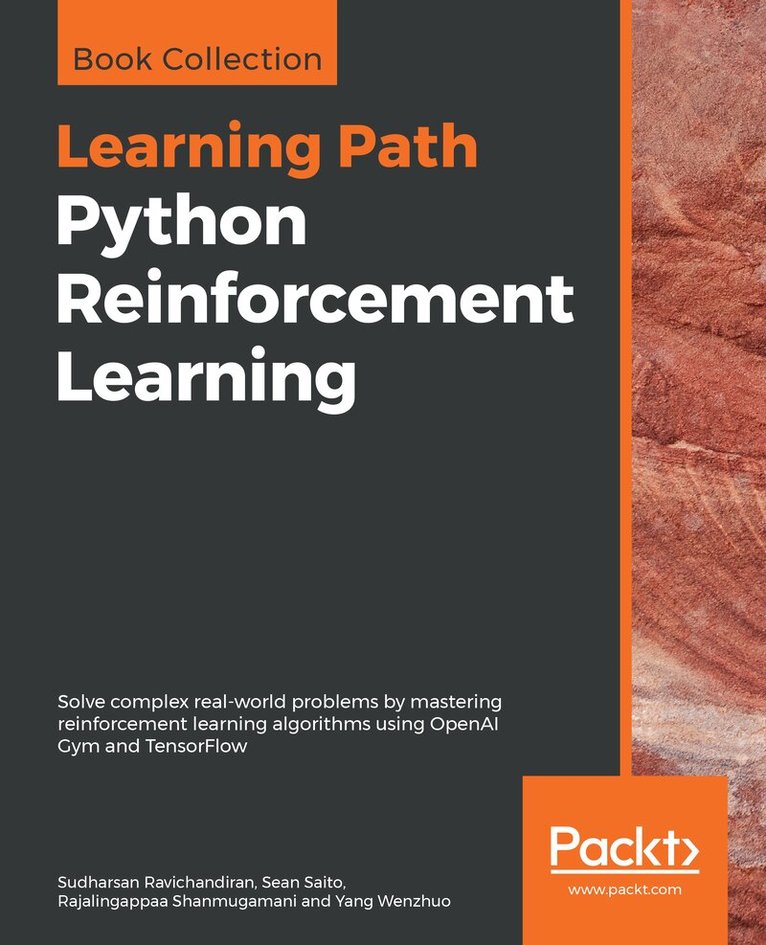
Apply modern reinforcement learning and deep reinforcement learning methods using Python and its powerful librariesKey FeaturesYour entry point into the world of artificial intelligence using the power of PythonAn example-rich guide to master various RL and DRL algorithmsExplore the power of modern Python libraries to gain confidence in building self-trained applicationsBook DescriptionReinforcement Learning (RL) is the trending and most promising branch of artificial intelligence. This Learning Path will help you master not only the basic reinforcement learning algorithms but also the advanced deep reinforcement learning algorithms.The Learning Path starts with an introduction to RL followed by OpenAI Gym, and TensorFlow. You will then explore various RL algorithms, such as Markov Decision Process, Monte Carlo methods, and dynamic programming, including value and policy iteration. You'll also work on various datasets including image, text, and video. This example-rich guide will introduce you to deep RL algorithms, such as Dueling DQN, DRQN, A3C, PPO, and TRPO. You will gain experience in several domains, including gaming, image processing, and physical simulations. You'll explore TensorFlow and OpenAI Gym to implement algorithms that also predict stock prices, generate natural language, and even build other neural networks. You will also learn about imagination-augmented agents, learning from human preference, DQfD, HER, and many of the recent advancements in RL.By the end of the Learning Path, you will have all the knowledge and experience needed to implement RL and deep RL in your projects, and you enter the world of artificial intelligence to solve various real-life problems.This Learning Path includes content from the following Packt products:Hands-On Reinforcement Learning with Python by Sudharsan RavichandiranPython Reinforcement Learning Projects by Sean Saito, Yang Wenzhuo, and Rajalingappaa ShanmugamaniWhat you will learnTrain an agent to walk using OpenAI Gym and TensorFlowSolve multi-armed-bandit problems using various algorithmsBuild intelligent agents using the DRQN algorithm to play the Doom gameTeach your agent to play Connect4 using AlphaGo ZeroDefeat Atari arcade games using the value iteration methodDiscover how to deal with discrete and continuous action spaces in various environmentsWho this book is forIf you’re an ML/DL enthusiast interested in AI and want to explore RL and deep RL from scratch, this Learning Path is for you. Prior knowledge of linear algebra is expected.
Häftad, Engelska, 2021
565 kr
Skickas inom 5-8 vardagar
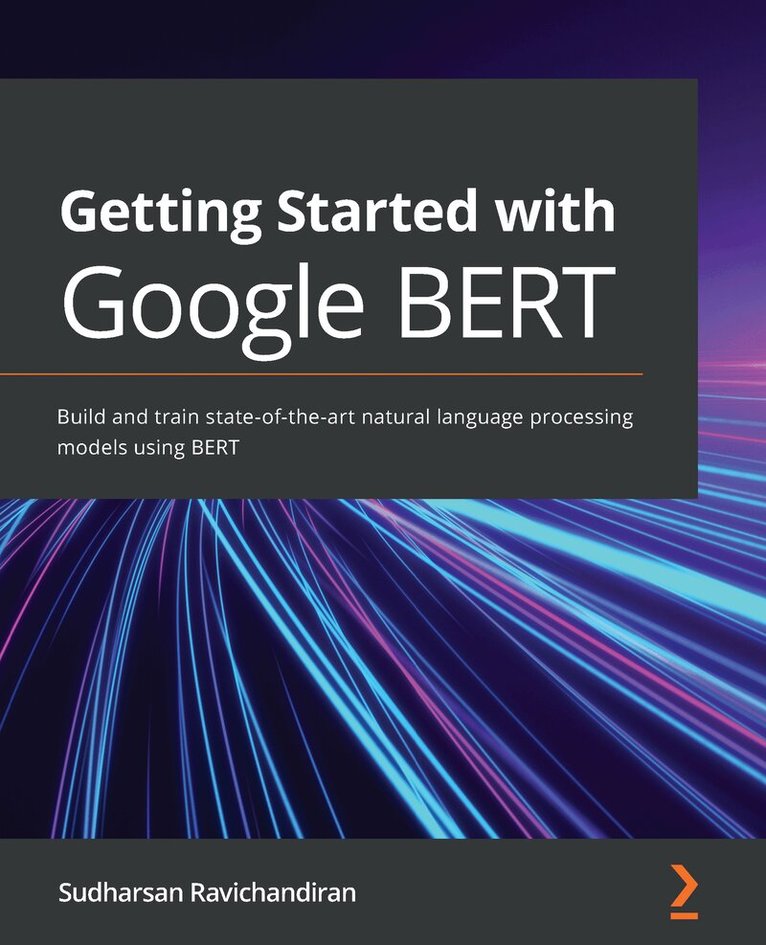
Kickstart your NLP journey by exploring BERT and its variants such as ALBERT, RoBERTa, DistilBERT, VideoBERT, and more with Hugging Face\'s transformers libraryKey FeaturesExplore the encoder and decoder of the transformer modelBecome well-versed with BERT along with ALBERT, RoBERTa, and DistilBERTDiscover how to pre-train and fine-tune BERT models for several NLP tasksBook DescriptionBERT (bidirectional encoder representations from transformer) has revolutionized the world of natural language processing (NLP) with promising results. This book is an introductory guide that will help you get to grips with Google's BERT architecture. With a detailed explanation of the transformer architecture, this book will help you understand how the transformer’s encoder and decoder work.You’ll explore the BERT architecture by learning how the BERT model is pre-trained and how to use pre-trained BERT for downstream tasks by fine-tuning it for NLP tasks such as sentiment analysis and text summarization with the Hugging Face transformers library. As you advance, you’ll learn about different variants of BERT such as ALBERT, RoBERTa, and ELECTRA, and look at SpanBERT, which is used for NLP tasks like question answering. You'll also cover simpler and faster BERT variants based on knowledge distillation such as DistilBERT and TinyBERT. The book takes you through MBERT, XLM, and XLM-R in detail and then introduces you to sentence-BERT, which is used for obtaining sentence representation. Finally, you'll discover domain-specific BERT models such as BioBERT and ClinicalBERT, and discover an interesting variant called VideoBERT.By the end of this BERT book, you’ll be well-versed with using BERT and its variants for performing practical NLP tasks.What you will learnUnderstand the transformer model from the ground upFind out how BERT works and pre-train it using masked language model (MLM) and next sentence prediction (NSP) tasksGet hands-on with BERT by learning to generate contextual word and sentence embeddingsFine-tune BERT for downstream tasksGet to grips with ALBERT, RoBERTa, ELECTRA, and SpanBERT modelsGet the hang of the BERT models based on knowledge distillationUnderstand cross-lingual models such as XLM and XLM-RExplore Sentence-BERT, VideoBERT, and BARTWho this book is forThis book is for NLP professionals and data scientists looking to simplify NLP tasks to enable efficient language understanding using BERT. A basic understanding of NLP concepts and deep learning is required to get the best out of this book.
Häftad, Engelska, 2020
628 kr
Skickas inom 5-8 vardagar
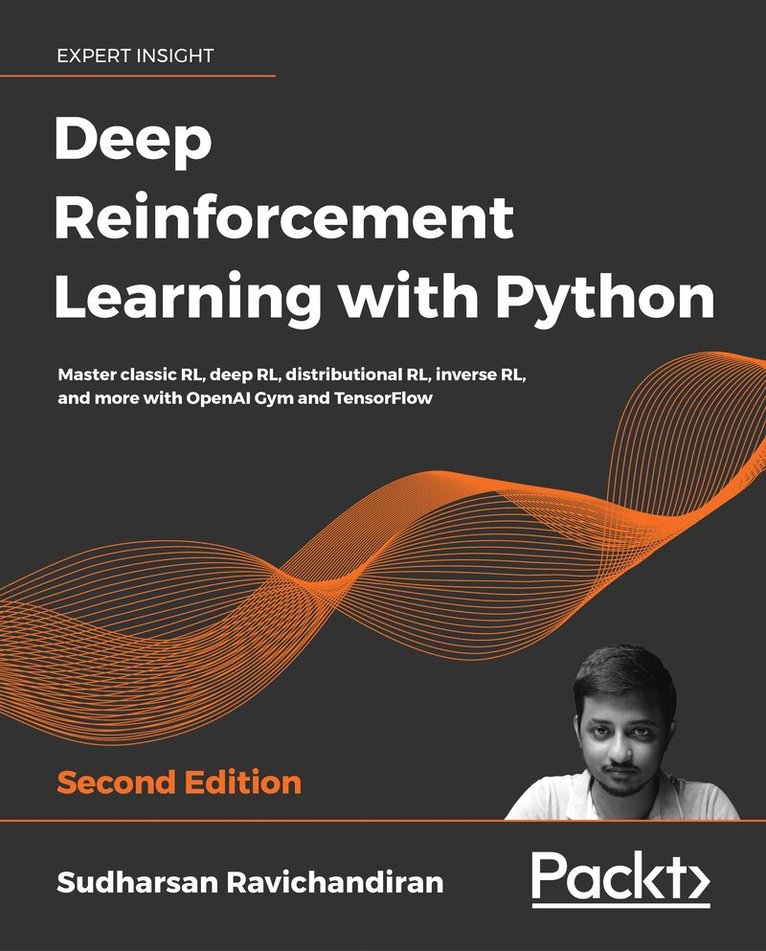
An example-rich guide for beginners to start their reinforcement and deep reinforcement learning journey with state-of-the-art distinct algorithmsKey FeaturesCovers a vast spectrum of basic-to-advanced RL algorithms with mathematical explanations of each algorithmLearn how to implement algorithms with code by following examples with line-by-line explanationsExplore the latest RL methodologies such as DDPG, PPO, and the use of expert demonstrationsBook DescriptionWith significant enhancements in the quality and quantity of algorithms in recent years, this second edition of Hands-On Reinforcement Learning with Python has been revamped into an example-rich guide to learning state-of-the-art reinforcement learning (RL) and deep RL algorithms with TensorFlow 2 and the OpenAI Gym toolkit.In addition to exploring RL basics and foundational concepts such as Bellman equation, Markov decision processes, and dynamic programming algorithms, this second edition dives deep into the full spectrum of value-based, policy-based, and actor-critic RL methods. It explores state-of-the-art algorithms such as DQN, TRPO, PPO and ACKTR, DDPG, TD3, and SAC in depth, demystifying the underlying math and demonstrating implementations through simple code examples.The book has several new chapters dedicated to new RL techniques, including distributional RL, imitation learning, inverse RL, and meta RL. You will learn to leverage stable baselines, an improvement of OpenAI’s baseline library, to effortlessly implement popular RL algorithms. The book concludes with an overview of promising approaches such as meta-learning and imagination augmented agents in research.By the end, you will become skilled in effectively employing RL and deep RL in your real-world projects.What you will learnUnderstand core RL concepts including the methodologies, math, and codeTrain an agent to solve Blackjack, FrozenLake, and many other problems using OpenAI GymTrain an agent to play Ms Pac-Man using a Deep Q NetworkLearn policy-based, value-based, and actor-critic methodsMaster the math behind DDPG, TD3, TRPO, PPO, and many othersExplore new avenues such as the distributional RL, meta RL, and inverse RLUse Stable Baselines to train an agent to walk and play Atari gamesWho this book is forIf you’re a machine learning developer with little or no experience with neural networks interested in artificial intelligence and want to learn about reinforcement learning from scratch, this book is for you.Basic familiarity with linear algebra, calculus, and the Python programming language is required. Some experience with TensorFlow would be a plus.