Suguru Ishizaki - Böcker
Visar alla böcker från författaren Suguru Ishizaki. Handla med fri frakt och snabb leverans.
4 produkter
4 produkter
90 kr
Tillfälligt slut
747 kr
Skickas inom 10-15 vardagar
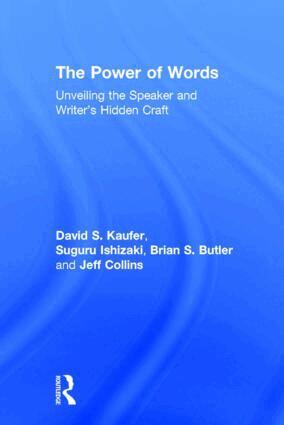
In 1888, Mark Twain reflected on the writer's special feel for words to his correspondent, George Bainton, noting that "the difference between the almost-right word and the right word is really a large matter." We recognize differences between a politician who is "willful" and one who is "willing" even though the difference does not cross word-stems or parts of speech. We recognize that being "held up" evokes different experiences depending upon whether its direct object is a meeting, a bank, or an example. Although we can notice hundreds of examples in the language where small differences in wording produce large reader effects, the authors of The Power of Words argue that these examples are random glimpses of a hidden systematic knowledge that governs how we, as writers or speakers, learn to shape experience for other human beings.Over the past several years, David Kaufer and his colleagues have developed a software program for analyzing writing called DocuScope. This book illustrates the concepts and rhetorical theory behind the software analysis, examining patterns in writing and showing writers how their writing works in different categories to accomplish varying objectives. Reflecting the range and variety of audience experience that contiguous words of surface English can prime, the authors present a theory of language as an instrument of rhetorically priming audiences and a catalog of English strings to implement the theory. The project creates a comprehensive map of the speaker and writer's implicit knowledge about predisposing audience experience at the point of utterance. The book begins with an explanation of why studying language from the standpoint of priming--not just meaning--is vital to non-question begging theories of close reading and to language education in general. The remaining chapters in Part I detail the steps taken to prepare a catalog study of English strings for their properties as priming instruments. Part II describes in detail the catalog of priming categories, including enough examples to help readers see how individual words and strings of English fit into the catalog. The final part describes how the authors have applied the catalog of English strings as priming tools to conduct textual research.
2 150 kr
Skickas inom 10-15 vardagar
In 1888, Mark Twain reflected on the writer's special feel for words to his correspondent, George Bainton, noting that "the difference between the almost-right word and the right word is really a large matter." We recognize differences between a politician who is "willful" and one who is "willing" even though the difference does not cross word-stems or parts of speech. We recognize that being "held up" evokes different experiences depending upon whether its direct object is a meeting, a bank, or an example. Although we can notice hundreds of examples in the language where small differences in wording produce large reader effects, the authors of The Power of Words argue that these examples are random glimpses of a hidden systematic knowledge that governs how we, as writers or speakers, learn to shape experience for other human beings.Over the past several years, David Kaufer and his colleagues have developed a software program for analyzing writing called DocuScope. This book illustrates the concepts and rhetorical theory behind the software analysis, examining patterns in writing and showing writers how their writing works in different categories to accomplish varying objectives. Reflecting the range and variety of audience experience that contiguous words of surface English can prime, the authors present a theory of language as an instrument of rhetorically priming audiences and a catalog of English strings to implement the theory. The project creates a comprehensive map of the speaker and writer's implicit knowledge about predisposing audience experience at the point of utterance. The book begins with an explanation of why studying language from the standpoint of priming--not just meaning--is vital to non-question begging theories of close reading and to language education in general. The remaining chapters in Part I detail the steps taken to prepare a catalog study of English strings for their properties as priming instruments. Part II describes in detail the catalog of priming categories, including enough examples to help readers see how individual words and strings of English fit into the catalog. The final part describes how the authors have applied the catalog of English strings as priming tools to conduct textual research.
254 kr
Tillfälligt slut
When Arab women are portrayed in western media, they are typically veiled and voiceless, their words spoken for them in captions and voice-overs. But where do Arab women stand in current Arab news? Are the western stereotypes reinforced or countered? For the first time, this book provides systematic answers to these and other questions. Using empirical, text-mining and close reading techniques, it sheds light on a range of concepts through which Arab women can be canvassed, all couched in a lively and accessible exchange between leading experts on gender and human rights.