Susan E. Mayer - Böcker
Visar alla böcker från författaren Susan E. Mayer. Handla med fri frakt och snabb leverans.
2 produkter
2 produkter
365 kr
Skickas inom 10-15 vardagar
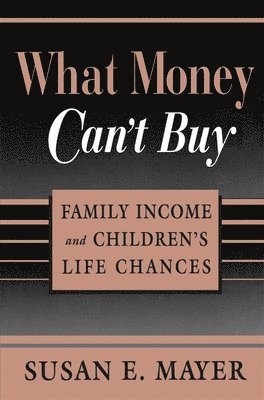
Children from poor families generally do a lot worse than children from affluent families. They are more likely to develop behavior problems, to score lower on standardized tests, and to become adults in need of public assistance.Susan Mayer asks whether income directly affects children's life chances, as many experts believe, or if the factors that cause parents to have low incomes also impede their children's life chances. She explores the question of causation with remarkable ingenuity. First, she compares the value of income from different sources to determine, for instance, if a dollar from welfare is as valuable as a dollar from wages. She then investigates whether parents' income after an event, such as teenage childbearing, can predict that event. If it can, this suggests that income is a proxy for unmeasured characteristics that affect both income and the event. Next she compares children living in states that pay high welfare benefits with children living in states with low benefits. Finally, she examines whether national income trends have the expected impact on children. Regardless of the research technique, the author finds that the effect of income on children's outcomes is smaller than many experts have thought.Mayer then shows that the things families purchase as their income increases, such as cars and restaurant meals, seldom help children succeed. On the other hand, many of the things that do benefit children, such as books and educational outings, cost so little that their consumption depends on taste rather than income. Money alone, Mayer concludes, does not buy either the material or the psychological well-being that children require to succeed.
279 kr
Skickas inom 10-15 vardagar
A Brookings Institution Press and Russell Sage Foundation publicationEducation is one of the largest sectors of the U.S. economy--yet scholars, educators, policymakers, and parents do not agree about what the money spent on education really buys. In particular, they do not agree on how much education improves children's ability to learn or whether the things children learn in school truly improve their chances for success as adults. If schooling increases how much students know and what they know does pay off later, then it is important to ask what schools can do to increase students' learning and earning.The essays in this book report estimates of the effects of learning on earnings and other life outcomes. They also examine whether particular aspects of schooling--such as the age at which children begin school, classroom size, and curriculum--or structural reform--such as national or statewide examinations or school choice--affect learning. Taken together, their findings suggest that liberals are correct in saying that more investment is needed in early education, that class sizes should be further reduced, and that challenging national or state standards should be established. But they also provide support for conservatives who ask for a more demanding curriculum and greater school choice.Contributors include John Bishop, Eric Hanushek, James Heckman, Christopher Jencks, Caroline Minter Hoxby, Fred Mosteller, and Christopher Winship.