Susan Engel – författare
209 kr
Skickas inom 5-8 vardagar
2 435 kr
Skickas inom 10-15 vardagar
670 kr
Skickas inom 10-15 vardagar
3 674 kr
Skickas inom 10-15 vardagar
2 477 kr
Skickas inom 10-15 vardagar
591 kr
Skickas inom 10-15 vardagar
399 kr
Skickas inom 10-15 vardagar
168 kr
Skickas inom 5-8 vardagar
224 kr
Skickas inom 10-15 vardagar
757 kr
Läs direkt efter köp
This book explores the evolution of the 30 functioning multilateral development banks (MDBs). MDBs have their roots in the growing system of international finance and multilateral cooperation, with the first recognisable MDB being proposed by Latin America in financial cooperation with the US in the late 1930s. That Inter-American Bank did not eventuate but was a precursor to the World Bank being negotiated at Bretton Woods in 1944. Since then, a complex network of regional, sub-regional, and specialised development banks has progressively emerged across the globe, including two significant recent entrants established by China and the BRICS.
MDBs arrange loans, credits, and guarantees for investment in member states, generally with the stated aim of fostering economic growth. They operate in both the Global North and South, though there are more MDBs focusing on emerging and developing states. While the World Bank and some of the larger regional banks have been scrutinised, little attention has been paid to the smaller banks or the overall system. This book provides the first study of all 30 MDBs and it evaluates their interrelationships. It analyses the emergence of the MDBs in relation to geopolitics, development paradigms and debt. It includes sections on each of the banks as well as on how MDBs have approached the key sectors of infrastructure, human development, and climate.
This book will be of particular interest to researchers of development finance, global governance, and international political economy.
757 kr
Läs direkt efter köp
This book explores the evolution of the 30 functioning multilateral development banks (MDBs). MDBs have their roots in the growing system of international finance and multilateral cooperation, with the first recognisable MDB being proposed by Latin America in financial cooperation with the US in the late 1930s. That Inter-American Bank did not eventuate but was a precursor to the World Bank being negotiated at Bretton Woods in 1944. Since then, a complex network of regional, sub-regional, and specialised development banks has progressively emerged across the globe, including two significant recent entrants established by China and the BRICS.
MDBs arrange loans, credits, and guarantees for investment in member states, generally with the stated aim of fostering economic growth. They operate in both the Global North and South, though there are more MDBs focusing on emerging and developing states. While the World Bank and some of the larger regional banks have been scrutinised, little attention has been paid to the smaller banks or the overall system. This book provides the first study of all 30 MDBs and it evaluates their interrelationships. It analyses the emergence of the MDBs in relation to geopolitics, development paradigms and debt. It includes sections on each of the banks as well as on how MDBs have approached the key sectors of infrastructure, human development, and climate.
This book will be of particular interest to researchers of development finance, global governance, and international political economy.
807 kr
Läs direkt efter köp
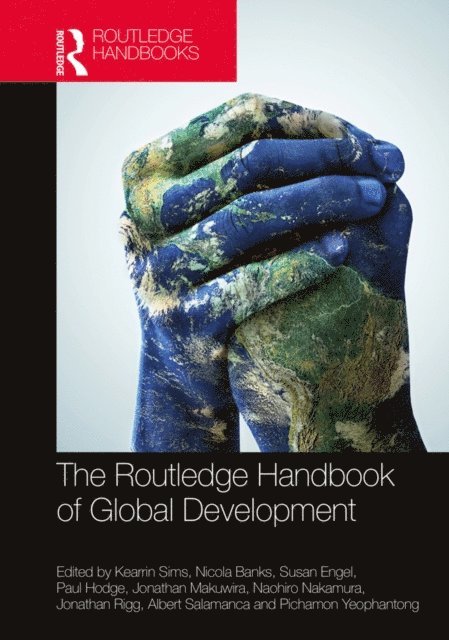
This Handbook provides a comprehensive analysis of some of the world’s most pressing global development challenges – including how they may be better understood and addressed through innovative practices and approaches to learning and teaching.
Featuring 61 contributions from leading and emerging academics and practitioners, this multidisciplinary volume is organized into five thematic parts exploring: changes in global development financing, ideologies, norms and partnerships; interrelationships between development, natural environments and inequality; shifts in critical development challenges, and; new possibilities for positive change. Collectively, the handbook demonstrates that global development challenges are becoming increasingly complex and multi-faceted and are to be found in the Global ‘North’ as much as the ‘South’. It draws attention to structural inequality and disadvantage alongside possibilities for positive change.
The Handbook will serve as a valuable resource for students and scholars across multiple disciplines including Development Studies, Anthropology, Geography, Global Studies, Indigenous and Postcolonial Studies, Political Science, and Urban Studies.
The Introduction of this book is freely available as a downloadable Open Access PDF at http://www.taylorfrancis.com under a Creative Commons Attribution-Non Commercial-No Derivatives (CC-BY-NC-ND) 4.0 license.
807 kr
Läs direkt efter köp
This Handbook provides a comprehensive analysis of some of the world’s most pressing global development challenges – including how they may be better understood and addressed through innovative practices and approaches to learning and teaching.
Featuring 61 contributions from leading and emerging academics and practitioners, this multidisciplinary volume is organized into five thematic parts exploring: changes in global development financing, ideologies, norms and partnerships; interrelationships between development, natural environments and inequality; shifts in critical development challenges, and; new possibilities for positive change. Collectively, the handbook demonstrates that global development challenges are becoming increasingly complex and multi-faceted and are to be found in the Global ‘North’ as much as the ‘South’. It draws attention to structural inequality and disadvantage alongside possibilities for positive change.
The Handbook will serve as a valuable resource for students and scholars across multiple disciplines including Development Studies, Anthropology, Geography, Global Studies, Indigenous and Postcolonial Studies, Political Science, and Urban Studies.
The Introduction of this book is freely available as a downloadable Open Access PDF at http://www.taylorfrancis.com under a Creative Commons Attribution-Non Commercial-No Derivatives (CC-BY-NC-ND) 4.0 license.
713 kr
Skickas inom 10-15 vardagar
727 kr
Läs direkt efter köp
This book explores the history, structure and current operations of the World Bank, which despite being the largest development organisation and the largest development research body in the world with tremendous direct and indirect influence on developing economies, has rarely received the critical attention its importance merits. The book’s unique contribution is twofold: it provides an original analysis of the interaction between economic theory, political practice and the Bank’s development praxis as well as two detailed, grounded studies of the Bank’s lending practices.
The book starts with a detailed examination of the development theory and practice of the World Bank from its Keynesian origins to the current shift through the Washington Consensus to the so-called post-Washington Consensus. The second part is a detailed analysis of the Bank’s lending practices in two countries, Vietnam and Indonesia. The case studies extensively utilise World Bank sources —analysing the Project Appraisal Documents for some 113 loans. They also draw on the secondary literature and on interviews with World Bank staff, government officials, academics and NGOs in both countries. The case studies enable the development of empirically-based conclusions regarding the impact of Bank policies on the economic and social development of two important Southeast Asian nations making possible an assessment of the extent to which the rhetoric of the post-Washington Consensus has been incorporated into the Bank’s lending practices.
This book will be of interest to both advanced undergraduate and graduate students as well as specialist audiences in the fields of international political economy, development, international organizations and Southeast Asian Studies.
727 kr
Läs direkt efter köp
This book explores the history, structure and current operations of the World Bank, which despite being the largest development organisation and the largest development research body in the world with tremendous direct and indirect influence on developing economies, has rarely received the critical attention its importance merits. The book’s unique contribution is twofold: it provides an original analysis of the interaction between economic theory, political practice and the Bank’s development praxis as well as two detailed, grounded studies of the Bank’s lending practices.
The book starts with a detailed examination of the development theory and practice of the World Bank from its Keynesian origins to the current shift through the Washington Consensus to the so-called post-Washington Consensus. The second part is a detailed analysis of the Bank’s lending practices in two countries, Vietnam and Indonesia. The case studies extensively utilise World Bank sources —analysing the Project Appraisal Documents for some 113 loans. They also draw on the secondary literature and on interviews with World Bank staff, government officials, academics and NGOs in both countries. The case studies enable the development of empirically-based conclusions regarding the impact of Bank policies on the economic and social development of two important Southeast Asian nations making possible an assessment of the extent to which the rhetoric of the post-Washington Consensus has been incorporated into the Bank’s lending practices.
This book will be of interest to both advanced undergraduate and graduate students as well as specialist audiences in the fields of international political economy, development, international organizations and Southeast Asian Studies.
270 kr
Skickas inom 3-6 vardagar
182 kr
Läs direkt efter köp
152 kr
Skickas inom 5-8 vardagar
347 kr
Tillfälligt slut
215 kr
Tillfälligt slut
215 kr
Tillfälligt slut