Susan Frye – författare
Visar alla böcker från författaren Susan Frye. Handla med fri frakt och snabb leverans.
6 produkter
6 produkter
E-bok
PDF, Engelska, 1999690 kr
Läs direkt efter köp
This new collection of sixteen essays considers evidence for the varied forms of women''s alliances in early modern England. It shows how women, prohibited from direct participation in the institutional structures that shaped the lives of men, constructed informal connections with other females for purposes of survival, advancement, and creativity. The essays presented here consider a variety of communities--formed among groups as diverse as serving women, vagrants, aristocrats, and authors--in order to study the historical traces of women''s connections. "Alliance"--as understood by the essayists in this volume--does not preclude competition or antagonism, since the bonds among women were frequently determined by an opposition to other women. As shown here, the theorizing of women''s connections, and the recovery of the historical evidence for these connections, can only add to our understanding of women''s activities in early modern English society. Maids and Mistresses, Cousins and Queens is divided into four sections. The first two, "Alliances in the City" and "Alliances in the Household," examine the circumstances of women''s communities in two primary sites for women of this place and time. The second two, "Materializing Communities" and "Emerging Alliances," fully study the aspirations that guided and transformed the courses of women''s lives. All of these interdisciplinary essays, deftly combining literary and historical methods and materials, are informed by feminism, queer theory, and studies of class and race in the early modern period.
E-bok
PDF, Engelska, 1996420 kr
Läs direkt efter köp
Elizabeth I is perhaps the most visible woman in early modern Europe, yet little attention has been paid to what she said about the difficulties of constructing her power in a patriarchal society. This revisionist study examines her struggle for authority through the representation of her female body. Based on a variety of extant historical and literary materials, Frye''s interpretation focuses on three representational crises spaced fifteen years apart: the London coronation of 1559, the Kenilworth entertainments of 1575, and the publication of The Faerie Queene in 1590. In ways which varied with social class and historical circumstance, the London merchants, the members of the Protestant faction, courtly artists, and artful courtiers all sought to stabilize their own gendered identities by constructing the queen within the "natural" definitions of the feminine as passive and weak. Elizabeth fought back, acting as a discursive agent by crossing, and thus disrupting, these definitions. She and those closely identified with her interests evolved a number of strategies through which to express her political control in terms of the ownership of her body, including her elaborate iconography and a mythic biography upon which most accounts of Elizabeth''s life have been based. The more authoritative her image became, the more vigorously it was contested in a process which this study examines and consciously perpetuates.
E-bok
Engelska, 1996435 kr
Läs direkt efter köp
Elizabeth I is perhaps the most visible woman in early modern Europe, yet little attention has been paid to what she said about the difficulties of constructing her power in a patriarchal society. This revisionist study examines her struggle for authority through the representation of her female body. Based on a variety of extant historical and literary materials, Frye''s interpretation focuses on three representational crises spaced fifteen years apart: the London coronation of 1559, the Kenilworth entertainments of 1575, and the publication of The Faerie Queene in 1590. In ways which varied with social class and historical circumstance, the London merchants, the members of the Protestant faction, courtly artists, and artful courtiers all sought to stabilize their own gendered identities by constructing the queen within the "natural" definitions of the feminine as passive and weak. Elizabeth fought back, acting as a discursive agent by crossing, and thus disrupting, these definitions. She and those closely identified with her interests evolved a number of strategies through which to express her political control in terms of the ownership of her body, including her elaborate iconography and a mythic biography upon which most accounts of Elizabeth''s life have been based. The more authoritative her image became, the more vigorously it was contested in a process which this study examines and consciously perpetuates.
E-bok
PDF, Engelska, 2011878 kr
Läs direkt efter köp
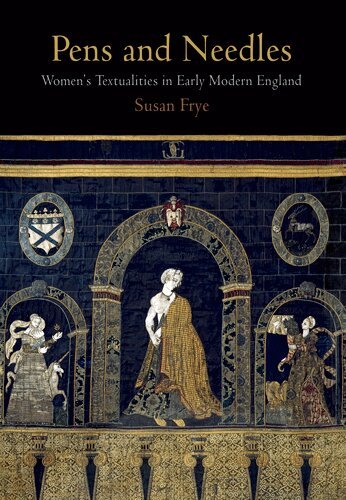
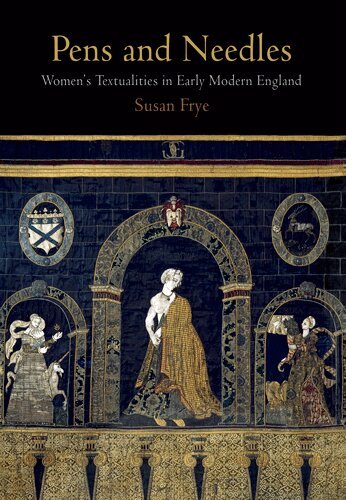
The Renaissance woman, whether privileged or of the artisan or the middle class, was trained in the expressive arts of needlework and painting, which were often given precedence over writing. Pens and Needles is the first book to examine all these forms as interrelated products of self-fashioning and communication.Because early modern people saw verbal and visual texts as closely related, Susan Frye discusses the connections between the many forms of women's textualities, including notes in samplers, alphabets both stitched and penned, initials, ciphers, and extensive texts like needlework pictures, self-portraits, poetry, and pamphlets, as well as commissioned artwork, architecture, and interior design. She examines works on paper and cloth by such famous figures as Elizabeth I, Mary, Queen of Scots, and Bess of Hardwick, as well as the output of journeywomen needleworkers and miniaturists Levina Teerlinc and Esther Inglis, and their lesser-known sisters in the English colonies of the New World. Frye shows how traditional women's work was a way for women to communicate with one another and to shape their own identities within familial, intellectual, religious, and historical traditions. Pens and Needles offers insights into women's lives and into such literary texts as Shakespeare's Othello and Cymbeline and Mary Sidney Wroth's Urania.
Häftad, Engelska, 2013
579 kr
Skickas
The Renaissance woman, whether privileged or of the artisan or the middle class, was trained in the expressive arts of needlework and painting, which were often given precedence over writing. Pens and Needles is the first book to examine all these forms as interrelated products of self-fashioning and communication.Because early modern people saw verbal and visual texts as closely related, Susan Frye discusses the connections between the many forms of women's textualities, including notes in samplers, alphabets both stitched and penned, initials, ciphers, and extensive texts like needlework pictures, self-portraits, poetry, and pamphlets, as well as commissioned artwork, architecture, and interior design. She examines works on paper and cloth by such famous figures as Elizabeth I, Mary, Queen of Scots, and Bess of Hardwick, as well as the output of journeywomen needleworkers and miniaturists Levina Teerlinc and Esther Inglis, and their lesser-known sisters in the English colonies of the New World. Frye shows how traditional women's work was a way for women to communicate with one another and to shape their own identities within familial, intellectual, religious, and historical traditions. Pens and Needles offers insights into women's lives and into such literary texts as Shakespeare's Othello and Cymbeline and Mary Sidney Wroth's Urania.
Inbunden, Engelska, 2010
981 kr
Skickas inom 5-8 vardagar
The Renaissance woman, whether privileged or of the artisan or the middle class, was trained in the expressive arts of needlework and painting, which were often given precedence over writing. Pens and Needles is the first book to examine all these forms as interrelated products of self-fashioning and communication.Because early modern people saw verbal and visual texts as closely related, Susan Frye discusses the connections between the many forms of women's textualities, including notes in samplers, alphabets both stitched and penned, initials, ciphers, and extensive texts like needlework pictures, self-portraits, poetry, and pamphlets, as well as commissioned artwork, architecture, and interior design. She examines works on paper and cloth by such famous figures as Elizabeth I, Mary, Queen of Scots, and Bess of Hardwick, as well as the output of journeywomen needleworkers and miniaturists Levina Teerlinc and Esther Inglis, and their lesser-known sisters in the English colonies of the New World. Frye shows how traditional women's work was a way for women to communicate with one another and to shape their own identities within familial, intellectual, religious, and historical traditions. Pens and Needles offers insights into women's lives and into such literary texts as Shakespeare's Othello and Cymbeline and Mary Sidney Wroth's Urania.