Susan Haack - Böcker
Visar alla böcker från författaren Susan Haack. Handla med fri frakt och snabb leverans.
11 produkter
11 produkter
297 kr
Skickas inom 7-10 vardagar
Initially proposed as rivals of classical logic, alternative logics have become increasingly important in areas such as computer science and arti ficial intelligence. Fuzzy logic, in particular, has motivated major technological developments in recent years. Susan Haack's "Deviant Logic" provided an extended examination of the philosophical consequences of alternative logics. In this volume, Haack includes the complete text of "Deviant Logic", as well as five additional papers that expand and update it. Two of these essays critique fuzzy logic, while three augment "Deviant Logic"'s treatment of deduction and logical truth. Haack also provides an extensive new foreword, brief introductions to the new essays, and an updated bibliography of current work in these areas.
211 kr
Skickas inom 7-10 vardagar
Forthright and wryly humorous, philosopher Susan Haack deploys her penetrating analytic skills on some of the most highly charged cultural and social debates of recent years. Relativism, multiculturalism, feminism, affirmative action, pragmatisms old and new, science, literature, the future of the academy and of philosophy itself—all come under her keen scrutiny in Manifesto of a Passionate Moderate."The virtue of Haack's book, and I mean virtue in the ethical sense, is that it embodies the attitude that it exalts. . . Haack's voice is urbane, sensible, passionate—the voice of philosophy that matters. How good to hear it again."—Jonathan Rauch, Reason"A tough mind, confident of its power, making an art of logic . . . a cool mastery."—Paul R. Gross, Wilson Quarterly"Few people are better able to defend the notion of truth, and in strong, clear prose, than Susan Haack . . . a philosopher of great distinction."—Hugh Lloyd-Jones, National Review"If you relish acute observation and straight talk, this is a book to read."—Key Reporter (Phi Beta Kappa)"Everywhere in this book there is the refreshing breeze of common sense, patiently but inexorably blowing."—Roger Kimball, Times Literary Supplement"A refreshing alternative to the extremism that characterizes so much rhetoric today."—Kirkus Reviews
347 kr
Skickas inom 7-10 vardagar
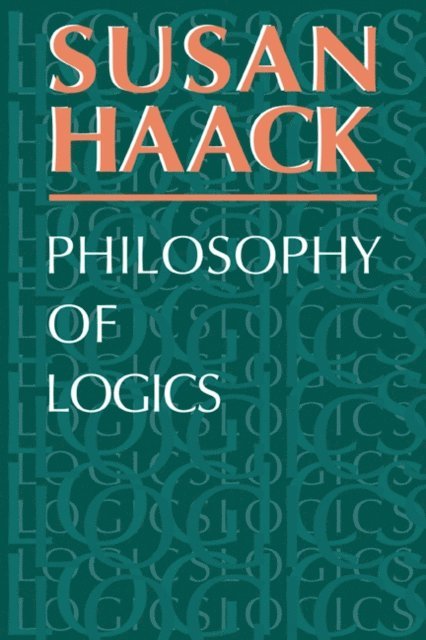
The first systematic exposition of all the central topics in the philosophy of logic, Susan Haack's book has established an international reputation (translated into five languages) for its accessibility, clarity, conciseness, orderliness, and range as well as for its thorough scholarship and careful analyses. Haack discusses the scope and purpose of logic, validity, truth-functions, quantification and ontology, names, descriptions, truth, truth-bearers, the set-theoretical and semantic paradoxes, and modality. She also explores the motivations for a whole range of non-classical systems of logic, including many-valued logics, fuzzy logic, moddal and tense logics, and relevance logics. Persupposing only an elementary knowledge of formal logic, this book includes many useful summary tables and diagrams, as well as a helpful glossary of technical terms. Wide-ranging, informative, and eminently readable, this book has proven a valuable resource for generations of students and scholars in a variety of disciplines outside philosophy needing guidance on the philosophy of logic.
438 kr
Skickas inom 7-10 vardagar
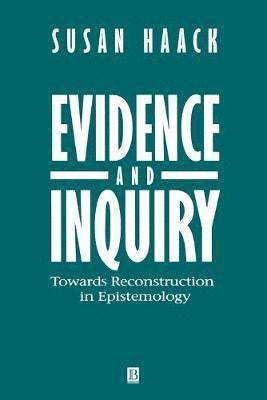
In this important new work, Haack develops an original theory of empirical evidence or justification, and argues its appropriateness to the goals of inquiry. In so doing, Haack provides detailed critical case studies of Lewis's foundationalism; Davidson's and Bonjour's coherentism; Popper's 'epistemology without a knowing subject'; Quine's naturalism; Goldman's reliabilism; and Rorty's, Stich's, and the Churchlands' recent obituaries of epistemology.
951 kr
Skickas inom 7-10 vardagar
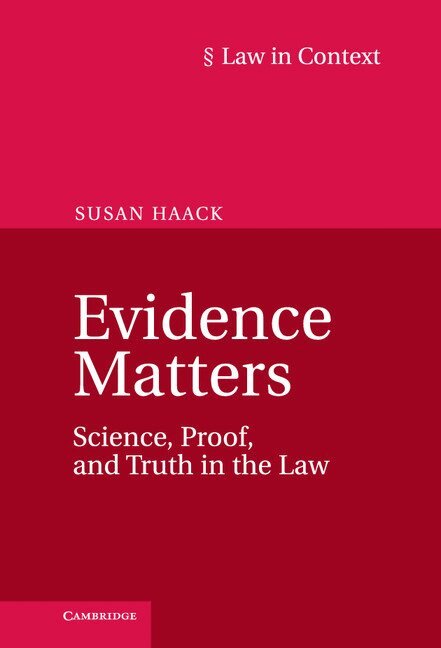
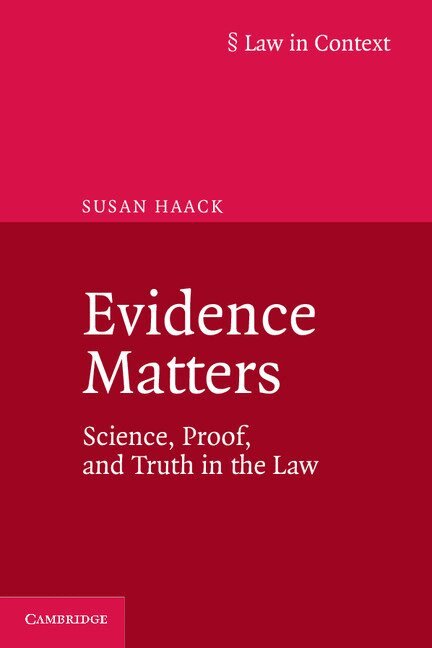
Is truth in the law just plain truth - or something sui generis? Is a trial a search for truth? Do adversarial procedures and exclusionary rules of evidence enable, or impede, the accurate determination of factual issues? Can degrees of proof be identified with mathematical probabilities? What role can statistical evidence properly play? How can courts best handle the scientific testimony on which cases sometimes turn? How are they to distinguish reliable scientific testimony from unreliable hokum? These interdisciplinary essays explore such questions about science, proof, and truth in the law. With her characteristic clarity and verve, Haack brings her original and distinctive work in theory of knowledge and philosophy of science to bear on real-life legal issues. She includes detailed analyses of a wide variety of cases and lucid summaries of relevant scientific work, of the many roles of the scientific peer-review system, and of relevant legal developments.
412 kr
Skickas inom 7-10 vardagar
Is truth in the law just plain truth - or something sui generis? Is a trial a search for truth? Do adversarial procedures and exclusionary rules of evidence enable, or impede, the accurate determination of factual issues? Can degrees of proof be identified with mathematical probabilities? What role can statistical evidence properly play? How can courts best handle the scientific testimony on which cases sometimes turn? How are they to distinguish reliable scientific testimony from unreliable hokum? These interdisciplinary essays explore such questions about science, proof, and truth in the law. With her characteristic clarity and verve, Haack brings her original and distinctive work in theory of knowledge and philosophy of science to bear on real-life legal issues. She includes detailed analyses of a wide variety of cases and lucid summaries of relevant scientific work, of the many roles of the scientific peer-review system, and of relevant legal developments.
325 kr
Skickas inom 5-8 vardagar
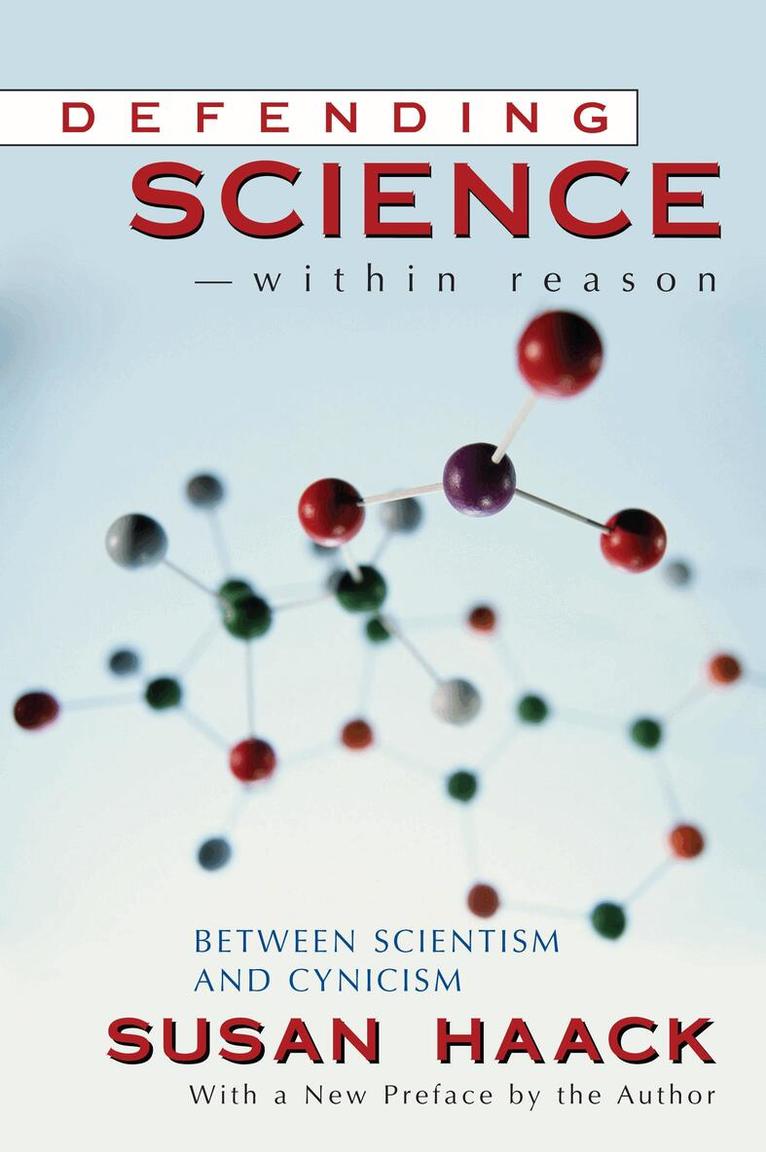
Sweeping in scope, penetrating in analysis, and generously illustrated with examples from the history of science, this new and original approach to familiar questions about scientific evidence and method tackles vital questions about science and its place in society. Avoiding the twin pitfalls of scientism and cynicism, noted philosopher Susan Haack argues that, fallible and flawed as they are, the natural sciences have been among the most successful of human enterprises-valuable not only for the vast, interlocking body of knowledge they have discovered, and not only for the technological advances that have improved our lives, but as a manifestation of the human talent for inquiry at its imperfect but sometimes remarkable best.This wide-ranging, trenchant, and illuminating book explores the complexities of scientific evidence, and the multifarious ways in which the sciences have refined and amplified the methods of everyday empirical inquiry; articulates the ways in which the social sciences are like the natural sciences, and the ways in which they are different; disentangles the confusions of radical rhetoricians and cynical sociologists of science; exposes the evasions of apologists for religious resistance to scientific advances; weighs the benefits and the dangers of technology; tracks the efforts of the legal system to make the best use of scientific testimony; and tackles predictions of the eventual culmination, or annihilation, of the scientific enterprise.Writing with verve and wry humor, in a witty, direct, and accessible style, Haack takes readers beyond the "Science Wars" to a balanced understanding of the value, and the limitations, of the scientific enterprise.
377 kr
Tillfälligt slut
Morris R. Cohen once described pragmatism as "a philosophy for people who cannot think"; and Bertrand Russell feared that pragmatism would lead philosophy into "cosmic impiety." Nothing could be further from the truth. Pragmatism was one of the most fruitful philosophical movements of the late nineteenth century, and has continued to be a significant influence on some of the major figures in philosophy - F. P. Ramsey, W. V. Quine, Sidney Hook, Nelson Goodman, Hilary Putnam, and many others.Today some even speak of a remarkable renaissance of pragmatism. Very often, though, what they have in mind is not the rich heritage of the classical pragmatist tradition, but a radical self-styled neo-pragmatism that has of late transmuted the reformist aspirations of classical pragmatism into a kind of revolutionary anti-intellectualism - a radical neo-pragmatism that seems to confirm Russell's worst fears.Asking what we can learn from the older pragmatist tradition, and what we can salvage from the intellectual shipwreck of the new, Susan Haack, with the assistance of Robert Lane, has put together a wide-ranging anthology that tells the story of the evolution of pragmatism from its origins in C. S. Peirce's hopes of making philosophy more scientific and William James's of "unstiffening our theories," to the radical literary-political neo-pragmatism recently popularized by Richard Rorty. Opening with a history of pragmatism from its inception to the present day, and closing with Haack's famous "interview" with Peirce and Rorty, the book presents a broad and diverse selection of pragmatist writings - classical and contemporary, reformist and revolutionary - on logic, metaphysics, theory of inquiry, philosophy of mind, philosophy of religion, aesthetics, philosophy of education, and moral, social, and political philosophy.
247 kr
Skickas inom 5-8 vardagar
Sweeping in scope, penetrating in analysis, and generously illustrated with examples from the history of science, this new and original approach to familiar questions about scientific evidence and method tackles vital questions about science and its place in society. Avoiding the twin pitfalls of scientism and cynicism, noted philosopher Susan Haack argues that, fallible and flawed as they are, the natural sciences have been among the most successful of human enterprises-valuable not only for the vast, interlocking body of knowledge they have discovered, and not only for the technological advances that have improved our lives, but as a manifestation of the human talent for inquiry at its imperfect but sometimes remarkable best.This wide-ranging, trenchant, and illuminating book explores the complexities of scientific evidence, and the multifarious ways in which the sciences have refined and amplified the methods of everyday empirical inquiry; articulates the ways in which the social sciences are like the natural sciences, and the ways in which they are different; disentangles the confusions of radical rhetoricians and cynical sociologists of science; exposes the evasions of apologists for religious resistance to scientific advances; weighs the benefits and the dangers of technology; tracks the efforts of the legal system to make the best use of scientific testimony; and tackles predictions of the eventual culmination, or annihilation, of the scientific enterprise.Writing with verve and wry humor, in a witty, direct, and accessible style, Haack takes readers beyond the "Science Wars" to a balanced understanding of the value, and the limitations, of the scientific enterprise.
278 kr
Skickas inom 5-8 vardagar
Described by Hilary Putnam as "both a fine introduction and a significant contribution" to epistemology, and by Anthony Quinton as "at once comprehensive ... and judicious," Evidence and Inquiry is unique both in its scope and in its originality. C. I. Lewis's foundationalism, BonJour's and Davidson's coherentism, Popper's critical rationalism, Quine's naturalism, and Rorty's, Stich's, and Churchland's anti-epistemological neopragmatism all come under Haack's uniquely thorough critical scrutiny. Core epistemological questions about the nature of belief, the character and structure of evidence, the determinants of evidential quality, the relation of justification, probability, and truth, among others, are given refreshingly novel, and reasonable, answers.Most books in epistemology are written only for other epistemologists. But Evidence and Inquiry has proven of interest not only to specialists but also to many other readers, from thoughtful scientists to thoughtful scholars of law and literature.This new, expanded edition-with a substantial new foreword and several additional papers on topics ranging from feminist epistemology to Peirce's critique of the adversarial legal system and Bentham's critique of exclusionary rules of evidence-should attract longtime readers and newcomers alike.
Putting Philosophy to Work
Inquiry and Its Place in Culture -- Essays on Science, Religion, Law, Literature, and Life
Häftad, Engelska, 2013
294 kr
Skickas inom 5-8 vardagar
This engaging and wide-ranging collection of essays is informed and unified by the conviction that philosophy can, and should, engage with real-world issues. Susan Haack's keen analytical skills and well-chosen illustrations illuminate a diverse range of cultural questions; and her direct style and wry sense of humor make complex ideas and subtle distinctions accessible to serious readers whatever their discipline or particular interests. Putting Philosophy to Work will appeal not only to philosophers but also to thoughtful scientists, economists, legal thinkers, historians, literary scholars, and humanists. This new, expanded second edition includes several previously unpublished essays: a devastating critique of Karl Popper's highly (and dangerously) influential philosophy of science; a searching and thought-provoking analysis of scientism; and a groundbreaking paper on "academic ethics in a preposterous environment" that every professor, and would-be professor, should read.