Susan M. Reinhart - Böcker
Visar alla böcker från författaren Susan M. Reinhart. Handla med fri frakt och snabb leverans.
3 produkter
3 produkter
330 kr
Skickas inom 7-10 vardagar
Many law students feel that they are learning a new language during their first year of law school. For those students who are not native English speakers this process can be even more overwhelming. Strategies for Legal Case Reading and Vocabulary Development was written for just these students. The goal of the text is to help students develop the case reading and vocabulary strategies they will need to compete and succeed in an American law school.Strategies for Legal Case Reading and Vocabulary Development begins with an overview of the American legal system and relevant research and guidelines relating to case reading. The book is divided into sections on common law, statutory law, and constitutional law. Approximately twenty cases (some abridged) and eight readings are included in the text. Questions for Discussion follow each case to help students prepare to actively participate in class case discussions. Additional features include hypotheticals (often posed by law professors), vocabulary tasks, and short writing assignments.
267 kr
Skickas inom 7-10 vardagar
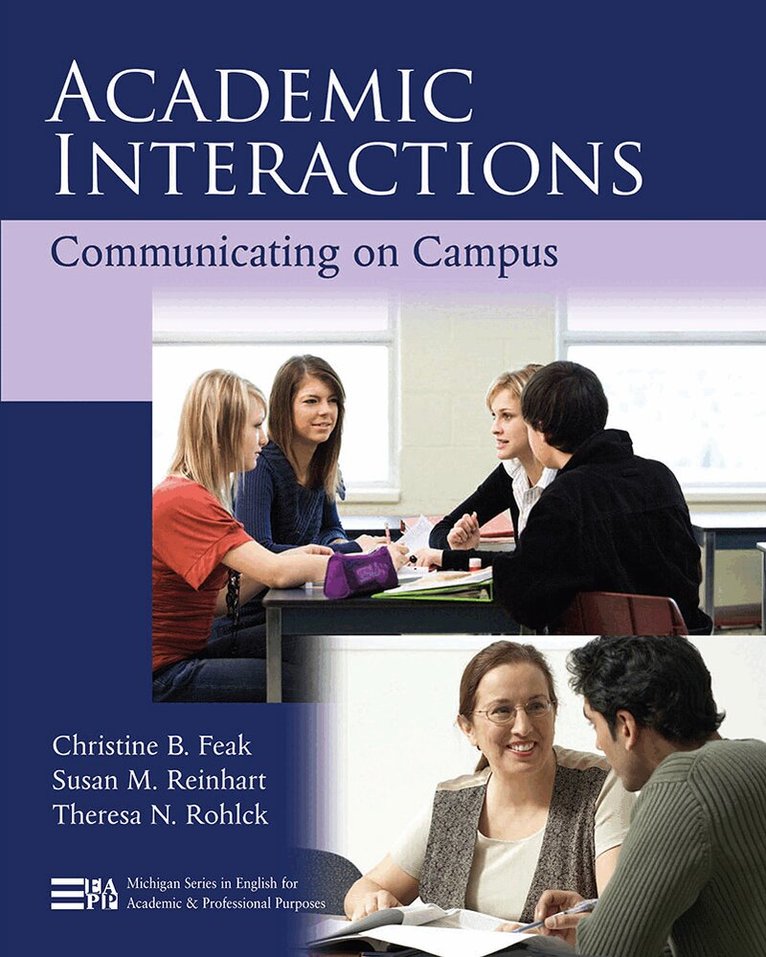
This version of the book matches 9780472033324 except it is not packaged with a DVD. All references to the DVD in the text have been replaced with "videos." Video access sold separately on Vitalsource, here: https://www.vitalsource.com/products/videos-to-accompany-academic-interactions-christine-b-feak-susan-m-v9780472003631?term=9780472003631. The ability to understand and be understood when communicating with professors and with native speakers is crucial to academic success. Academic Interactions focuses on actual academic speaking events, particularly classroom interactions and office hours, and gives students practice improving the ways that they communicate in a college/university setting. Academic Interactions addresses skills like using names and names of locations correctly on campus, giving directions, understanding instructors and their expectations, interacting during office hours, participating in class and in seminars, and delivering formal and informal presentations. In addition, advice is provided for communicating via email with professors and working in groups with native speakers (including negotiating tasks in groups). The text uses transcripts from MICASE (the Michigan Corpus of Academic Spoken English) to ensure that students learn the vocabulary and communication strategies that will be most effective in their academic pursuits. Units also feature language use issues like ellipsis, hedging, and apologies.
312 kr
Skickas inom 7-10 vardagar
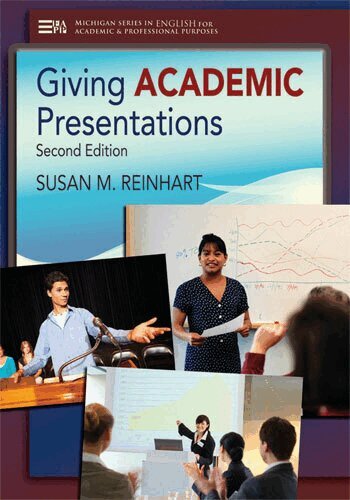
Giving Academic Presentations provides guidance on academic-style presentations for university students. A goal of the text is to make presenters aware that giving an effective academic presentation requires mastery of a broad range of skills. The presentation genres addressed in the book are: making introductions, describing and comparing objects, explaining a process, defining a concept, and giving a problem-solution speech. Among the many academic skills and concepts addressed in the book are:Examination of major speech types and the accompanying organizational strategies Discussion of speech overviews and suggestions for designing them and creating visuals to accompany them Suggestions for speaker-listener interaction including checking for understanding, soliciting questions from the audience, preparing for and responding to questions, and interrupting the speaker to ask questions or request clarification Discussion of the importance of using evidence in academic speaking and the advantages of using certain types of evidence Suggestions of ways to qualify claims and strategies for making weaker or stronger claims Strategies and practice to improve pausing, stress, and intonation Practical advice about preparing and practicing speeches Opportunities for presenters to evaluate their own and others’ work The Second Edition includes many new tasks and additional speeches; more attention to working with and using visuals; information about computer projection and using PowerPoint; and new sections on presenting biographical information, referring to handouts, and giving research presentations.